
Looking Up, Looking Back
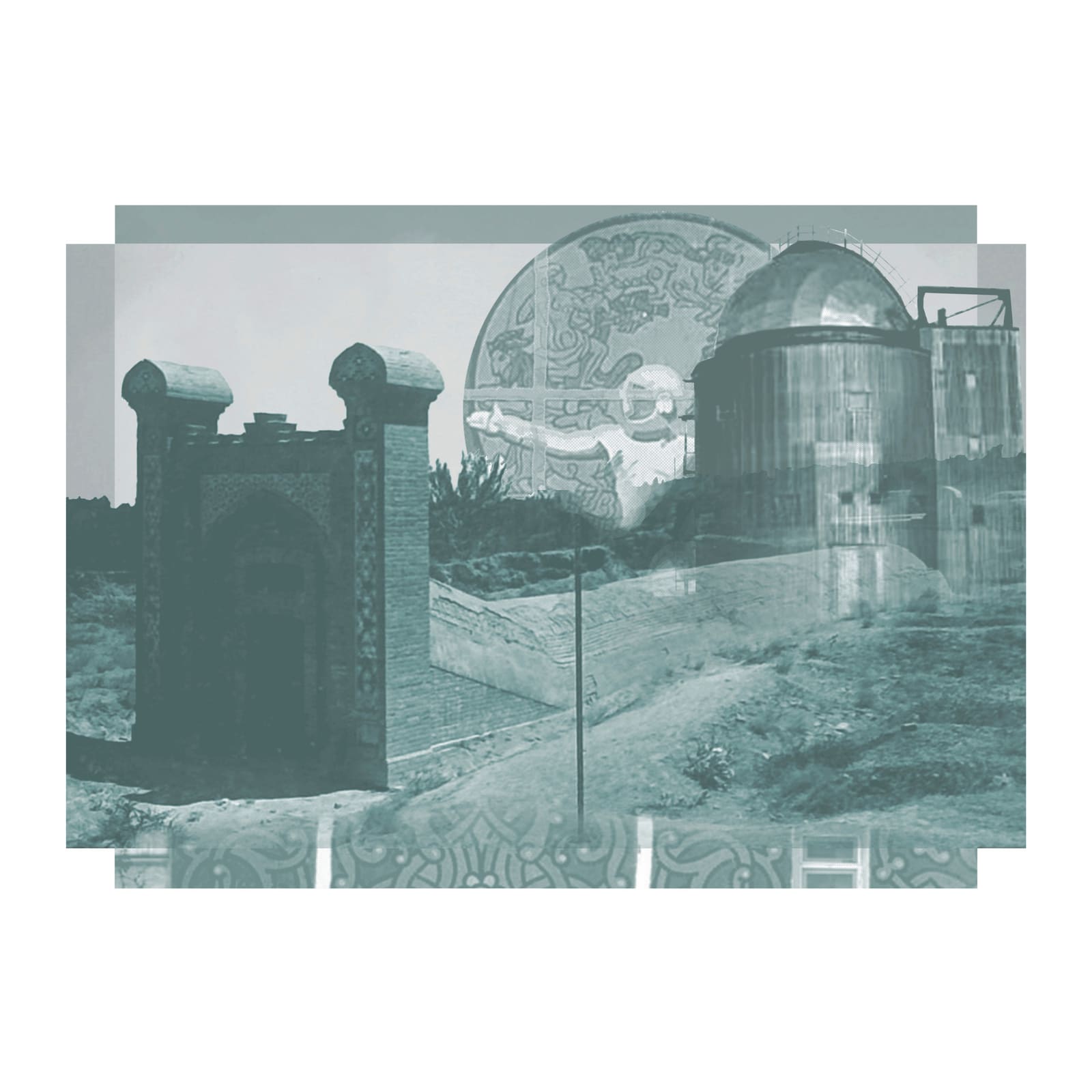
Few historic structures embody the relationship between built form and the cosmos quite like Ulugbek's observatory in Samarkand. Constructed in the 1420s by the Timurid astronomer-king, the structure was once the most sophisticated instrument of celestial measurement in the Islamic world - a machine for watching the sky, built into the earth. Today, it serves as something more: a lens through which a new generation of designers is being asked to reconsider how we perceive, document, and safeguard heritage in an era of accelerating environmental change.
The AA Visiting School has announced a ten-day intensive workshop at the site, titled Imagined Skies. Supported by the Uzbekistan Art and Culture Development Foundation, the program positions the observatory not merely as an artifact to be preserved, but as an active site of inquiry - one that invites participants to engage with layered questions about vision, representation, and the future of historic places under climatic stress.
Architecture as Instrument
What makes the Ulugbek Observatory compelling as a pedagogical site is its original function: it was never meant to be contemplated from a distance, but operated. The building's sunken arc - a massive sextant carved into bedrock - was designed to track solar and planetary motion with unprecedented precision. In that sense, the structure collapses the boundary between architecture and scientific apparatus, between shelter and tool.
The workshop takes this instrumentality as a conceptual starting point. Rather than treating the observatory as a static monument, participants will explore how its form and purpose might inform contemporary practices of observation and recording. The agenda asks: if the building was once a device for seeing the heavens, how might we reimagine it as a device for seeing the present - for making visible the slow, often imperceptible effects of climate on heritage sites across Central Asia?
Layers of Time, Layers of Meaning
Samarkand's observatory has been destroyed, rediscovered, reconstructed, and memorialized multiple times over six centuries. Buried after Ulugbek's assassination in 1449, the site was excavated in 1908 by Russian archaeologist V. L. Vyatkin. Soviet-era interventions added new structures and interpretive layers, including a museum and protective canopy. More recently, the site has been inscribed on UNESCO's World Heritage List, a designation that brings both resources and constraints.
The workshop invites participants to work directly with this stratigraphic history. Archival photographs, astronomical charts, and material studies will form the raw material for speculative projects that address how we choose to document and represent sites whose meanings shift across political, cultural, and environmental contexts. The program emphasizes collaborative methods - drawing on artistic practice, spatial research, and regional expertise - to develop work that is responsive rather than prescriptive.
Vision and Vulnerability
At the heart of the program is a question about perception itself. Climate change operates at scales that often exceed the limits of human vision: incremental soil erosion, shifts in groundwater, the gradual degradation of mudbrick and stone. Heritage sites in arid and semi-arid regions - where temperature extremes are intensifying and precipitation patterns are becoming less predictable - are particularly vulnerable, yet these threats remain difficult to visualize in ways that mobilize action or inform design intervention.
The workshop's focus on "the medium of vision" suggests an interest in new forms of representation: not just documentation, but interpretation; not just data, but narrative. Participants will be encouraged to develop visual and spatial strategies that make legible the relationship between heritage and environment - work that might take the form of installations, mappings, or speculative proposals for adaptive reuse.
Central Asia's Architectural Futures
The program arrives at a moment of heightened interest in Central Asia's built heritage, driven in part by increased tourism, international funding, and regional efforts to reclaim pre-Soviet cultural narratives. Yet much of the discourse around heritage preservation in the region remains focused on restoration and reconstruction - approaches that prioritize aesthetic fidelity over adaptive capacity.
By situating the workshop at a site that is simultaneously ancient and contested, monumental and fragile, the AA Visiting School opens space for a more nuanced conversation. The observatory is not a problem to be solved, but a condition to be inhabited - one that might teach us how to design with, rather than against, the forces reshaping our historic landscapes.
Building a Pedagogy of Place
We have seen, across the design schools we track, a growing interest in programs that embed students in specific geographies for sustained periods of engagement. The best of these initiatives resist the extractive logic of the academic field trip, instead cultivating forms of knowledge that emerge from sustained attention to local materials, histories, and communities.
The Samarkand workshop's emphasis on collaboration and sensitivity suggests an awareness of this shift. By grounding the program in archival research and regional expertise, and by framing climate and heritage as interconnected rather than separate concerns, the school positions architecture not as a discipline that imposes solutions, but as one that learns to listen - and to see - differently.
Save this story. A free account keeps your reading list and the 07:00 email in one place.
CREATE FREE ACCOUNT →SIGN IN