
A Framework Organised by Scale
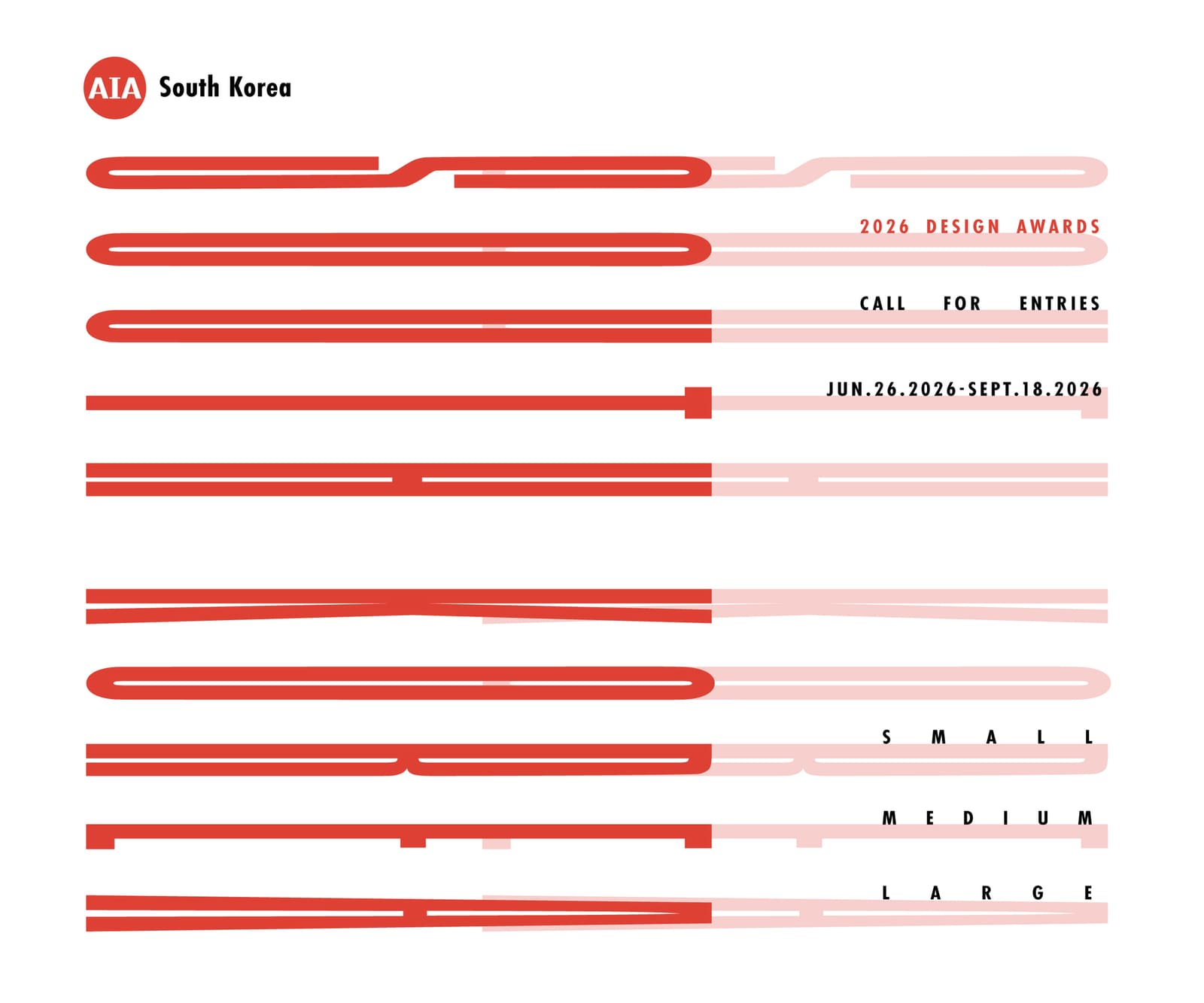
Not all architectural challenges present themselves at the same size. AIA South Korea has structured its second annual design awards programme around this premise, dividing recognition into three categories determined by project scale: small, medium, and large. The framework acknowledges that a 50-square-metre pavilion and a 50,000-square-metre cultural centre operate under fundamentally different constraints, budgets, and urban pressures, even when both pursue innovation and contextual sensitivity.
The chapter, established as one of six regional sections under AIA International, launched the awards in 2025 to recognise built work by architects practising in South Korea. The programme's return in 2026 signals an intent to make this an annual fixture, building a record of contemporary Korean practice as seen through the criteria of architectural innovation and responsiveness to site and culture.
Criteria Beyond Geography
The awards explicitly prioritise two qualities: innovation in design and contextual sensitivity. Innovation here is not limited to formal experimentation or material novelty; it encompasses spatial organisation, programmatic flexibility, and tectonic resolution. Contextual sensitivity, meanwhile, speaks to how a building negotiates its surroundings, whether urban, rural, or infrastructural, and how it engages with climate, topography, and the cultural layers embedded in place.
At World Archi Design, we have observed that awards programmes often default to a single-track hierarchy, where projects compete across all scales and typologies in one pool. AIA South Korea's decision to separate by size allows the jury to assess ambition relative to scope. A small-scale intervention, such as a community pavilion or a house extension, can demonstrate material ingenuity and spatial economy that would be diluted in comparison with a large civic building. Conversely, large-scale projects face complexities of coordination, urban impact, and multi-stakeholder negotiation that smaller works do not encounter.
The Jury's Discretion
The programme does not predetermine the number of winners per category. The jury retains discretion to select any number of projects, or none, based on the quality of submissions. This approach avoids the participation-trophy effect that can dilute the credibility of design awards. It also means that in a given year, one category might yield multiple recognised projects while another yields none, a reflection of the uneven landscape of built work rather than a forced distribution.
This flexibility aligns with how architectural practice itself unfolds. Excellent small projects may cluster in certain years as practices experiment with prototypes or temporary installations. Large projects, constrained by longer timelines and regulatory processes, may appear less frequently but with greater urban consequence when they do.
AIA International's Regional Architecture
AIA South Korea operates as part of a broader network. AIA International established six regional sections to extend the reach of the American Institute of Architects beyond the United States, creating nodes for collaboration and professional development in different parts of the world. These sections serve architects who are AIA members but practise outside North America, offering them access to resources, continuing education, and platforms for recognition.
The regional structure reflects a decentralised model of professional organisation. Rather than imposing a single standard from Washington, DC, each section adapts to local practice conditions while maintaining alignment with AIA's core values: advocacy for design excellence, ethical practice, and the advancement of the built environment. South Korea's chapter, in this context, functions both as a professional body and as a curatorial voice, selecting work that it believes merits wider attention.
Why Scale Matters in Evaluation
Architectural discourse has long debated how to evaluate projects of vastly different sizes. Mies van der Rohe's Barcelona Pavilion, a small structure of only 1,100 square metres, exerted influence far beyond its footprint. Peter Zumthor's Therme Vals, at roughly 3,500 square metres, operates at a modest scale yet achieves a tectonic and experiential intensity that many larger buildings lack. Conversely, Rem Koolhaas's CCTV Headquarters in Beijing and Norman Foster's Millau Viaduct demonstrate ambition that is inseparable from their scale, the former through programmatic density and structural audacity, the latter through infrastructural span and landscape integration.
AIA South Korea's three-tier system does not resolve this debate, but it acknowledges it. By creating separate categories, the programme allows small projects to be assessed for qualities such as material detail, spatial intimacy, and craft, while large projects are evaluated for urban strategy, systemic coordination, and civic presence. Medium-scale projects occupy the middle ground, where both concerns often overlap.
Promoting Korean Architecture Internationally
The awards programme explicitly aims to promote Korean architectural contributions to a global audience. South Korea has produced a generation of practices whose work engages both local building traditions and international discourse. Firms such as Moon Hoon, BCHO Architects, and Mass Studies have received attention for projects that negotiate Seoul's dense urban fabric, vernacular building types, and contemporary material technologies.
Yet much of this work remains underrepresented in the English-language architectural press, which tends to concentrate on a small number of global cities and a familiar roster of names. Regional awards programmes like this one function as mechanisms of visibility, surfacing projects that might otherwise remain known only within national borders.
The Built Work Criterion
AIA South Korea's awards focus exclusively on completed buildings. This criterion excludes unbuilt proposals, competition entries, and theoretical projects, narrowing the field to work that has navigated the full arc of design, approval, construction, and occupation. Built work carries different evidence than speculative design. It reveals how intentions survive the realities of budget, regulation, contractor interpretation, and client revision. It also allows for post-occupancy assessment, observing how spaces perform once inhabited.
This emphasis on built work aligns with AIA's broader professional mandate, which centres on the practice of architecture rather than its conceptualisation alone. It also distinguishes the programme from competitions that reward ideas over execution, or biennales that curate installations and research projects alongside buildings.
What the Programme Signals
The second iteration of the AIA South Korea Design Awards suggests an emerging pattern. Annual programmes build cumulative records, creating an archive of what a particular professional community values at a given moment. Over time, these archives reveal shifts in priority, the rise of new typologies, and the evolving interpretation of terms like innovation and context.
For practices in South Korea, the awards offer both recognition and critique. Selection implies that a project meets the jury's threshold for excellence. Non-selection, conversely, is a form of editorial judgement, a signal that the work, however competent, does not yet advance the discourse in ways the jury considers significant.
For the broader architectural community, the programme provides a curated view into Korean practice, filtered through the lens of an international professional organisation. It is not the only such view, other platforms, publications, and exhibitions offer alternative perspectives, but it is one with institutional backing and a commitment to recurrence.
Looking Forward
As the programme matures, questions will emerge about its long-term role. Will it expand to include categories for interior architecture, landscape, or adaptive reuse? Will it introduce a student or emerging practitioner track? Will the jury composition rotate to bring in different perspectives, or will it stabilise around a core group of evaluators?
These are not merely procedural questions. They shape what kind of work gets seen, who gets to define excellence, and how the programme positions itself within the crowded field of design awards. For now, AIA South Korea has chosen a structure that is straightforward: three categories, built work only, jury discretion, and an emphasis on innovation and context. Whether that structure evolves or remains fixed will depend on how the programme responds to the work it receives and the conversations it generates.
Save this story. A free account keeps your reading list and the 07:00 email in one place.
CREATE FREE ACCOUNT →SIGN IN