
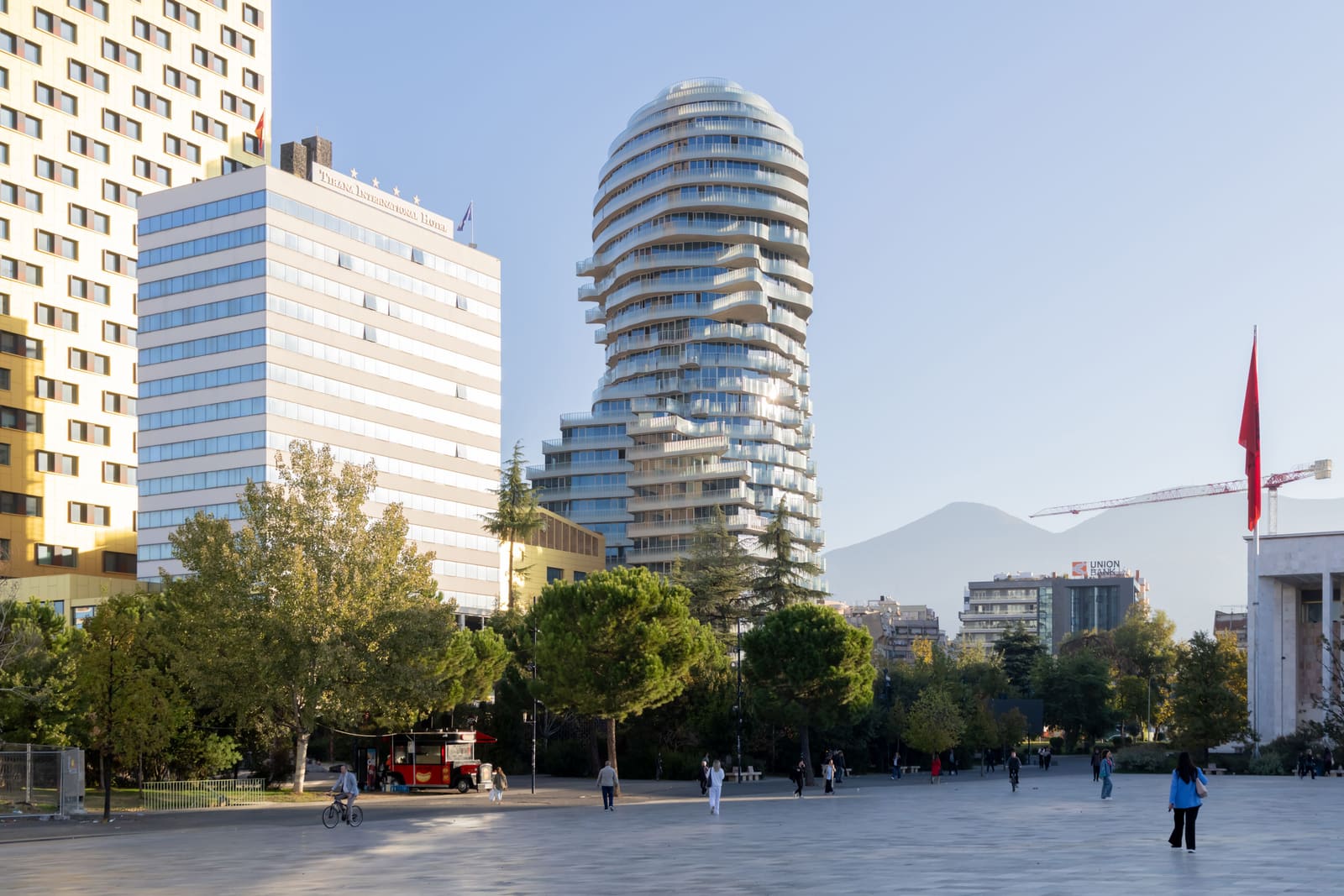
A Capital Caught Between Vision and Discontent
The spectacle of Molotov cocktails punctuating an otherwise ordinary dinner service captures something essential about Tirana today. Here is a city of roughly 600,000 inhabitants undergoing a state-orchestrated architectural transformation, yet the reception on the ground has grown increasingly hostile. Since 2013, Prime Minister Edi Rama has pursued an unusual urban strategy: importing internationally recognised architects to redesign swathes of the Albanian capital, from civic buildings to public squares. The approach has drawn figures such as Bjarke Ingels and Alejandro Aravena, the 2016 Pritzker laureate, to a country that until recently occupied the periphery of global architectural discourse. Yet by mid-2025, protesters were holding signs that read "Starchitects go home," and by autumn the demonstrations had escalated into outright violence.
The tension raises a question that extends well beyond the Balkans: when does state-led architectural ambition serve the public, and when does it become a form of imposed spectacle?
The Mechanics of a Top-Down Campaign
Rama, who trained as a painter before entering politics, has framed architecture as a tool for national rebranding. His administration has commissioned projects from a rotating cast of international practices, many of whom gather annually at a government-hosted summit. Participants reportedly fund their own travel, drawn by the rare opportunity to pitch ideas directly to a head of state. The villa in which Rama conducts interviews, a raw concrete structure rendered in vivid red, was designed by Spanish architect Pablo Bofill and serves as both residence and manifesto, an advertisement for the aesthetic direction the government seeks to impose.
The model bears a striking resemblance to earlier experiments in state-curated design. In 2008, the Chinese industrialist backing the Ordos 100 project enlisted artist Ai Weiwei to recruit young architects from across the globe. Each designer was assigned a villa plot by lottery, paid in cash, and sent home. None of the structures was ever built, yet the project achieved a kind of mythic status within the profession, a moment of collective possibility untethered from the usual constraints of client demands or construction budgets. Tirana's initiative echoes that same mixture of giddy optimism and structural ambiguity. Architects arrive, present proposals, and depart, often with little clarity about which schemes will advance beyond renderings.
The Gap Between Rendering and Reality
What distinguishes Tirana from Ordos, however, is that buildings are actually rising. The Book Building, designed by Brussels-based practice 51N4E, stands as one tangible outcome of Rama's campaign. Yet the pace of construction has not kept up with the volume of proposals circulated at summit gatherings. This lag between announced vision and delivered infrastructure has become a focal point for public frustration. When citizens see international architects celebrated while local concerns about housing affordability, infrastructure maintenance, and transparent procurement go unaddressed, the architectural programme begins to read less as civic improvement and more as performative branding.
The protests that erupted in May 2025, coinciding with Rama's second annual architecture summit, were not solely about buildings. They reflected broader dissatisfaction with governance, economic stagnation, and a sense that decision-making had become insulated from public input. But architecture offered a visible, symbolic target. The presence of high-profile foreign designers, flown in to shape the capital's future, crystallised a perception that the city was being designed for an imagined international audience rather than for the people who inhabit it daily.
Precedent and the Perils of Borrowed Prestige
Tirana's approach sits within a longer tradition of governments using architecture to project modernity and legitimacy. From Brasília to Astana, state-commissioned capital projects have often prioritised symbolic legibility over incremental urbanism. The strategy can yield striking results, monuments that anchor national identity and attract global attention. Yet it also carries inherent risks. When architectural ambition outpaces institutional capacity or public buy-in, the resulting structures can feel alienating, impositions rather than contributions.
The Pritzker Prize, awarded to Aravena in 2016, was partly a recognition of his work on incremental housing and participatory design, an approach rooted in dialogue with end users. His presence in Tirana, then, highlights a paradox. The architects being invited to Albania are celebrated in part for their sensitivity to context and community, yet the framework within which they are operating in Tirana is fundamentally top-down. The disconnect suggests that importing architectural talent does not automatically import the processes that make thoughtful, responsive design possible.
What the Protests Reveal About Process
The escalation from placards to petrol bombs in late 2025 underscores a failure not primarily of aesthetics but of process. Architecture, at its most effective, emerges from negotiation between competing interests: public agencies, private developers, community groups, preservation advocates, and design professionals. When that negotiation is short-circuited, when a single political figure becomes the de facto client for an entire city, the resulting projects may be formally accomplished yet still generate resentment.
Rama's villa, dyed red and fortified, is an apt metaphor. It is bold, uncompromising, and inaccessible, a building that announces its presence without inviting engagement. The same could be said of the broader architectural programme. The annual summits generate publicity and attract talent, but they do not appear to have fostered the kind of sustained, participatory planning that might anchor public support.
The Question of Legacy
Whether Rama's architectural campaign will be judged a success or a cautionary tale depends largely on what follows. If the current unrest forces a recalibration, if future projects incorporate greater transparency and community input, the initiative may yet evolve into something more durable. If, however, the government continues to treat architecture as a branding exercise, the gap between vision and lived experience will likely widen.
Other cities have faced similar reckonings. Dubai's rapid construction boom in the early 2000s produced iconic towers and artificial islands, yet also exposed the social and environmental costs of development driven by spectacle. Closer to Tirana, Athens has grappled with the legacy of projects commissioned for the 2004 Olympics, structures that were celebrated at the time but later criticised as financially reckless and disconnected from everyday urban needs.
Albania's experiment is still unfolding. The buildings commissioned under Rama's watch will remain long after the current political moment has passed. Whether they are embraced as symbols of progress or resented as emblems of overreach will depend not only on their formal qualities but on the extent to which they reflect genuine dialogue between architects, government, and citizens. For now, the sound of Molotov cocktails suggests that dialogue has broken down.
Save this story. A free account keeps your reading list and the 07:00 email in one place.
CREATE FREE ACCOUNT →SIGN IN