
An Experiment in Nation-Building
Postcolonial architecture often carries a double burden: it must serve the immediate needs of a population while also symbolizing a break from the past. In India, the years following 1947 saw an outpouring of civic infrastructure designed to signal modernity, progress, and a departure from colonial idioms. The Sardar Vallabhbhai Patel Stadium in Ahmedabad's Navrangpura district is one such artifact. Unlike the grand institutional commissions that attracted international luminaries like Le Corbusier, this cricket ground emerged from a more localized, pragmatic impulse. Yet it shares the same ideological DNA: a belief that architecture could help construct a new national identity.
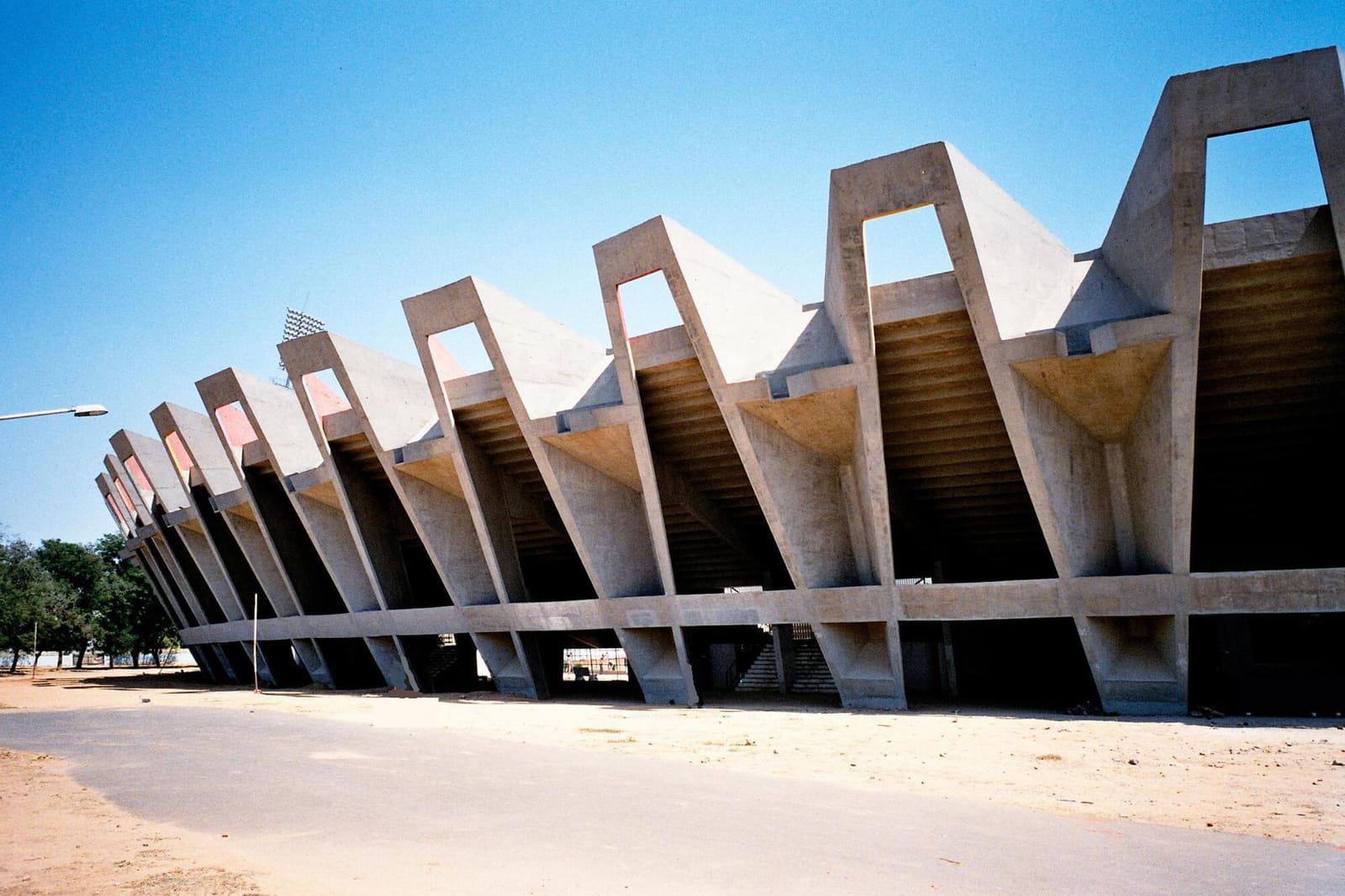
At World Archi Design, we've been tracking the fate of mid-century public buildings across South Asia, and the stadium offers a particularly instructive case. It is neither a monument nor a ruin, but something in between: a structure still in use, still woven into the rhythms of daily life, yet visibly fraying at the edges. The World Monuments Fund recognized this precarious state in 2020 when it added the stadium to its Watch list, a designation reserved for sites facing urgent threats.
The Context of Nehruvian Modernism
To appreciate the stadium's significance, one must situate it within the broader architectural project undertaken by Jawaharlal Nehru's government. Nehru envisioned modernization as a multifaceted endeavor: industrialization, scientific advancement, and the creation of new institutions. Architecture was not an afterthought but a central tool in this transformation. The invitation extended to Le Corbusier to design Chandigarh, the new capital of Punjab, is the most famous example. But the impulse extended far beyond a single city. Universities, hospitals, dams, and sports facilities were all part of a national program to build a modern India.
The Sardar Vallabhbhai Patel Stadium, completed in the decades after independence, reflects this ethos. It was conceived as a public gathering space, a venue for cricket matches that could accommodate large crowds and serve as a focal point for civic pride. The design language, while less radical than Chandigarh's brutalist geometry, nonetheless adopted modernist principles: clean lines, functional planning, and an emphasis on spatial openness. The stadium was not merely a place to watch cricket; it was a statement about what kind of public life the new nation aspired to create.
Material Choices and Structural Logic
Modernist architecture in India often grappled with the tension between international design vocabularies and local climatic realities. Concrete, steel, and glass were the materials of choice for architects seeking to signal progress, yet these materials behaved differently under the intense heat and monsoon rains of the subcontinent. The Sardar Vallabhbhai Patel Stadium employed reinforced concrete for its primary structure, a decision that aligned with global trends but also introduced long-term maintenance challenges.
Concrete, when properly maintained, can endure for decades. But in humid, tropical climates, it is vulnerable to spalling, cracking, and rebar corrosion. The stadium's cantilevered canopies and open seating tiers, which provided shade and ventilation, also exposed structural elements to the elements. Over the years, inadequate waterproofing and deferred repairs have accelerated deterioration. What was once a crisp, confident expression of modernist engineering has become a study in material decay.
The Stadium as Urban Infrastructure
Ahmedabad is a city that has undergone rapid transformation over the past half-century. Once a center of textile manufacturing, it has evolved into a hub for education, information technology, and cultural tourism. The Navrangpura district, where the stadium is located, has densified considerably, and the stadium itself has become a landmark within the urban grid. It functions not only as a sports venue but also as a gathering place for community events, political rallies, and informal social life.
This embeddedness in the urban fabric is both a strength and a complication. On one hand, the stadium remains relevant, still used and valued by residents. On the other, its deteriorating condition poses safety risks and raises questions about whether the structure can be meaningfully preserved without substantial intervention. The challenge is not simply one of conservation technique but of negotiating between competing interests: heritage advocates, municipal authorities, sports organizations, and the public itself.
Precedents in Preservation
The inclusion of the Sardar Vallabhbhai Patel Stadium on the World Monuments Watch places it within a lineage of threatened modernist structures worldwide. In recent years, preservation organizations have increasingly turned their attention to mid-century buildings, recognizing that the passage of time has made them vulnerable. Unlike historic monuments that benefit from established conservation protocols, modernist buildings often occupy an uncertain legal and cultural status. They are too recent to command automatic reverence, yet old enough to require serious repair.
Consider the case of the Pirelli Tower in Milan, which underwent extensive restoration to address material degradation while retaining its original design intent. Or the Sydney Opera House, which has been subject to ongoing conservation efforts since its completion in 1973. Both projects involved balancing the demands of contemporary use with the imperative to preserve architectural character. The stadium in Ahmedabad faces similar dilemmas, albeit with fewer financial resources and less institutional support.
The Politics of Heritage
Preservation is never a purely technical endeavor. It involves questions of value: whose history matters, which buildings are worth saving, and who gets to decide. In India, the designation of heritage sites has often favored ancient temples, colonial-era structures, and palaces associated with royal lineages. Modernist buildings, by contrast, have struggled to gain recognition. They lack the aesthetic appeal of traditional craftsmanship and the historical cachet of monuments linked to pre-colonial civilizations.
The Sardar Vallabhbhai Patel Stadium challenges this hierarchy. It is not monumental in the conventional sense, nor does it boast the sculptural drama of a Le Corbusier building. But it represents a specific moment in India's architectural history, one in which the nation sought to define itself through the built environment. Preserving the stadium is, in effect, an argument for a more inclusive understanding of heritage, one that encompasses the ordinary as well as the exceptional.
Forward Prospects
The World Monuments Fund's designation has brought visibility, but visibility alone does not guarantee survival. Effective preservation will require coordination among multiple stakeholders, including government agencies, conservation professionals, and the local community. It will also require funding, technical expertise, and a clear vision for the stadium's future role. Should it continue to function primarily as a sports venue, or might it be reimagined as a cultural center, a museum, or a hybrid space?
These are not questions with easy answers. What is clear, however, is that the fate of the Sardar Vallabhbhai Patel Stadium will have implications beyond Ahmedabad. It will serve as a test case for how India navigates the preservation of its modernist legacy, and whether structures that embody postcolonial aspiration can be sustained in an era of rapid urban change. The stadium stands, for now, as both a relic and a resource, a reminder that the work of nation-building is never truly finished.
Save this story. A free account keeps your reading list and the 07:00 email in one place.
CREATE FREE ACCOUNT →SIGN IN