
The Consistency Problem
Walk through a recently completed interior and you may notice a recurring frustration: a colour specified for kitchen cabinetry that shifts slightly when applied to adjacent worktops, or a matte finish on furniture fronts that fails to match the edging detail. The culprit is rarely the designer's vision. More often, it is the fragmented nature of material supply chains, where lacquered panels, laminates, and edge banding arrive from different manufacturers with subtly different formulations and surface characteristics.
At World Archi Design, we have been tracking a shift in how specification teams approach this challenge. Rather than treating each interior element as a discrete material decision, practices are beginning to prioritise systems that offer coordinated finishes across multiple substrates and applications. The goal is not uniformity for its own sake, but the preservation of a coherent material language when a single decor must perform across vertical cabinetry, horizontal countertops, and three-dimensional furniture bodies.
This is not a new concern. Mies van der Rohe's Barcelona Pavilion famously relied on precise material continuity, with onyx and travertine panels selected and book-matched to maintain visual rhythm across walls and floors. What has changed is the scale of contemporary practice, where residential towers, hospitality interiors, and workplace fit-outs demand reproducible surface quality across hundreds of identical units or floors. The stakes are higher, and the margin for variation narrower.
Matte as Method
The resurgence of matte finishes in high-specification interiors reflects more than aesthetic preference. Matte surfaces absorb rather than reflect light, reducing glare and visual noise in environments where screens, glazing, and artificial illumination already compete for attention. In open-plan offices and hospitality lobbies, this quality translates into calmer spatial atmospheres and fewer distractions.
Yet matte is not a monolithic category. A flat, unreflective finish can read as lifeless if texture and material depth are absent. The more compelling recent examples introduce variation within the matte register, using partial gloss effects or synchronised textures that respond to changing light conditions. These surfaces reveal complexity gradually, shifting in appearance as users move through the space or as daylight cycles through the day.
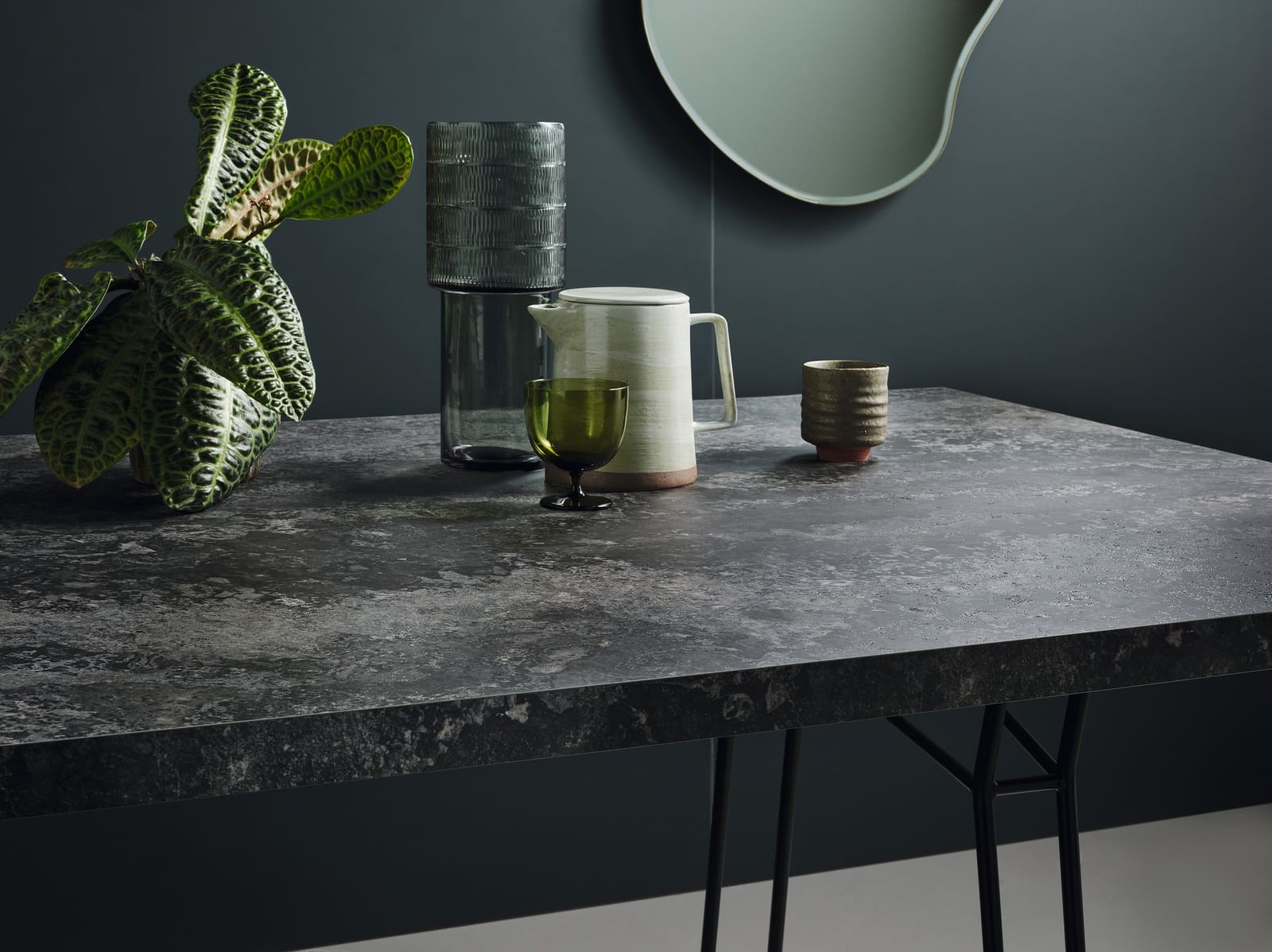
EGGER's PerfectSense Premium Ambiance range exemplifies this approach. The F128 PA Black Ambiance Granite decor, for instance, combines a predominantly matte surface with localised gloss areas that follow the printed granite pattern. The result is a finish that reads as velvety from a distance but reveals subtle reflectivity upon closer inspection. The coordination between printed image and tactile texture is precise, a characteristic made possible by industrial manufacturing processes that synchronise digital printing with embossing dies.
The F129 PA Beige Ambiance Granite extends this logic to a lighter palette, while the F199 PA Black Ambiance Marble introduces metallic veining within a super-matte black field. The latter received an iF Design Award in 2026, recognition that underscores the technical achievement required to maintain visual coherence across such contrasting surface behaviours. These are not imitations of natural stone in the traditional sense. They reinterpret the visual language of marble and granite while introducing functional characteristics, such as anti-fingerprint properties and ease of maintenance, that natural materials cannot offer.
Specifying Across Substrates
Material continuity becomes more complex when a single decor must appear on different substrates. A lacquered MDF panel used for cabinet fronts cannot be specified for a worktop, which requires a more robust particleboard or laminate construction. Edging presents yet another challenge, as ABS or PVC strips must match the face material in colour, gloss level, and texture.
EGGER addresses this through its Decor Match system, which coordinates finishes across lacquered MDF boards, particleboards, high-pressure laminates, worktops, and ABS edging. The Decorative Collection 26+ includes twenty-five solid-colour decors, eight of which were introduced in the latest iteration, available in coordinated formats. This allows architects to select the appropriate substrate for each application while maintaining a unified visual identity.
The practical implications are significant. In a residential kitchen, cabinet fronts might use lacquered MDF for a smooth, seamless finish, while the worktop employs a laminate or compact panel for durability and resistance to heat and moisture. Edging on shelving and drawer fronts must match both in tone and texture. Without a coordinated system, achieving this continuity requires custom colour matching, sample approvals, and frequent site visits to verify alignment. A pre-coordinated portfolio reduces these frictions, allowing specification teams to focus on spatial composition rather than material troubleshooting.
The Haptic Dimension
Touch remains an underexplored variable in architectural specification. Designers routinely assess materials visually, through samples and renderings, but the tactile experience of a surface is harder to predict and often overlooked until occupancy. Yet touch is frequent in interiors. Cabinet handles, countertops, furniture edges, and wall panels are all subject to repeated contact, and the sensory feedback they provide shapes user perception.
Matte lacquered surfaces, particularly those with velvety textures, offer a distinct haptic quality compared to high-gloss alternatives. They feel warmer, less slippery, and more forgiving under the hand. This is partly a function of surface chemistry, the absence of a glossy topcoat allows for finer texture, but it is also perceptual. Matte finishes evoke associations with natural materials like unfinished wood or honed stone, even when the substrate is entirely synthetic.
The anti-fingerprint properties of PerfectSense matte finishes extend this logic into the realm of maintenance. In hospitality environments and shared workspaces, visible fingerprints and smudges accumulate quickly on high-touch surfaces. Matte lacquers with anti-fingerprint coatings reduce the frequency of cleaning required to maintain a pristine appearance, a consideration that influences both operational costs and the longevity of the material's visual appeal.
Precedents in Material Consistency
The demand for coordinated surface systems has historical roots. Carlo Scarpa's interiors for the Olivetti showroom in Venice, completed in 1958, relied on meticulous coordination between terrazzo, plaster, and timber finishes, with each material calibrated to a specific tonal range. Scarpa worked closely with artisans to achieve this, but the scale of his projects allowed for bespoke fabrication. Contemporary practice operates under different constraints, where projects are larger, timelines shorter, and budgets less accommodating of custom work.
Industrial manufacturing offers a different path to consistency. By centralising production and maintaining tight tolerances, manufacturers can deliver reproducible surface quality across large quantities and multiple product formats. This is the logic underlying EGGER's approach: rather than treating each material as a standalone product, the system coordinates decors, substrates, and finishes into a coherent portfolio.
This model has parallels in other industries. Automotive manufacturers, for instance, have long coordinated paint finishes, interior trim, and upholstery within a unified colour and material palette. The architectural sector has been slower to adopt similar systems, in part because buildings are less standardised than cars and in part because the supply chain is more fragmented. Integrated surface portfolios represent a step toward greater coordination, even if they do not fully resolve the complexity of architectural material specification.
Long-Term Availability and Project Phasing
Another variable in material specification is availability over time. Large-scale developments, particularly those built in phases, require assurance that a specified decor will remain in production for the duration of the project and beyond. Discontinuation of a finish mid-project forces costly redesigns or necessitates stockpiling, both of which introduce risk.
EGGER's commitment to long-term decor availability addresses this concern. By maintaining core collections over extended periods, the company allows architects to specify with confidence that replacement panels, repairs, or future expansions can draw from the same material palette. This is particularly relevant for hospitality brands and corporate fit-outs, where consistency across multiple locations or successive phases is a contractual requirement.
The alternative, custom finishes, offers greater design freedom but introduces supply-chain risk. A bespoke lacquer colour may be unavailable for reorder if the original batch specifications are not retained, or if the supplier discontinues the formulation. Standardised portfolios sacrifice some degree of uniqueness in exchange for reliability, a trade-off that many practices find acceptable given the operational complexities of contemporary construction.
From Sample to Specification
The process of material selection increasingly involves digital tools, from parametric modelling to virtual reality walkthroughs. Yet physical samples remain indispensable. A rendered surface on a screen cannot convey texture, reflectivity, or haptic qualities with sufficient fidelity for final specification decisions. Architects still request sample boards, often in multiple sizes and lighting conditions, to assess how a finish will perform in situ.
EGGER supports this process through accessible sample services and technical documentation. Specifiers can request coordinated samples across multiple product formats, allowing direct comparison between lacquered MDF, laminate, and edging. Technical data sheets provide information on scratch resistance, UV stability, moisture performance, and cleaning protocols, enabling informed decisions about where each product is appropriate.
This level of specification support is not universal in the industry. Smaller manufacturers may offer compelling finishes but lack the infrastructure to provide coordinated samples, detailed technical data, or long-term availability guarantees. For practices working on large or complex projects, these factors can outweigh the appeal of a unique finish that lacks robust specification support.
Material Coordination as Architectural Strategy
The value of a coordinated surface portfolio extends beyond convenience. It allows architects to develop a material strategy that remains consistent from initial concept through to daily use, reducing the gap between design intent and built reality. When cabinetry, furniture, and horizontal surfaces share a unified finish, the interior reads as a composed whole rather than an assembly of discrete elements.
This does not preclude contrast or variety. A well-coordinated material system provides a stable foundation against which other materials, textures, and colours can be introduced. In a residential kitchen, for instance, matte black cabinetry might be paired with timber shelving and polished stone countertops, but the coherence of the black finish across cabinet fronts, drawer bodies, and edging allows the other materials to register clearly.
The question, then, is not whether architects should prioritise material consistency, but how they can achieve it within the constraints of contemporary practice. Integrated surface systems offer one answer, trading some degree of bespoke customisation for reproducibility, technical support, and long-term availability. For projects where coherence, durability, and specification efficiency are paramount, this trade-off is increasingly defensible.
Save this story. A free account keeps your reading list and the 07:00 email in one place.
CREATE FREE ACCOUNT →SIGN IN