
A Platform for Global Architectural Dialogue
When UNESCO and the International Union of Architects established the World Capital of Architecture designation, the intent was clear: identify cities that can serve as living laboratories for how the built environment shapes urban futures. Beijing joins that roster for 2029, following Rio de Janeiro, Copenhagen, and Barcelona in carrying the triennial title. The selection, announced in early August 2026, places one of the world's oldest continuously inhabited capitals at the center of an architectural conversation that has grown more urgent with each passing congress.
The designation is more than ceremonial. It comes with an expectation that Beijing will organize a year-long programme of exhibitions, symposia, public installations, and design workshops, culminating in the UIA World Congress of Architects. For a city that has spent the last two decades reconciling its imperial past with breakneck modernization, the opportunity to frame that tension as an international case study is both strategic and revealing.
Heritage and Velocity
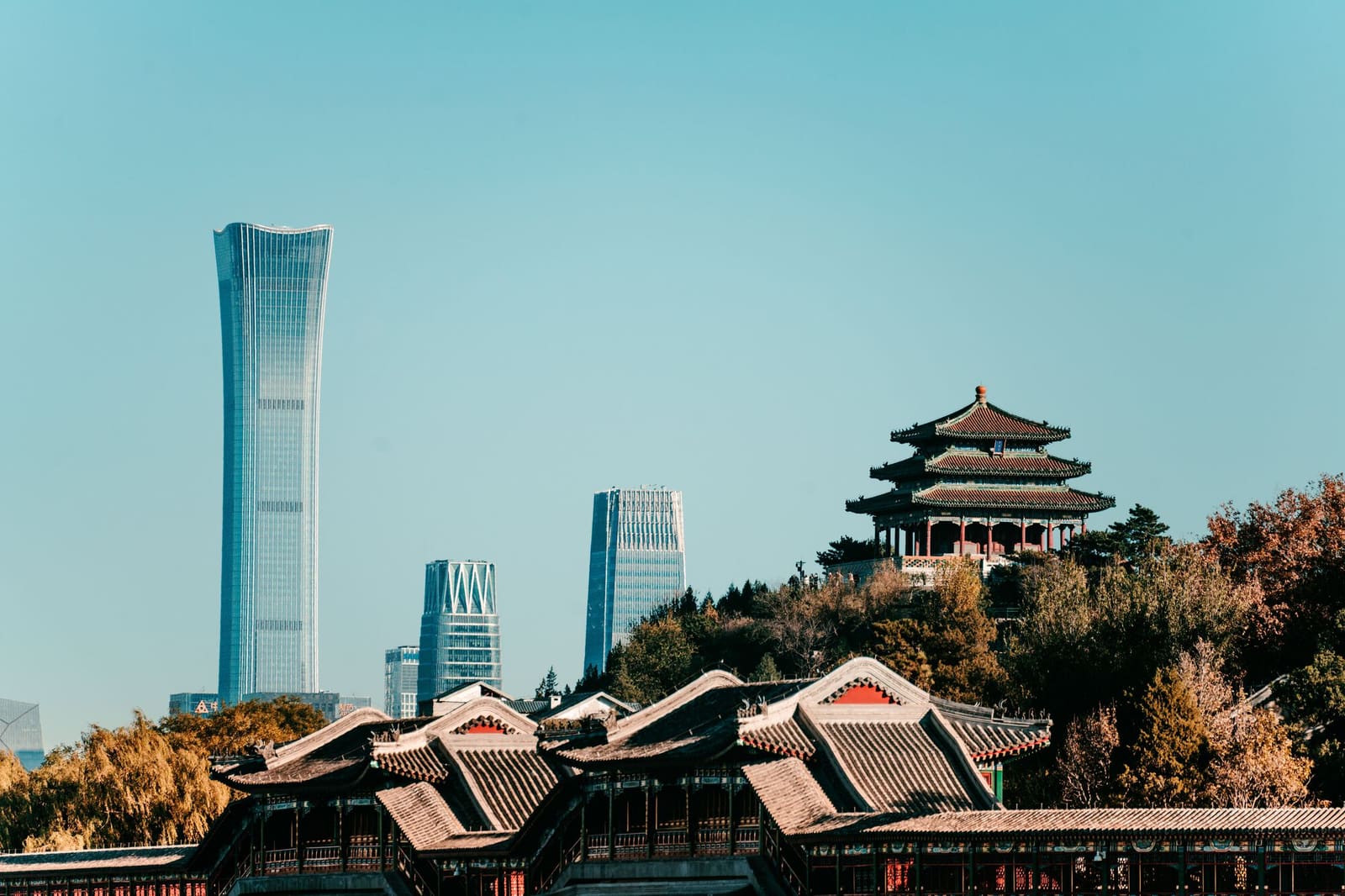
Beijing's architectural identity has always been plural. The hutong districts, with their courtyard typologies and narrow alleys, sit in visual and functional contrast to the glass-clad towers that have redefined the skyline since the early 2000s. The China Zun skyscraper, completed in 2018, rises 528 meters and anchors the Central Business District; a few kilometers west, the Forbidden City remains untouched, its axial symmetry and timber construction a monument to Ming and Qing spatial logic.
This duality is not accidental. Urban planners in Beijing have, over the past decade, shifted from wholesale demolition toward adaptive reuse and contextual infill. Projects like the Environmental Improvement for the Five Dragon Temple by URBANUS demonstrate how heritage sites can be stabilized and reintegrated into contemporary urban life without erasing their material history. The temple complex, dating to the Tang dynasty, was carefully restored with minimal intervention, allowing the original timber structure and masonry to remain legible.
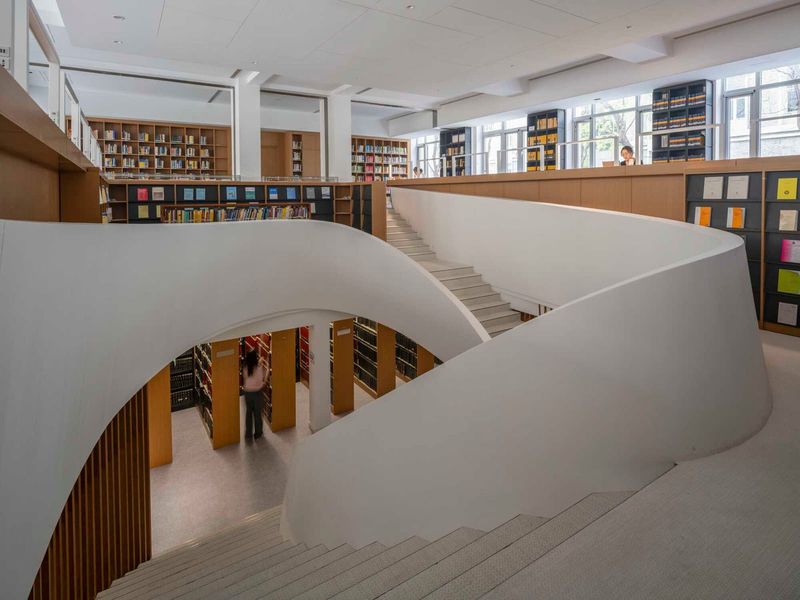
Snøhetta's Beijing City Library, which opened in 2023, offers another model. The building's permeable ground plane and terraced reading rooms engage the surrounding parkland, creating a civic threshold that prioritizes accessibility over monumentality. The fenestration strategy, with its irregular perforations, filters daylight while reducing glare, a technical response to Beijing's intense summer sun and winter haze. The library has become a popular public space, drawing visitors who might not otherwise enter a cultural institution, a sign that architectural programming can extend beyond the building's nominal function.
Back to Balance
The theme for Beijing 2029, "Back to Balance," reflects a broader recalibration in Chinese urban policy. After decades of rapid expansion, cities across the country are now grappling with the environmental and social costs of that growth. Air quality, water scarcity, urban heat islands, and social equity have all become central concerns in planning discourse. Beijing's designation by UNESCO acknowledges these challenges while recognizing the city's efforts to address them through design.
The Beijing Performing Arts Centre by Perkins&Will and Schmidt Hammer Lassen, completed in 2022, exemplifies this shift. The building's massing responds to its site along the Grand Canal, with a low profile that minimizes visual intrusion and a facade system that incorporates passive ventilation. The interior acoustics were developed in collaboration with engineers from Arup, resulting in performance spaces that require less mechanical amplification and energy input. The project was designed to LEED Gold standards, a certification that remains relatively uncommon in China's cultural sector.
At World Archi Design, we've been tracking how Chinese cities are beginning to prioritize long-term resilience over short-term spectacle. The Green Wall reforestation programme, which aims to halt desertification in the Gobi Desert, is one such initiative. While not strictly an architectural project, it represents a spatial intervention at a continental scale, one that will reshape microclimates, migration patterns, and settlement strategies across northern China. The programme has already planted over 66 billion trees since its inception in 1978, creating a buffer zone that stretches from Xinjiang to Heilongjiang.
A Regional Lens
Beijing's selection also highlights the growing influence of Chinese architectural practice on the global stage. Dong Yugan's Brick Art Museum, a small-scale project in Beijing's outskirts, has garnered international attention for its use of reclaimed brick and minimalist detailing. The building's tectonic clarity, its reliance on local materials and craft traditions, offers a counterpoint to the high-tech, parametrically driven projects that have dominated Chinese architecture discourse for the past decade.
Elsewhere in China, Shenzhen has emerged as a testing ground for cultural infrastructure. The Shenzhen Natural History Museum, designed by a consortium including 3XN, B+H Architects, and Zhubo Design, opened recently as the largest natural history museum in South China. Its scale and ambition reflect Shenzhen's aspirations to become a cultural hub, not just an economic one. MAD's Shenzhen Bay Culture Square, completed around the same time, functions as a mixed-use facility that blurs the boundaries between art space, public plaza, and civic forum.
MVRDV's Bihailou Art Village, currently under development, extends the firm's "Vertical Village" concept into a Chinese context. The project stacks cultural, commercial, and residential programmes within a single massing strategy, creating a porous urban block that encourages informal interaction. The design challenges the typical segregation of uses that characterizes much of China's post-reform urban planning, proposing instead a denser, more integrated model.
The Congress as Catalyst
The UIA World Congress of Architects, which Beijing will host in 2029, is expected to draw thousands of practitioners, educators, students, and policymakers. The event has historically served as a forum for debate on the profession's role in addressing climate change, inequality, and urbanization. Previous congresses in Barcelona, Rio de Janeiro, and Copenhagen have produced declarations and frameworks that, while not binding, have influenced national policy and professional standards.
Beijing's congress will likely focus on the relationship between tradition and innovation, a theme that resonates across the Global South and in post-industrial cities in Europe and North America. How do cities preserve cultural identity while accommodating growth? How can vernacular building practices inform contemporary sustainability strategies? These questions are not unique to Beijing, but the city's scale and complexity make it an instructive case.
The Joint Committee for the World Capital of Architecture, chaired by architect Dominique Perrault, recommended Beijing based on its demonstrated ability to integrate heritage preservation with contemporary urban development. Perrault, whose own work includes the French National Library and the Ewha Womans University campus in Seoul, has long advocated for architecture that engages its social and environmental context. His endorsement suggests that Beijing's selection was driven not by political considerations, but by a recognition of the city's architectural heterogeneity and its willingness to experiment with new models of urban governance.
Looking Ahead
The designation positions Beijing to shape international architectural discourse for the next three years. It also places the city under scrutiny. Critics will watch to see whether the programming reflects genuine engagement with difficult urban issues or serves primarily as a promotional vehicle. The success of Beijing 2029 will depend on the city's ability to facilitate open dialogue, to invite dissenting voices, and to present its architectural challenges alongside its achievements.
For the global architecture community, the congress offers an opportunity to observe how one of the world's most rapidly transforming cities is negotiating the tension between preservation and progress. The lessons learned in Beijing, whether about adaptive reuse, climate-responsive design, or participatory planning, will have relevance far beyond China's borders. As cities everywhere confront the limits of growth-oriented urbanism, the models and mistakes on display in 2029 will matter.
Save this story. A free account keeps your reading list and the 07:00 email in one place.
CREATE FREE ACCOUNT →SIGN IN