
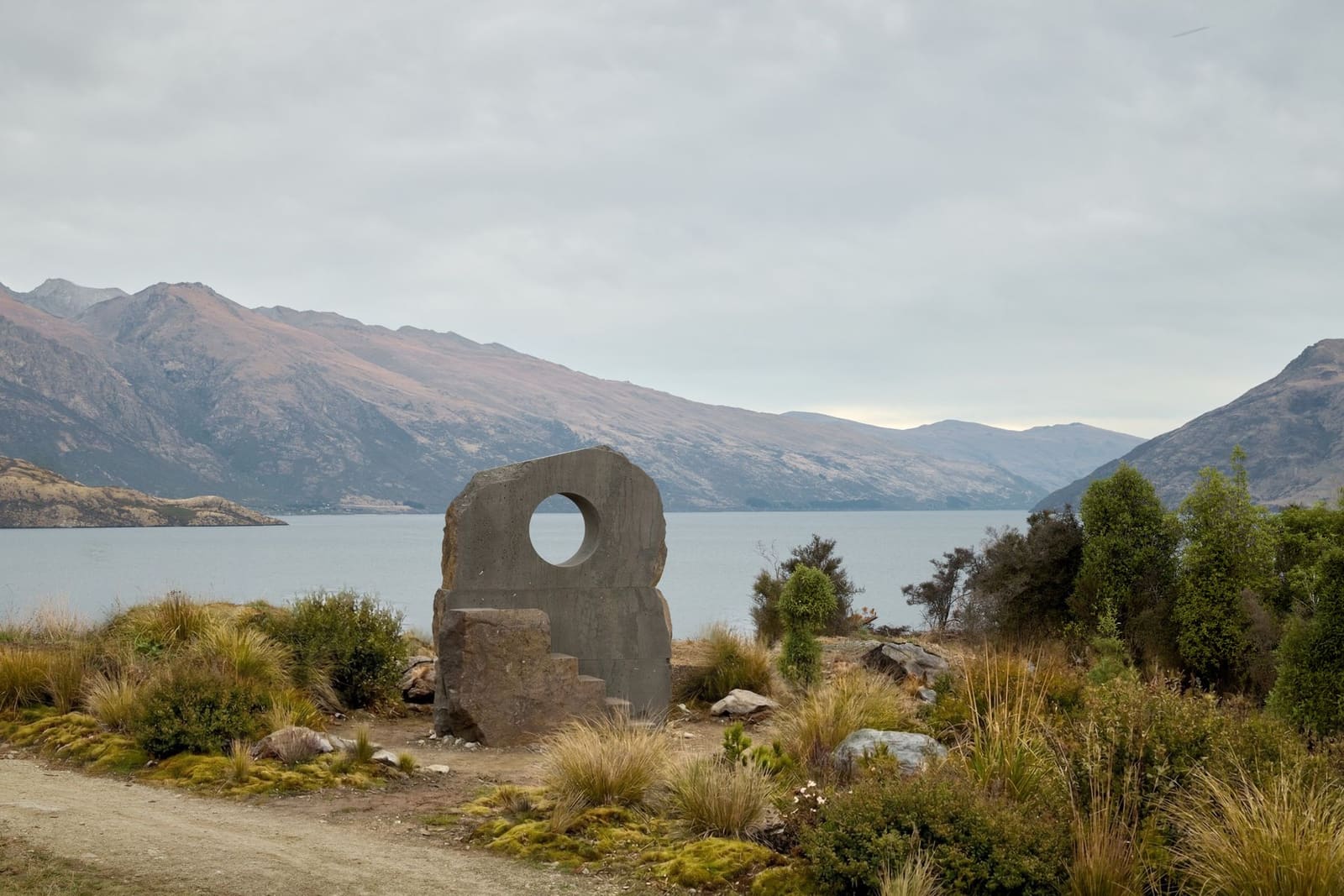
The Threshold Between Now and Then
Most architecture operates within the human lifespan - fifty years if the client is lucky, a century if the materials hold. But what happens when a brief asks for ten times that, for a structure meant to outlast not just careers but civilisations? Madhav Kidao and Brando Posocco, co-founders of London studio Nebbia, found themselves wrestling with precisely this question when they accepted a commission for Paererewā, an initiative spearheaded by Japanese entrepreneur Hideaki Fukutake and his company Still. The programme calls for one thousand works - incorporating sculpture and seating - to endure one thousand years across Aotearoa, each piece functioning as what the organisers describe as a threshold between the everyday and the contemplative.
The result, titled Interlude, is a portal-like structure of locally sourced basalt bluestone perched on a clifftop at Jardine Park in the South Island. It overlooks Lake Whakatipu and The Remarkables range, a site where geology speaks louder than any human narrative. Nebbia's previous portfolio skews toward the monumental - a cathedral-scale installation of stacking blocks at Coachella in 2024, an aluminium pavilion hovering over the V&A's John Madejski Garden - but this commission forced the duo to rethink monumentality not through scale alone, but through temporal ambition and material honesty.
The Anthropology of a Millennium
The first challenge was conceptual. Kidao and Posocco began by interrogating what a thousand years actually signifies in both human and ecological terms. Aotearoa was uninhabited by people a millennium ago; the first Polynesian navigators arrived roughly eight hundred years back. Projecting forward another thousand years raises uncomfortable questions: will humans still occupy these islands? If not, for whom - or what - should a designer build?
This line of inquiry is rare in contemporary practice, where client needs and regulatory frameworks anchor design firmly in the present tense. Yet it aligns with a strand of architectural thinking that stretches back through deep-time projects like the Clock of the Long Now or the Svalbard Global Seed Vault - structures predicated on the assumption that civilisation as we know it may not persist, but that certain artefacts of care and intention should.
Rather than retreat into abstraction, Nebbia chose to ground their response in encounter. Interlude is designed as a meeting place for two strangers, a piece of infrastructure for serendipity. One can climb its stepped basalt forms, sit, and share - knowledge, silence, or simply a view. The gesture is humble in programme yet audacious in duration, a social condenser calibrated not for a single generation but for dozens.
Material as Temporal Agent
The practical dimension of the brief introduced another layer of complexity. The South Island sits atop active tectonic boundaries; seismic forces operate on timescales indifferent to human intent. Nebbia's response was to reject the notion of static permanence. The studio sourced basalt bluestone from Timaru, a material indigenous to the region and geologically suited to slow weathering. But crucially, they embraced the possibility that Interlude might change - grow, fragment, erode - over its intended lifespan.
This stance marks a departure from conventional preservation logic, which tends to equate longevity with stasis. Instead, Nebbia's approach echoes the Japanese concept of wabi-sabi, an aesthetic philosophy that finds beauty in impermanence and imperfection. Stone, after all, operates on geological time; a millennium is a blink. Basalt itself is volcanic, born of upheaval, and will eventually return to the landscape through erosion and tectonic recycling.
The studio investigated the possibility of incorporating living organisms - native plant species that might grow with the structure - but discovered that no plant endemic to New Zealand survives a thousand years. Trees like the kauri can reach ages of two thousand years, but individual specimens are rare and their cultivation unpredictable. Stone, by contrast, offered a conception of time that transcends the anthropocentric. It exists before us, persists through us, and will outlast us.
Impermanence as Design Principle
Nebbia's body of work frequently explores transience - installations that exist for days, pavilions dismantled after a festival, structures that acknowledge their own ephemerality. Interlude extends this sensibility into a paradox: a monument to impermanence, a sculpture designed to endure precisely by accepting that it will not remain unchanged.
This philosophical position has precedents in both vernacular and avant-garde traditions. The stone circles of the British Isles, many over four thousand years old, have shifted, fallen, and been re-erected by successive cultures. The rammed-earth mosques of the Sahel require annual replastering, their longevity dependent on continuous communal labour rather than material inertness. In contemporary practice, architects like Wang Shu have championed the reuse of salvaged materials, embedding temporal layers into new structures. Nebbia's Interlude sits within this lineage, proposing that duration need not imply immutability.
The choice of basalt also carries tectonic and symbolic weight. Bluestone's fine grain and density make it resistant to freeze-thaw cycles, a practical consideration in alpine climates. Its colour - a deep charcoal grey that lightens with lichen colonisation - will shift over decades, registering ecological succession on its surface. The stone's thermal mass means it will warm in sunlight and cool slowly, creating microclimatic variation that may attract mosses, insects, and eventually birds. In this sense, Interlude is not a finished object but a substrate, a platform for processes the designers cannot fully script.
Forces Beyond Control
The seismic reality of New Zealand introduces an element of contingency that European or North American projects rarely confront with such immediacy. The Alpine Fault, which runs close to the site, ruptures approximately every three hundred years; the next event is statistically overdue. A magnitude 8 earthquake could topple Interlude, scatter its blocks, or leave it miraculously intact. Nebbia's willingness to design for this uncertainty reflects a maturation of architectural thinking around resilience - not as resistance to change, but as capacity to absorb and adapt.
This resonates with recent discourse around adaptive reuse and circular material economies, though Nebbia's project operates at a slower temporal resolution. If Interlude fractures in an earthquake, its basalt blocks become raw material for future reconstruction or reinterpretation. The stone does not cease to exist; it simply enters a new phase of its lifecycle. This is architecture as geological process, a stance that relinquishes authorial control in favour of long-term material continuity.
The Social Life of a Portal
Programmatically, Interlude is minimal - a place to sit, to pause, to look. Yet its social ambition is significant. The notion of a threshold between the mundane and the reflective recalls the engawa of Japanese architecture, the intermediary space between interior and exterior, or the liminality that anthropologist Victor Turner identified in ritual spaces. By framing encounter as the structure's core function, Nebbia aligns with a tradition of public architecture that prioritises collective experience over individual authorship.
The portal form itself is archetypal, appearing across cultures and epochs - from Stonehenge's trilithons to Isamu Noguchi's sculptural gardens. In Nebbia's hands, it becomes a device for framing the landscape, directing attention outward to the mountains and lake while simultaneously creating an enclosure, a spatial pause. The act of climbing onto the structure transforms visitors into participants, their bodies completing the composition.
This participatory dimension is critical to the work's longevity. A sculpture that invites touch, wear, and inhabitation will age differently from one kept behind barriers. The basalt will acquire a patina shaped by human contact - polished surfaces where hands grip, worn edges where feet land. Over centuries, these traces will accumulate, inscribing anonymous histories into the stone.
A Provocation for Practice
Interlude's value extends beyond its immediate site. It poses a challenge to contemporary architecture, which remains overwhelmingly preoccupied with the short term - funding cycles, construction schedules, the next publication deadline. At World Archi Design, we have covered numerous projects that claim sustainability or longevity, but few that genuinely reckon with timescales beyond a human lifetime. Nebbia's work for Paererewā suggests that designing for deep time requires not just durable materials, but a conceptual framework that accommodates uncertainty, transformation, and the eventual obsolescence of human stewardship.
The project also raises questions about authorship and legacy. If Interlude fragments or evolves beyond recognition, does it remain Nebbia's work? If future communities repurpose its stone, who claims credit? These are not merely academic puzzles; they touch on the ethics of design in an era of ecological crisis, where the consequences of our material choices will outlast any individual career or cultural moment.
Stone, in this context, becomes more than a construction material. It is a medium for thinking beyond the human-centred viewpoint, a reminder that our interaction with the built environment - whether one day or one thousand years - is fleeting. Nebbia's portal does not solve the riddle of permanence; it reframes it, proposing that the most enduring structures may be those that accept their own impermanence, that invite transformation rather than resist it. In a discipline still grappling with its complicity in resource extraction and environmental degradation, this is a provocation worth sitting with - preferably on a basalt cliff, looking out over a lake, waiting for a stranger to arrive.
Save this story. A free account keeps your reading list and the 07:00 email in one place.
CREATE FREE ACCOUNT →SIGN IN