
A Question of Eternity
Physical permanence has always been an illusion. The pharaohs commissioned limestone mountains in the belief that their souls would navigate back to preserved bodies; the structures remain, yet the dynasties dissolved. Jiang Qiong Er encountered this paradox on her first visit to the Giza Plateau, and it prompted a reframing. If stone and sovereignty offer no true continuity, perhaps the only enduring element is the capacity to connect across generations and geographies. Her installation, currently on view through 28 November 2026 as part of the sixth edition of Forever is Now, proposes an answer through form rather than rhetoric.
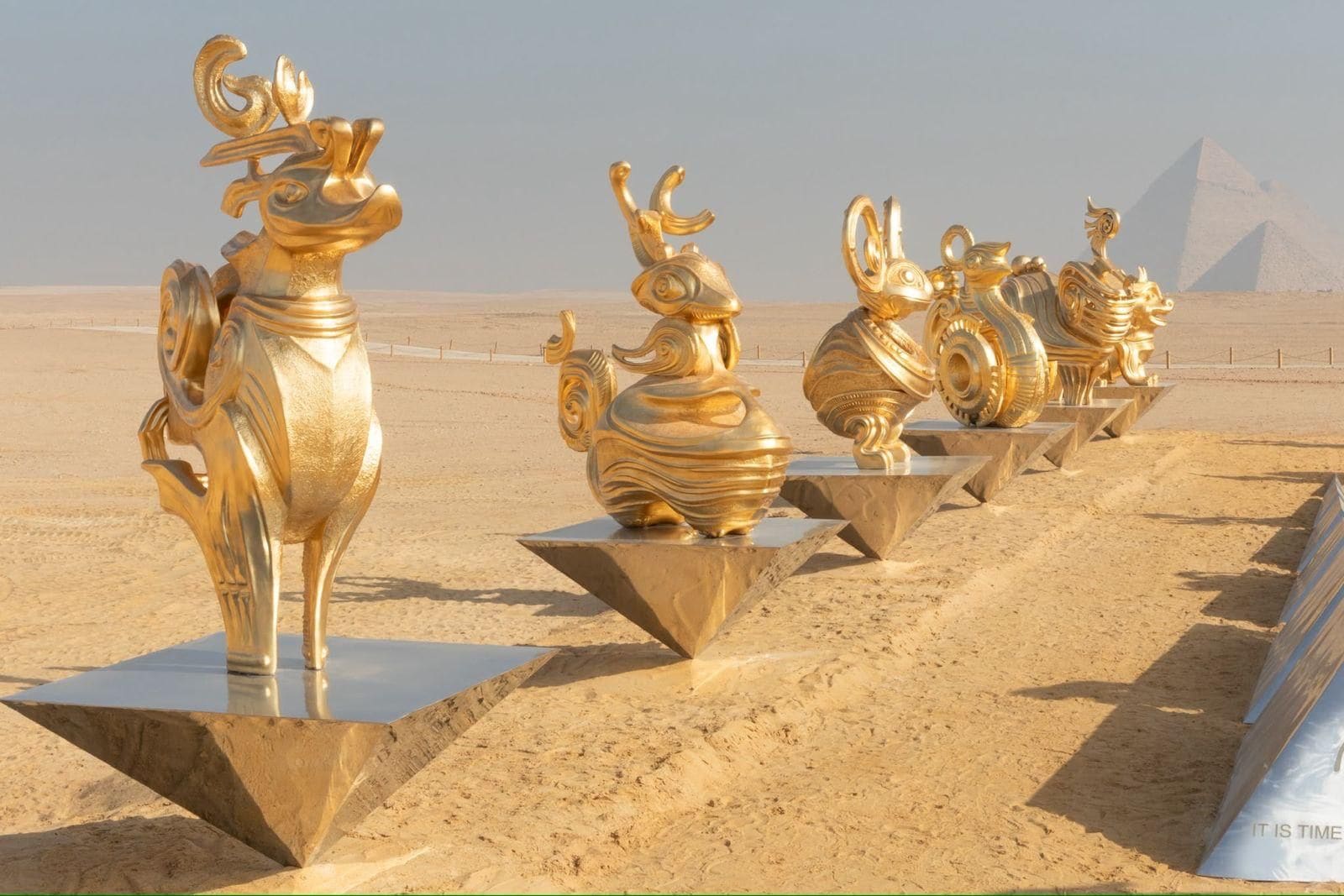
The work comprises twelve sculptures arranged in a double row that frames the three pyramids. Each figure stands four metres high atop an inverted pyramidal base clad in mirrored panels. The creatures themselves are hybrids, their anatomies and iconography synthesised from the mythologies of four ancient civilisations: China, Egypt, the Indus Valley and the Maya. One embodies authenticity, another bravery, a third wisdom. The lexicon is universal, the execution site-specific.
Precedent and Counterpoint
The Great Sphinx offers the nearest formal precedent. Carved from a single block of limestone around 2500 BCE, it merges the head of a king with the body of a lion, a composite intended to project both intellect and strength. Jiang's guardians operate within the same symbolic grammar, though their constituent parts are drawn from a wider geographical range. Where the Sphinx is monolithic, her sculptures are fabricated, their surfaces clad in gold leaf applied by two Cairo-based ateliers over the course of six site visits. The material choice is deliberate. Ancient Egyptians reserved gold for the divine, and the apex of the Great Pyramid, the sole survivor of the Seven Wonders of the Ancient World, was once capped with it until looters intervened.
The mirrored bases perform a dual function. They reflect the sand beneath, which visually lightens the mass of each sculpture, and they introduce a horizontal plane of reflection between the two rows. A low mirrored divider runs the length of the path, doubling the sculptures and the sky while also catching the silhouette of any visitor who walks between them. The path itself is oriented towards the pyramids, then reverses, a linear procession that Jiang describes as a symbolic return to history followed by a step into the future. The choreography is simple, but it lends the work a temporal dimension that static sculpture often lacks.
Universal Art as Methodology
Jiang has termed her broader practice "Universal Art", a framework that prioritises commonalities over distinctions. The twelve guardians first appeared in 2023, smaller and cast in bronze or foam, for an exhibition at the Musée Guimet in Paris. At that scale, they functioned as discrete objects within a gallery context. Relocated to Giza and enlarged, they acquire a tectonic presence, operating less as sculpture and more as architecture, mediating between the viewer and the pyramids beyond.
The approach diverges from much contemporary practice, which tends to foreground difference as a generator of meaning. Jiang's interest lies in identifying shared structures, whether formal, symbolic or ethical. She poses two questions across her projects: Are we together? How do we live together? The framing is reductive by design, stripping away layers of specificity to locate a common denominator. In the context of Giza, where the pyramids themselves are monuments to hierarchy and the afterlife of a single ruler, the guardians propose an alternative model, one predicated on collective values rather than individual apotheosis.
Craft, Scale and Site
The transition from the Musée Guimet to the Giza Plateau required more than a change in scale. Jiang adjusted proportions, angles and surface treatments across six trips to Cairo. The final sculptures are fabricated with a steel armature and a substrate that accepts the gold leaf, which was applied by hand. The mirrored elements, both the inverted pyramidal bases and the horizontal divider, were engineered to withstand wind loads and temperature fluctuations. Desert conditions impose constraints that a gallery does not: thermal expansion, sand infiltration, and the logistics of installing work on a protected archaeological site.
The gold cladding introduces a chromatic shift throughout the day. At midday, the surfaces are nearly white, reflecting the intensity of direct sunlight. At dawn and dusk, they take on the amber tones of low-angle light. The mirrored bases, meanwhile, collapse the boundary between sculpture and ground plane, a technique that recalls Robert Smithson's use of mirrors in the desert, though Jiang's intent is symbolic rather than phenomenological.
Seeds of Love and Performative Gesture
Alongside the guardians, Jiang developed a new hieroglyph for "love", synthesising symbols from ancient Egyptian hieroglyphics, Chinese oracle bone inscriptions and early writing systems from other cultures. The resulting glyph comprises three horizontal curved lines that suggest human figures or, depending on the viewing angle, pyramidal forms. She reproduced this symbol on 12,135 smooth wooden tokens, a quantity corresponding to the combined length of the Nile and Yellow rivers. In a performative act, she planted these tokens in the sand between the sculptures and the pyramids. The tokens are now available for purchase, with proceeds directed to Art d'Égypte, the organisation that commissions and produces Forever is Now.
The gesture occupies an ambiguous category. It is neither land art, since the tokens are removable and commodified, nor purely performance, since the act of planting was not the primary focus of the work. Instead, it functions as a participatory extension of the installation, allowing visitors to take a fragment of the project with them. The choice to link the sale to a non-profit introduces a pragmatic dimension, though it also raises questions about the relationship between symbolic action and material support.
Harmony, Rupture and the Cycle of Civilisations
Jiang's thesis rests on a cyclical reading of history. Civilisations achieve harmony, which enables flourishing; that harmony eventually fractures due to shifts in power or population; a new equilibrium is found, then lost again. The pattern, she argues, is observable across epochs and geographies. The guardians, in this framework, are not protective in a literal sense but rather as mnemonic devices, reminders of the values that underpin social cohesion.
Whether sculpture can perform that function is an open question. The history of monumental art is littered with works intended to edify or unite, many of which have been reinterpreted, defaced or dismantled as political contexts shift. Jiang's optimism is evident, but the work itself does not prescribe a path forward. It offers a catalogue of virtues, a formal dialogue with antiquity and a site that invites reflection. What visitors do with that invitation remains beyond the artist's control.
Lineage and Formation
Born in Shanghai in 1976, Jiang comes from a family steeped in art and architecture. Her grandfather was among the first Chinese artists to study abroad, introducing Western oil painting techniques to China. Her father, Xing Tonghe, designed the Shanghai Museum, a building known for its circular plan and bronze-clad exterior. Jiang began painting at age two and, at six, was selected for advanced training at the Shanghai Municipal Children's Palace, where she studied with masters of painting and calligraphy. After completing a degree in art and design in China, she attended the École Nationale Supérieure des Arts Décoratifs in Paris. In 2010, she collaborated with Hermès to establish Shang Xia, a home décor and lifestyle brand that merges contemporary design with traditional Chinese craftsmanship. She currently maintains studios in both France and China.
Her trajectory reflects a sustained engagement with craft traditions and a willingness to operate across disciplines. The guardians at Giza draw on that range, combining sculptural form, material expertise and site-specific installation. The project also demonstrates a comfort with scale and logistics that is less common among artists whose practice is primarily studio-based.
The Plateau as Stage
Forever is Now, launched in 2021, invites international artists to create large-scale works in dialogue with the pyramids. The event runs for approximately three weeks each autumn, transforming the Giza Plateau into a temporary exhibition site. Previous participants have included sculptors, installation artists and architects, each responding to the weight of the location in different ways. The site itself is both an opportunity and a challenge. The pyramids dominate any composition; they are among the most photographed structures on earth, and any intervention risks being reduced to a backdrop.
Jiang's solution is to embrace the relationship rather than compete with it. The guardians do not attempt to rival the pyramids in mass or presence. Instead, they establish a foreground, a threshold that visitors cross before reaching the ancient monuments. The mirrored elements ensure that the pyramids are always visible, either directly or in reflection, reinforcing the connection rather than obscuring it. The result is a work that operates at an intermediate scale, neither monumental nor intimate, but calibrated to the processional experience of moving through the site.
The installation will be dismantled after 28 November 2026, leaving only documentation and the dispersed wooden tokens. Whether the guardians will reappear in another context remains to be seen. For now, they occupy a narrow window in which contemporary art and ancient architecture share the same ground plane, a juxtaposition that is rare and, by design, temporary.
Save this story. A free account keeps your reading list and the 07:00 email in one place.
CREATE FREE ACCOUNT →SIGN IN