
The Architecture of Collective Knowing
There's a moment in childhood when learning stops feeling like work and starts feeling like exploration. You touch, you test, you fail without consequence. Tomás Saraceno's exhibition at the Haus der Kunst in Munich operates on this principle, building immersive environments where tactile engagement becomes a form of understanding. Running until February 2027, the show synthesizes years of research into arachnid behavior, water scarcity, and atmospheric possibility into spaces that demand participation.
At World Archi Design, we've been tracking Saraceno's trajectory from his Aerocene Foundation work in 2015, which achieved thirty-two world records for fossil-fuel-free flight using aerosolar sculptures, to his current preoccupations with what he calls "pluralistic futures." The Munich exhibition marks a shift in emphasis, one that moves from sky to ground, from air to water, and from individual encounter to collective ritual.
Vibration as Language
The centerpiece installation, Algo-r(h)i(y)thms (2019), consists of suspended ropes stretched throughout one of the museum's vast halls. When visitors pluck, flick, or strike the ropes, they emit deep, resonant tones. The piece is navigable only by crawling, hopping, or carefully threading your body through the tensioned network. It's a physical translation of spider web mechanics, where every movement sends information rippling through the entire structure.
Saraceno has spent years studying the vibrational languages spiders use to communicate through their webs. This installation externalizes that research, allowing human bodies to become nodes in a similar system. The piece refuses passive observation. You cannot experience it from a distance. You must enter, and in entering, you become part of the communicative structure. It's a rare example of biomimicry that operates at the scale of human proprioception, where the lesson isn't visual but kinesthetic.
Water Crisis Made Tangible
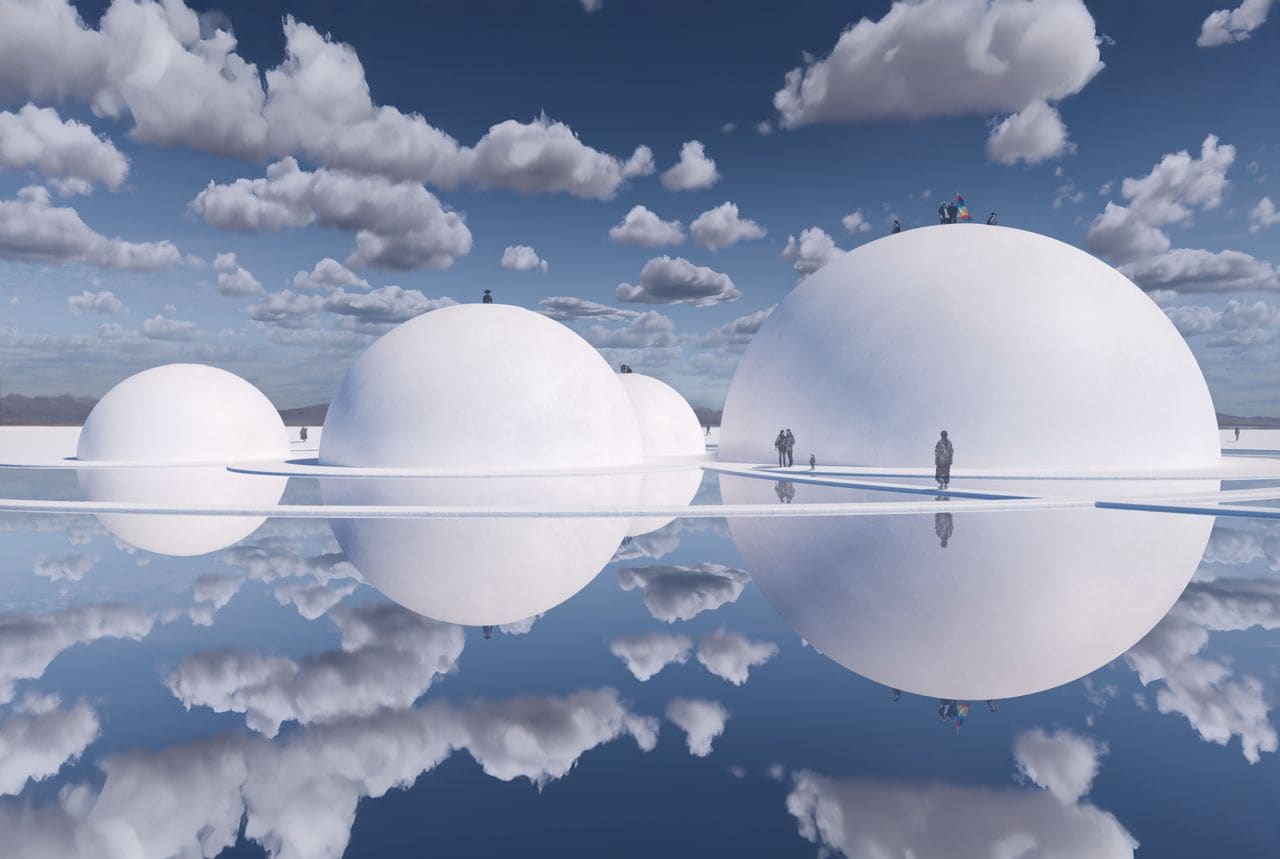
The exhibition also unveils a permanent land art project developed in collaboration with Indigenous communities in Red Atacama and Las Salinas Grandes in Northern Argentina. These communities face rapid groundwater depletion, and they've been pressing Saraceno for over a decade to turn his attention from atmospheric concerns to hydrological ones. Within the museum, water appears in two forms: pooled in shallow, reflective environments that visitors wade through, and crystallized in mountains of salt that crunch underfoot.
The salt installations are particularly effective. They're both beautiful and abrasive, inviting touch while reminding you of extraction. The crystals come from regions where lithium mining has accelerated desertification, and their presence in a Munich museum hall creates a deliberate geographic displacement. You're meant to feel the material consequence of resource extraction in a space far removed from the site of that extraction.
Saraceno's approach to environmental advocacy avoids didacticism. There are no wall texts explaining the mechanics of aquifer depletion. Instead, the work operates through sensory immersion. You walk through salt. You see water contained. You feel the contrast between abundance and scarcity made spatial.
The Pedagogy of Play
One of the exhibition's guiding principles is that learning requires play, and that most people stop playing too early. Saraceno has designed the show to be accessible to children, adults, and even dogs. The museum's historic halls, originally built during the Nazi era as a showcase for state-approved art, now host environments where visitors are encouraged to crawl, splash, and experiment.
This isn't play for its own sake. It's play as methodology. By removing the traditional barriers between artwork and viewer, Saraceno creates conditions where understanding happens through physical engagement rather than intellectual analysis. You learn about spider communication by moving through a web-like structure. You learn about water scarcity by encountering salt and pooled water in unexpected proximity.
The approach has precedents in the work of artists like Olafur Eliasson and Ann Hamilton, who similarly use immersive environments to create embodied knowledge. But Saraceno's focus on ecological systems and Indigenous collaboration gives his work a different inflection. The installations aren't just about perception; they're about interconnection and consequence.
Air-Filled Architectures
Another section of the exhibition features large-scale installations constructed from plastic bags filled with air. These sculptural forms, suspended and translucent, reference Saraceno's ongoing Aerocene project while also functioning as commentary on material reuse. The bags, sourced from everyday waste streams, become structural elements in temporary architectures that float and shift with air currents.
The installations demonstrate how lightweight, pneumatic structures can achieve significant spatial presence without heavy material investment. They're studies in buoyancy and tension, where form emerges from pressure differentials rather than solid mass. In architectural terms, they suggest alternatives to load-bearing construction, though their fragility makes them more provocative than practical.
Futures, Plural
Saraceno has titled the exhibition "Ancestral Futures," a phrase that deliberately collapses temporal boundaries. The "ancestral" acknowledges Indigenous knowledge systems that have long understood ecological interconnection. The "futures" (plural) rejects singular, techno-utopian visions in favor of multiple, community-specific possibilities.
This framing aligns with recent discourse in design and anthropology about pluriversality, the idea that modernity's single-world ontology should be replaced by recognition of multiple, coexisting worlds. Saraceno's work doesn't just illustrate this concept; it attempts to enact it spatially. Spider futures, human futures, water futures, air futures, each with their own logic and needs, all coexisting in the same exhibition halls.
The risk with such an approach is incoherence. When an exhibition tries to address arachnids, lithium mining, aerosolar flight, and participatory play simultaneously, it can lose focus. But Saraceno's installations are unified by a consistent formal language: lightness, transparency, vibration, and reflection. The materials may differ, but the sensibility remains constant.
Building With Joy
In a museum landscape increasingly dominated by screen-based media and archival documentation, Saraceno's insistence on tactile, participatory experience feels both anachronistic and necessary. The exhibition doesn't ask you to read about ecological crisis. It asks you to wade through salt, to pluck ropes, to move carefully through suspended structures. The learning happens in your muscles and your balance, not just your mind.
Whether this approach translates into meaningful ecological action remains an open question. Immersive art can create powerful experiences without necessarily changing behavior. But Saraceno's long-term collaborations with Indigenous communities suggest he's interested in more than museum spectacle. The exhibition functions as both artwork and advocacy tool, designed to be experienced by diverse publics and to generate conversations that extend beyond the gallery walls.
For architects and designers, the show offers lessons in how research can become spatial, how scientific observation can inform experiential design, and how collaboration with communities can produce work that's both formally sophisticated and ethically grounded. It's a model for practice that refuses the separation between aesthetic ambition and social responsibility, building worlds where learning feels like play and where connection becomes visible, tangible, and real.
Save this story. A free account keeps your reading list and the 07:00 email in one place.
CREATE FREE ACCOUNT →SIGN IN