
The Logic of Repetition
There is something quietly radical about an artwork that refuses to hold still. Not in the literal sense of kinetic sculpture, but in the way it resists a single, definitive reading. Cyril Lancelin's CUBE GRAPHICS, installed at Marina Bay Sands for i Light Singapore, operates precisely within this territory. A dense lattice of tubular elements arranged around a cubic volume, the installation embodies the paradox of contemporary spatial practice: rigorous in its geometric logic, yet fluid in its perceptual effects.
Lancelin, working through his Lyon-based studio Town and Concrete, has built a career exploring modular systems that generate complexity through repetition. At Marina Bay Sands, that approach yields a structure that oscillates between architectural proposition and optical device. The framework is composed of repeated tubular modules, each identical in profile but varying in orientation and density. The result is a composition that appears to vibrate, its surface shifting depending on the angle of approach, the quality of ambient light, and the speed of the viewer's movement.
We have seen parametric design applied to facades, pavilions, and installations across the past two decades, but CUBE GRAPHICS distinguishes itself by prioritizing perceptual instability over formal resolution. The work does not seek to impress through sheer scale or technical virtuosity. Instead, it asks visitors to slow down, to notice how their own movement through space alters what they see.
A Framework That Breathes
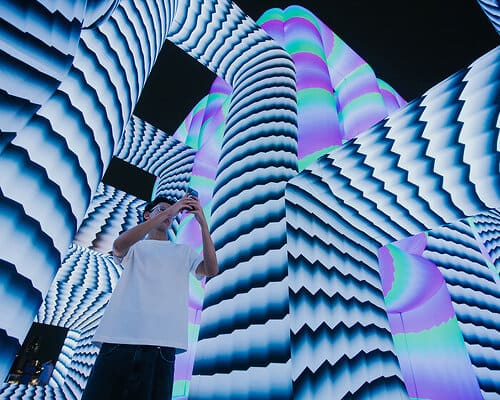
From the exterior, the cube reads as a monochromatic field. The tubular elements, arranged in tight proximity, create moiré-like interference patterns that blur the distinction between solid and void. Depending on the viewing angle, the structure can appear dense and opaque, or porous and nearly transparent. This optical ambiguity is not incidental; it is the work's primary subject.
The installation measures roughly cubic in proportion, but its exact dimensions matter less than its relationship to the viewer's body. It is sized to be approachable, walkable, occupiable. Unlike the monumental scale often associated with public art, CUBE GRAPHICS invites intimacy. Visitors can enter through a series of openings that puncture the lattice, stepping into a luminous interior where the logic of the exterior framework gives way to a different kind of spatial experience.
Inside, the monochrome dissolves. Color gradients, reflections, and carefully positioned lighting transform the cube into an immersive environment. The tubular elements, now backlit, glow with saturated hues that shift as one moves through the corridors. The repetition that structures the exterior becomes, on the inside, a medium for chromatic variation. It is a deliberate inversion: what appears rigid and systematic from without becomes fluid and atmospheric within.
Moiré, Movement, and the Viewer's Role
The moiré effect, a phenomenon that occurs when overlapping grids produce secondary patterns, is central to the work's visual strategy. Lancelin exploits this optical behavior not as decoration, but as a means of engaging the viewer in an active relationship with the structure. The patterns are not fixed; they emerge and dissolve as the viewer moves. This means that no two encounters with the work are identical.
In this sense, CUBE GRAPHICS shares conceptual ground with the kinetic and op-art experiments of the 1960s, particularly the work of artists like Jesús Rafael Soto and Carlos Cruz-Diez, who explored how perception could be destabilized through geometric repetition and chromatic interaction. But where those precedents often relied on two-dimensional surfaces, Lancelin's installation extends the logic into three dimensions, making the viewer's body a necessary component of the work's activation.
The installation also recalls the parametric pavilions that have proliferated in recent years, from Achim Menges's biomimetic research structures to the lattice experiments of studios like SOM and Zaha Hadid Architects. What sets CUBE GRAPHICS apart is its refusal to privilege structural performance or material innovation. The tubular elements are not load-bearing in any conventional sense; they are primarily visual. The work is unabashedly about appearance, about the ways in which geometry can produce image.
Color, Light, and the Digital Imaginary
After dark, the installation undergoes a second transformation. Artificial lighting amplifies the layered patterns and saturated colors, turning the cube into a glowing volume that stands in sharp contrast to the surrounding urban context. The effect is both spectacular and slightly uncanny, as if the structure has migrated from a digital rendering into physical space.
This convergence of the digital and the physical is a recurring theme in Lancelin's practice. His work often feels as though it has been extruded from a 3D modeling environment, its forms too precise, too iterative, to have originated through traditional craft. Yet the installations are resolutely material. They occupy space, they cast shadows, they can be touched. CUBE GRAPHICS navigates this tension between the virtual and the tangible, offering an experience that is simultaneously immersive and deeply photogenic.
The installation's popularity on social media platforms is not incidental. Lancelin designs with the camera in mind, understanding that contemporary public artworks function not only as spatial interventions but also as image-making devices. Visitors are encouraged to photograph the work, to share it, to reinterpret it through their own perspectives. In this way, the installation extends beyond its physical footprint, circulating as a set of images that continue to generate meaning long after the festival concludes.
Parametric Play and Public Engagement
CUBE GRAPHICS was presented as part of i Light Singapore, an annual festival that transforms the Marina Bay waterfront into a testing ground for light-based art and experimental installations. The festival has, over the past decade, become a significant platform for designers and artists working at the intersection of technology, public space, and environmental awareness.
Lancelin's contribution fits comfortably within this context, but it also raises questions about the role of parametric design in public art. Is the work accessible? Does it communicate beyond the aesthetics of algorithmic form? The answer, in this case, seems to be yes. CUBE GRAPHICS does not require specialized knowledge to appreciate. Its effects are immediate, legible, and physically engaging. Visitors can walk through it, photograph it, and experience it without needing to decode its parametric logic.
At the same time, the installation rewards closer attention. Those familiar with computational design will recognize the underlying principles: the use of repetition to generate variation, the reliance on parametric control to manage complexity, the exploitation of optical phenomena to produce visual interest. The work operates on multiple registers, offering different kinds of engagement depending on the viewer's background and interest.
Spatial Complexity from Simple Means
One of the most compelling aspects of CUBE GRAPHICS is its economy of means. The installation is built from a single repeated element, the tubular module, yet it produces a remarkably diverse range of spatial and visual effects. This approach reflects a broader shift in contemporary design practice, where complexity is understood not as a function of heterogeneity, but as an emergent property of simple, well-calibrated systems.
The corridors inside the cube guide visitors through a sequence of spatial conditions, each offering a different perspective on the overall structure. The sense of scale shifts as one moves deeper into the installation, and the boundary between interior and exterior becomes increasingly ambiguous. Openings in the lattice frame views of the surrounding waterfront, integrating the urban context into the work's spatial composition.
This sensitivity to context is important. While CUBE GRAPHICS is a self-contained object, it is not isolated from its surroundings. The installation responds to the scale and character of Marina Bay Sands, a development known for its blend of commercial, cultural, and recreational programming. The cube functions as a counterpoint to the polished surfaces and orthogonal geometries of the waterfront architecture, introducing a moment of visual and spatial complexity into an otherwise highly controlled environment.
Reflections on Immersive Environments
Lancelin's work sits within a broader conversation about immersive environments and the ways in which contemporary design practices engage with the body, perception, and experience. Over the past decade, we have seen a proliferation of installations that prioritize immersion over contemplation, that seek to envelop the viewer rather than hold them at a distance. CUBE GRAPHICS participates in this trend, but it does so with a degree of restraint that is worth noting.
The installation is immersive, but it is not overwhelming. The scale is manageable, the pathways are clear, and the visual effects, while striking, do not dominate to the point of spectacle. This balance allows the work to function as both a destination and a passage, a place to linger but also to move through.
The use of tubular elements, a recurring motif in Lancelin's practice, lends the work a certain playfulness. The modules read as simultaneously industrial and decorative, structural and ornamental. They evoke everything from scaffolding to children's toys, from technical infrastructure to abstract sculpture. This ambiguity is productive; it keeps the work open to multiple interpretations and prevents it from settling into a single, fixed identity.
A Vision of Convergence
At Marina Bay Sands, CUBE GRAPHICS reflects a vision of contemporary environments where art, architecture, and digital culture converge. The installation is not purely one or the other; it is a hybrid, a spatial proposition that draws on the vocabularies of multiple disciplines without being reducible to any single one.
This hybridity is characteristic of Lancelin's broader practice. He moves fluidly between the roles of artist, designer, and architect, producing work that resists easy categorization. CUBE GRAPHICS is not a building, but it has architectural qualities. It is not a sculpture in the traditional sense, but it occupies space in ways that are sculptural. It is not a digital artwork, but it is deeply informed by digital tools and aesthetics.
The installation also reflects the increasing importance of experience in contemporary design. Across the projects we have covered this year, from Snøhetta's sensory-focused pavilions to Studio Other Spaces's atmospheric interventions, there is a shared interest in designing not just objects, but situations. CUBE GRAPHICS is exemplary in this regard, offering visitors an opportunity to engage with space through movement, perception, and interaction.
Credits and Context
CUBE GRAPHICS / Cyril Lancelin and Town and Concrete, Marina Bay Sands, Singapore, 2025. The installation was presented by Marina Bay Sands for i Light Singapore, with production by Pico and management by kdArt. Photography by Vincent Ling, SY2, and the i Light Festival team.
The project underscores the potential of parametric design to generate public artworks that are both formally rigorous and experientially rich. It demonstrates how modular systems, when thoughtfully calibrated, can produce spatial complexity from relatively simple construction logic. And it reminds us that in an age of ubiquitous digital imagery, the physical encounter still matters. CUBE GRAPHICS may circulate widely as an image, but its primary function is to be walked through, to be inhabited, to be experienced in the flesh.
Photo: Vincent Ling / I Light Festival
Save this story. A free account keeps your reading list and the 07:00 email in one place.
CREATE FREE ACCOUNT →SIGN IN