
The Architecture of Fiction
Nations, like buildings, require foundations. But what happens when those foundations turn out to be stage props? Andreas Angelidakis poses this question at the Greek Pavilion in Venice, where his exhibition presents architecture itself as a drag performance, one that can be unzipped, examined, and perhaps escaped from entirely.
The pavilion's neo-Byzantine façade provided the starting point. Its exterior columns are simplified copies of those found in Hagia Sophia, a detail that Angelidakis reads not as aesthetic homage but as political yearning. The choice to reference Byzantium was never innocent; it encoded a revanchist fantasy, the desire to reclaim Constantinople as Greek territory. Architecture, in this reading, becomes a vessel for imperial nostalgia, each fluted column a monument to what never was and can never be again.
Inside, the building sheds its formal costume. Soft sculptures resembling those same columns now slump across the floor, wrapped in chains and rendered in plush fabric. By translating marble into textile, Angelidakis collapses the hierarchies these elements were designed to enforce. Visitors are invited to sit on them, to treat them as furniture rather than symbols. The gesture is both irreverent and tender, a way of domesticating monuments that were built to intimidate.
A Cave for the Algorithmic Age
Plato's allegory of the cave describes prisoners who mistake shadows for reality, unable to turn their heads toward the light. Angelidakis updates this scenario for an era in which shadows have multiplied beyond counting, projected not by firelight but by screens, algorithms, and surveillance systems that watch themselves watching.
The first gallery operates as a self-referential loop. A 21-meter screen dominates the space, fed by cameras pointed at one another to create a recursive panopticon. The effect resembles a bathroom mirror selfie extended to infinity, an image that consumes itself in the act of reproduction. Below, an LED floor pulses with light, transforming the room into something between a nightclub and a technological fever dream. The soundtrack reinforces this disorientation, looping a 1980s anthem until its lyrics dissolve into pure texture.
This is not escapism but its opposite: a space designed to make visible the mechanisms that construct our sense of reality. Where Plato's prisoners needed only to turn around, Angelidakis suggests that in our current condition, there is no outside to turn toward. We are already living inside the projection, and the question is not how to escape but how to recognize the architecture of the illusion.
Souvenirs and National Fantasy
The second gallery shifts typology, adopting the form of a periptero, the Greek street kiosk that serves as neighborhood hub and commercial node. In modern Greek, the word translates directly to "pavilion," a linguistic coincidence that Angelidakis exploits to collapse the distinction between national monument and roadside vendor.
Display cases hold 3D-printed figurines, classical forms that appear to have been digitally chewed and reconstituted. Oversized plush T-shirts hang from racks, their surfaces printed with collaged fragments: newspaper clippings, Wikipedia entries, archival images. Giant fabric books rest open on metal frames, presenting "clues" for visitors to decode. The entire installation mimics the logic of a game, inviting participation while refusing clear rules or victory conditions.
This staging reflects a historical argument. Modern Greece, as Angelidakis frames it, was itself a souvenir, a nation assembled by British, French, and Russian powers in the image of an ancient ideal that may never have existed in the form they imagined. The country functions as a bibelot, a decorative object meant to evoke antiquity for external consumption. By filling his pavilion with literal souvenirs, distorted and multiplied, Angelidakis makes this construction visible.
Minor Keys and Overlooked Histories
The late curator Koyo Kouoh chose "Minor Keys" as the theme for this Biennale edition, invoking the musical register that shadows major chords with dissonance and complexity. Angelidakis responds by foregrounding figures typically excluded from national narratives.
A heavy black veil hangs near the entrance, a tribute to Vaso Katraki, who won a Venice Biennale award in 1966 before being imprisoned the following year for her political beliefs. The exhibition references Zak Kostopoulos, a queer activist and drag performer killed in Athens in 2018, and Andreas Nomikos, known as the city's "feather lady," a street vendor whose presence offered the artist an early recognition of queer existence outside himself.
These inclusions are not decorative. They reframe the pavilion's central argument, suggesting that national identity is constructed not only through grand architectural gestures but also through violent exclusions, through the erasure of bodies and histories that complicate official narratives. By making space for these minor keys, Angelidakis proposes an alternative genealogy, one built from margins rather than monuments.
The Politics of Distortion
Red cap sculptures populate the exhibition, their lettering scrambled and incoherent. The reference is deliberate: the January 6 storming of the U.S. Capitol, an event Angelidakis sees as emblematic of how digital culture spills into physical space, how fantasies nurtured online manifest as bodies breaking through doors.
The parallel to Greek revanchism is structural rather than literal. Both involve a longing for a mythologized past, a desire to "make" something "again" that existed only in imagination. Both rely on architectural and symbolic language to naturalize claims that are, upon examination, recent fabrications. The pavilion's neo-Byzantine columns and MAGA's red hats perform similar work, turning political projects into aesthetic inevitabilities.
By rendering the caps as sculpture, by scrambling their text, Angelidakis strips them of their power to command. They become objects to be examined rather than slogans to be obeyed. The gesture extends to the exhibition as a whole, which presents the apparatus of nation-building not as immutable truth but as a game whose rules can be questioned, rewritten, or abandoned entirely.
Post-Truth and the Architecture of Play
Near the exhibition's entrance, Angelidakis displays a tattoo on his hand: another hand, frozen in the act of throwing dice. The image captures the exhibition's core proposition. In an environment where images can no longer be trusted as evidence, where video and documentation have lost their claim to objective truth, meaning becomes a matter of chance and interpretation.
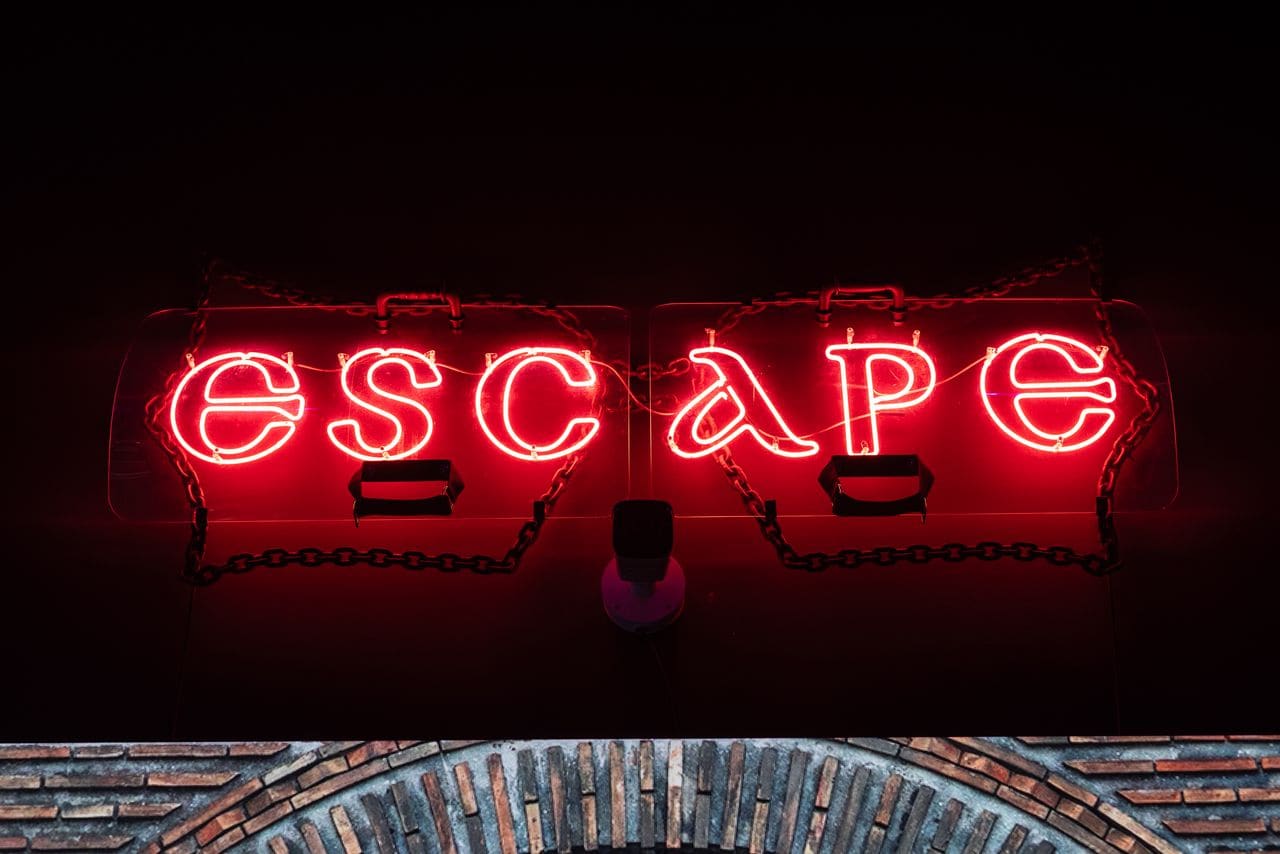
This is not a celebration of relativism but a reckoning with it. The "escape room" of the title is not a puzzle to be solved but a condition to be inhabited. There is no exit, no moment of revelation that will restore certainty. Instead, the exhibition offers tools for navigation: a heightened awareness of how spaces shape perception, how symbols accumulate meaning, how narratives harden into fact.
The pavilion itself, reimagined as a drag queen shedding her national costume, becomes a model for this process. Drag does not reveal an authentic self beneath the performance; it exposes performance as the only available mode. Similarly, the exhibition does not promise access to a "real" Greece behind the myths. It suggests instead that the myths are the material, and that understanding how they were constructed is the closest we can come to truth.
Navigating the Labyrinth
At Venice, architecture students often photograph the pavilions as case studies in national representation. Angelidakis inverts this pedagogy, using the building to teach a different lesson: that national pavilions are not neutral containers but active agents in the production of identity, that their forms encode political projects, and that these projects can be read, questioned, and refused.
The strobe lights and neon and looping soundtrack create an environment that is simultaneously playful and disorienting, pleasurable and unsettling. This tonal complexity is the point. By collapsing the nightclub and the kink dungeon and the souvenir shop and the cave into a single space, Angelidakis refuses the separation between high and low, serious and frivolous, that typically governs how we engage with national representation.
The exhibition runs through November, a durational presence that will outlast the Biennale's opening frenzy. For those who enter, the challenge is not to find the exit but to recognize the room for what it is: a constructed space, full of clues, where the game has no winner and the only move is to keep playing.
Save this story. A free account keeps your reading list and the 07:00 email in one place.
CREATE FREE ACCOUNT →SIGN IN