
When Infrastructure Becomes Canvas
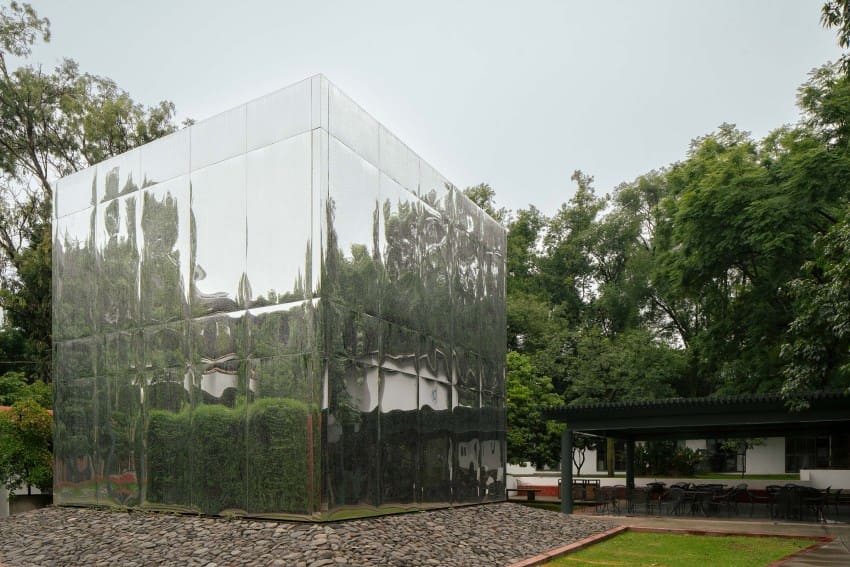
Not every architectural gesture requires permanence. At ITESO, a university campus in Tlaquepaque, Mexico, a six-metre cubic steel frame had stood vacant for an indeterminate period, its orthogonal skeleton an inert piece of infrastructure awaiting purpose. Fernando Hernandez, Humberto Espinoza, and Jessica Corona approached this dormant armature not as a problem to solve but as a spatial opportunity. Their response, the Sfumato Pavilion, transforms the rigid framework into a study of atmospheric thresholds, employing textile membranes and calibrated light to articulate space without mass.
The project title borrows from Leonardo's painting technique, sfumato, in which edges dissolve into gradations of tone rather than hard lines. The architectural parallel is deliberate. Where conventional pavilions delineate inside from outside through walls and roofs, this intervention proposes a softer boundary condition, one that negotiates visibility, enclosure, and transition through layered translucency.
Materiality and the Tectonic of Lightness
The designers suspended semi-transparent fabrics within and across the steel cube, creating a series of overlapping planes that respond to ambient light and air movement. The textiles, chosen for their varying degrees of opacity, establish spatial hierarchy without the weight of traditional enclosure. By day, sunlight filters through the layered membranes, casting diffuse shadows and revealing the frame's geometry in shifting relief. At dusk, artificial illumination reverses the effect, the pavilion becomes a glowing volume that reads as solid from a distance yet remains permeable up close.
This approach recalls the tensile experiments of Frei Otto, whose work with membrane structures in the 1960s and 70s demonstrated that enclosure need not equate to mass. Yet where Otto's projects often pursued structural optimisation at large scales, the Sfumato Pavilion operates at a more intimate register. Its six-metre cube is a room-sized intervention, a scale that invites occupation rather than observation alone.
The steel frame itself, a pre-existing constraint, becomes a datum line against which the textile planes are measured. The designers did not clad or obscure the structure but worked in dialogue with it, allowing the orthogonal rigidity of the frame to counterpoint the fabric's softness. This tectonic contrast, hard versus yielding, static versus responsive, generates the pavilion's spatial character.
Temporal Architecture and the Poetics of the Ephemeral
Temporary interventions occupy a peculiar position within architectural discourse. Freed from the durability requirements of permanent construction, they can explore material behaviours and spatial effects that would be impractical or prohibitively expensive at building scale. The Sfumato Pavilion leverages this freedom, proposing an architecture that is inherently mutable. Wind animates the fabric, altering the pavilion's internal partitions. Changing light conditions modulate its transparency. The structure is never quite the same twice.
This embrace of transience aligns with a broader shift in contemporary practice toward responsive and adaptive design. Across the projects we have covered this year, there is a growing interest in architecture that acknowledges time, weather, and use as active participants in spatial experience. The Sfumato Pavilion contributes to this conversation by foregrounding impermanence not as a limitation but as a design principle.
The installation's setting within a university campus is significant. Educational institutions have historically served as testing grounds for experimental architecture, spaces where speculative ideas can be prototyped and evaluated outside the commercial pressures of private development. ITESO's willingness to host such an intervention reflects a recognition that pedagogy extends beyond the classroom, the built environment itself becomes a medium for spatial literacy.
Precedents and Divergences
The pavilion invites comparison with other textile-based installations, particularly those by artists and architects working at the intersection of sculpture and spatial design. The chromatic environments of Olafur Eliasson, though more overtly theatrical, share a concern with perception and atmospheric effect. Closer to the architectural discipline, the fabric installations of Kengo Kuma, especially his early experiments with woven materials, explore similar territory, using textile to mediate between structure and void.
Yet the Sfumato Pavilion diverges from these precedents in its restraint. There is no spectacle here, no saturated colour or dramatic form. The intervention is subdued, almost reticent, allowing the interplay of light and material to generate spatial interest without recourse to formal gymnastics. This quietness is itself a position, a counterpoint to the image-driven imperatives that dominate much contemporary practice.
The project also engages with the vernacular tradition of temporary shade structures common throughout Mexico and broader Latin America, markets covered with tarps, courtyards draped with canvas, outdoor spaces made habitable through lightweight, removable canopies. The Sfumato Pavilion abstracts this pragmatic tradition into a more conceptual register, retaining the logic of layered screens while stripping away utilitarian function in favour of spatial exploration.
Spatial Experience and the Question of Programme
What does one do in the Sfumato Pavilion? The project does not prescribe a programme. There are no fixed furnishings, no designated activities. The space is open-ended, a condition that shifts agency to the occupant. Students might gather for informal discussion, individuals might pause between classes, or the pavilion might simply serve as a perceptual landmark within the campus landscape.
This programmatic ambiguity is intentional. By refusing to dictate use, the designers acknowledge that spatial experience cannot be fully controlled or predicted. The pavilion becomes a framework for occupation rather than a container for predetermined activity. This openness is particularly relevant in educational contexts, where unscripted interaction and chance encounter often prove as valuable as formal instruction.
The pavilion's scale, a six-metre cube, establishes intimacy without confinement. The space is large enough to accommodate several people yet small enough to retain a sense of enclosure. The textile membranes subdivide the volume into loosely defined zones, suggesting separation without enforcing it. One can move through the pavilion along multiple paths, each offering a different sequence of views and thresholds.
Implications for Practice
The Sfumato Pavilion raises questions about the relationship between permanence and value in architectural production. Contemporary practice remains largely oriented toward durable construction, projects measured in decades if not centuries. Yet there is a compelling argument for architectures of shorter duration, interventions that respond to immediate conditions and dissolve when those conditions change.
Such an approach requires a different economic model. Temporary projects cannot amortise costs over extended lifespans, making them difficult to justify within conventional development frameworks. Yet when sited within institutional or public contexts, where the brief extends beyond financial return to encompass cultural or pedagogical value, the calculus shifts. The Sfumato Pavilion demonstrates that modest means, a pre-existing frame, off-the-shelf textiles, basic lighting, can yield spatially rich results when deployed with precision and conceptual clarity.
At World Archi Design, we have been tracking a growing interest in what might be termed tactical interventions, small-scale projects that activate underutilised sites or infrastructure through minimal means. These works often operate outside the traditional commission structure, emerging instead from academic initiatives, community collaborations, or designer-led experiments. The Sfumato Pavilion fits this category, a project born from the convergence of available resources, a dormant frame, and an interest in exploring spatial atmospherics.
The pavilion also contributes to ongoing discussions about the architectural role of textiles. While fabric has long been present in architecture, primarily as awnings, curtains, or upholstery, its use as a primary spatial medium remains relatively uncommon. Projects like the Sfumato Pavilion suggest that textiles offer qualities, porosity, translucency, flexibility, that complement rather than compete with conventional building materials. The challenge lies in integrating these qualities into more permanent construction, a problem that several practices are beginning to address through advanced textile technologies and hybrid structural systems.
Reflection
The Sfumato Pavilion is not monumental. It will not appear in surveys of twenty-first-century architecture. Yet it exemplifies a mode of practice that values experimentation, spatial nuance, and economy of means. By working within constraints, a pre-existing frame, a temporary timeline, a modest budget, Hernandez, Espinoza, and Corona have produced an intervention that expands rather than fills space, that invites rather than dictates, that dissolves rather than encloses.
Whether such projects can influence broader architectural culture remains an open question. The pressures of scale, regulation, and market expectation often preclude the kind of lightness and ambiguity that the Sfumato Pavilion embodies. Yet the value of these experiments lies not in their direct replicability but in their capacity to remind the discipline that architecture need not always be heavy, permanent, or certain. Sometimes a frame, some fabric, and careful attention to light are enough.
Save this story. A free account keeps your reading list and the 07:00 email in one place.
CREATE FREE ACCOUNT →SIGN IN