
The Fissure as Method
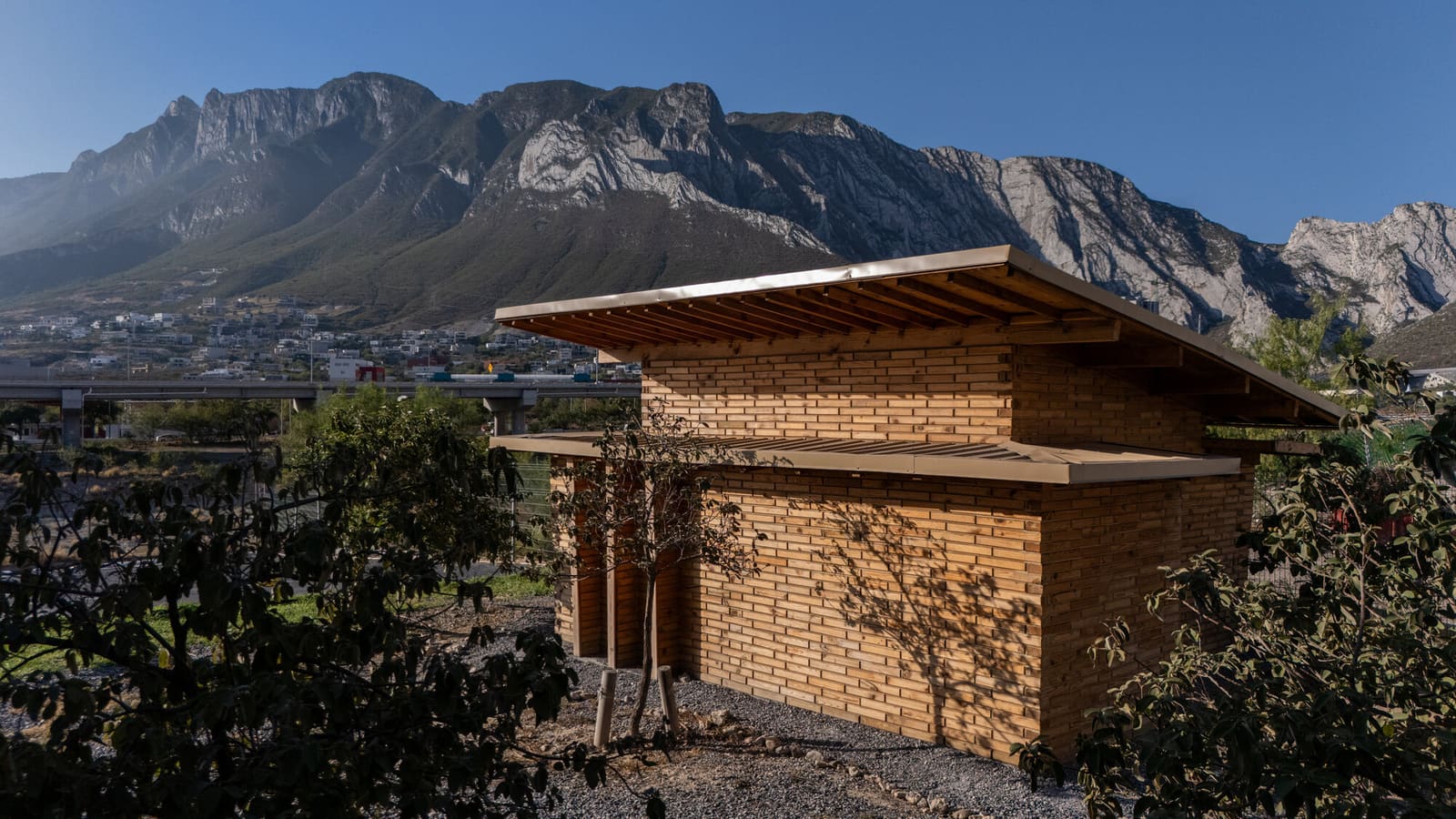
Architecture schools rarely teach students to build what they draw. La Grieta Pavilion - a 26-square-metre temporary structure completed in Ciudad Santa Catarina, Nuevo León, in 2025 - set out to close that gap. Developed through a collaboration between WEYES Estudio and architecture students at Centro de Estudios Superiores de Diseño de Monterrey (CEDIM), the project reframed the academic pavilion not as a showcase of formal invention but as a pedagogical instrument for understanding material behaviour, environmental response, and the temporal nature of architectural space.
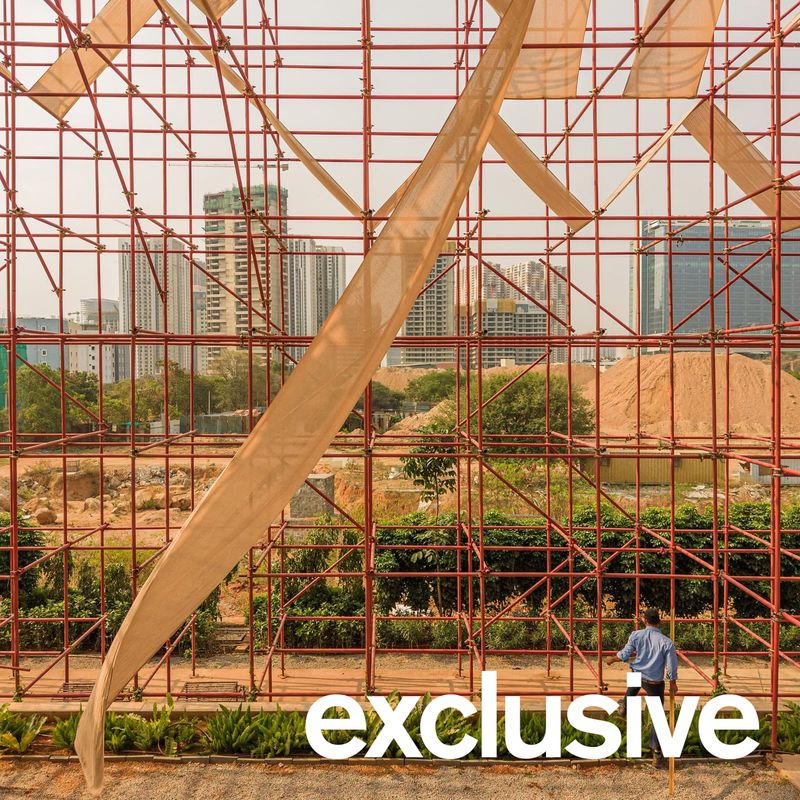
The pavilion's name, which translates to "the crack" or "the fissure," signals its conceptual point of departure: an opening that admits light, time, and the unpredictability of weather into a deliberately constrained tectonic system. Rather than concealing its structural logic or finishing its surfaces, the pavilion exposes the scaffold frame that holds it together, turning industrial construction equipment into both structure and ornament.
Scaffolding as Tectonic Vocabulary
La Grieta is built almost entirely from modular steel scaffolding supplied by Andamios Monterrey, a material choice that carries both practical and symbolic weight. Scaffolding is temporary by definition - a system designed to be assembled, dismantled, and reused across multiple sites. By foregrounding this impermanence, the pavilion positions itself within a lineage of experimental structures that interrogate the boundary between building and installation, between architecture and event.
The frame is clad with translucent and opaque panels that modulate daylight as it passes through the structure. These panels, sourced from PROMMAT and Habiteo, create a gradient of luminosity that shifts throughout the day, casting geometric shadows onto the ground plane and interior surfaces. The effect is neither static nor purely aesthetic; it functions as a temporal index, a way of marking the passage of hours through the migration of shadow and the warming or cooling of interior air.
At World Archi Design, we have tracked a growing interest in scaffolding as an architectural material - from Assemble's Turner Prize-winning community projects in Liverpool to the scaffold-based pavilions that populate architecture biennales in Venice, Tallinn, and Shenzhen. What distinguishes La Grieta is its pedagogical intent: the structure was not designed by a studio and handed to students for documentation but co-developed through a semester-long process that integrated design, detailing, and on-site assembly.
Building as Learning
The project was coordinated by Vicente Tapia and Djordje Stanojevic, with construction led by Jorge Jiménez and academic oversight from Héctor Pineda. Seventeen students participated in the design and fabrication process, working directly with the scaffold system to understand load transfer, joint articulation, and the relationship between module and assembly sequence.
This approach departs from the typical studio model, in which students produce drawings and renderings that remain unbuilt. By requiring students to confront the weight, tolerance, and assembly logic of real materials, the pavilion introduced a form of feedback that is absent from most academic work: the resistance of the physical world. Joints that appeared straightforward in drawings revealed clearance problems on site. Panel connections that seemed intuitive in section required improvised detailing when fabricators encountered misaligned scaffold nodes.
These moments of friction are not failures but opportunities for learning. They reveal the gap between representation and realisation, a gap that defines much of architectural practice but is rarely addressed in design education. La Grieta made that gap visible, turning it into the subject of inquiry rather than a problem to be solved through better documentation.
Light, Atmosphere, and Temporal Registration
The pavilion's most compelling feature is its treatment of light. The combination of scaffold frame and translucent cladding creates a layered optical condition in which sunlight is filtered, refracted, and modulated before reaching the interior. This is not the controlled, even illumination of a gallery space but a variable, time-dependent luminosity that responds to cloud cover, solar angle, and seasonal shifts in the sun's path.
The spatial experience is correspondingly mutable. Early morning light enters at a low angle, creating long shadows that emphasise the horizontal members of the scaffold. Midday sun produces sharper contrasts and flattens depth. Late afternoon light warms the interior, tinting the translucent panels and casting a diffuse glow onto adjacent surfaces. These variations are not programmed but emergent, the result of the pavilion's orientation, its material assembly, and its exposure to the environment.
This temporal registration recalls the work of James Turrell, whose Roden Crater project tracks celestial events through carefully calibrated apertures, and Olafur Eliasson's weather-responsive installations, which make atmospheric conditions perceptible as architectural phenomena. La Grieta operates at a smaller scale and with more modest means, but it shares a commitment to making time visible through material interaction.
Material Reuse and the Ethics of Temporariness
Because the pavilion is constructed from scaffolding, it is inherently reversible. Every connection can be unbolted, every panel removed, every component returned to inventory for future use. This circularity is not incidental but central to the project's environmental logic. In a discipline that generates enormous quantities of construction waste, the ability to disassemble and redeploy materials without degradation offers a model for sustainable practice that does not rely on high-tech materials or complex recycling streams.
The pavilion's sponsors - PROMMAT, Habiteo, and Andamios Monterrey - provided materials with the understanding that they would be returned after the installation period. This arrangement shifts the economic model of temporary architecture, moving away from single-use fabrication toward a leasing or loan-based system in which materials retain value across multiple projects.
This approach aligns with emerging interest in design for disassembly, a principle codified in frameworks such as the Cradle to Cradle certification and the European Union's Circular Economy Action Plan. While La Grieta does not claim certification or formal compliance, it demonstrates the principle at a small scale, offering a proof of concept that could inform larger institutional projects.
Pedagogy Beyond the Studio
The most significant outcome of La Grieta may be its impact on the students who built it. By engaging directly with construction logistics, material constraints, and on-site problem-solving, they acquired a form of knowledge that cannot be transmitted through lectures or software tutorials. They learned how to read a material's behaviour, how to negotiate with fabricators, how to adapt a design when conditions change.
This experiential dimension is increasingly rare in architectural education, where computational tools and parametric design have created new forms of sophistication but also new forms of distance from the physical realities of building. La Grieta reasserts the value of direct engagement, not as a nostalgic return to craft but as a critical counterbalance to screen-based design culture.
Looking forward, the project suggests a model for academic collaboration that could be replicated in other contexts. The partnership between WEYES Estudio and CEDIM created a framework in which professional expertise and student energy reinforced each other, producing a structure that neither party could have realised independently. The result is a pavilion that functions as both architecture and pedagogy, a built argument for the inseparability of thinking and making.
Conclusion
La Grieta Pavilion stands as a modest but instructive example of how temporary structures can serve purposes beyond formal experimentation. By grounding its design in material reuse, environmental responsiveness, and hands-on learning, the project offers a counterpoint to the spectacle-driven pavilions that dominate architecture festivals and biennales. Its significance lies not in its formal novelty but in its commitment to process, to the slow accumulation of knowledge that comes from building with one's hands and watching how light moves through a space over the course of a day.
In an era when architectural education is increasingly mediated by screens and simulations, La Grieta reminds us that some forms of understanding can only emerge through direct contact with materials, weather, and time.
Save this story. A free account keeps your reading list and the 07:00 email in one place.
CREATE FREE ACCOUNT →SIGN IN