
The Primitive Hut, Reconsidered
Architecture has long been justified through the story of human shelter. From Vitruvius to Laugier, the discipline anchors itself in a narrative of protection: rain, cold, predators, the elements. The primitive hut is always our hut. But what happens when we ask architecture to serve beings that do not commission it, do not occupy it in ways we recognize, and certainly do not pay for it?
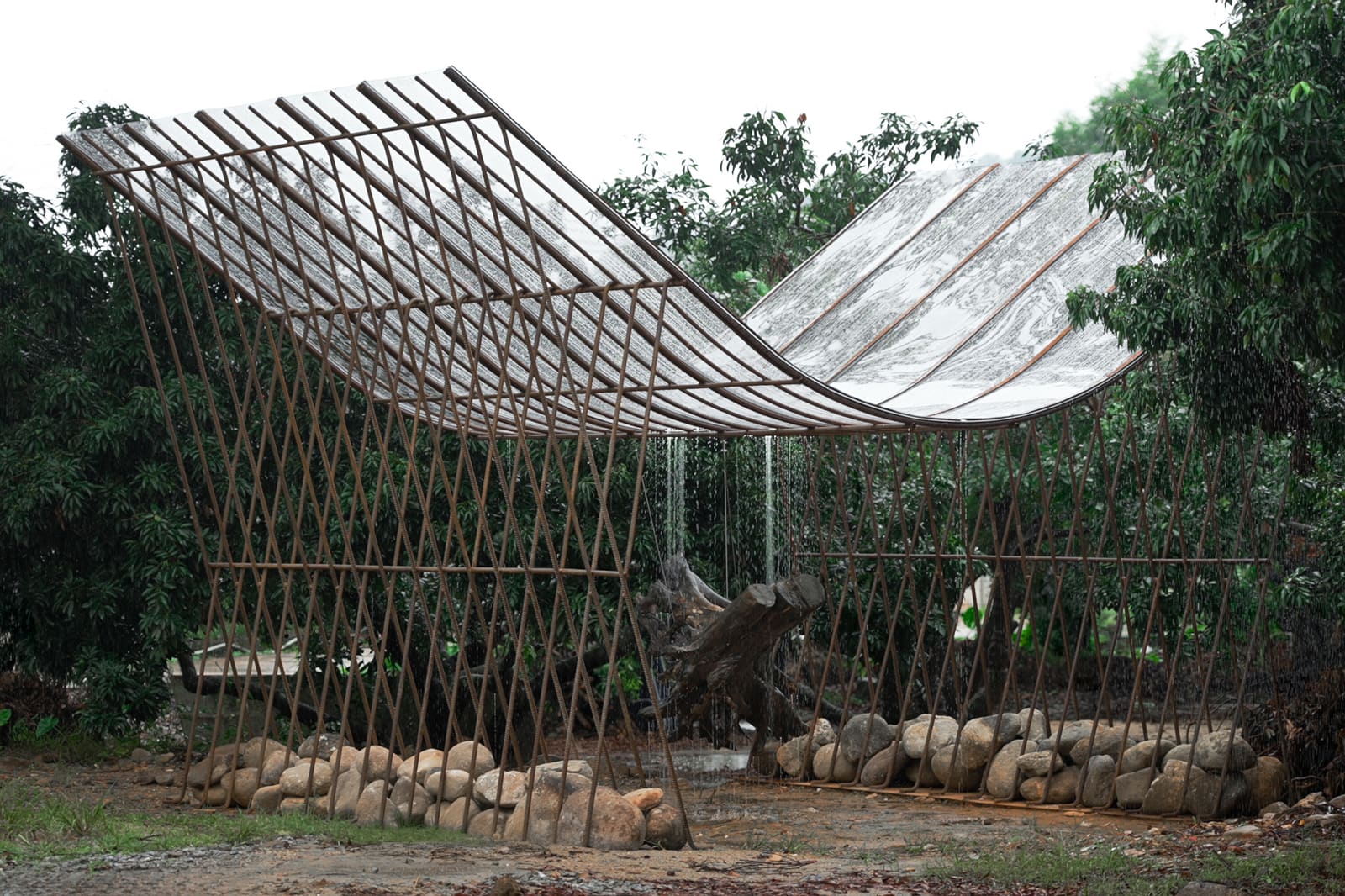
Insight Architects' Deadwood Hut, completed in 2025 along the Xutian River in Huizhou, China, offers one answer. The 20-square-meter installation was exhibited as part of the Nankunshan-Luofushan Rim Pioneer Zone Architectural Art Project, an initiative that invited practitioners to reimagine what shelter means when divorced from human primacy. Lead architect Siming Wu and his team turned their attention not to people but to the overlooked: insects, microorganisms, plants, and the deadwood itself, abandoned and rotting along the riverbank.
The project does not position itself as a folly or sculptural gesture. It is explicitly framed as habitat, an artificial structure designed to accommodate other-than-human life. In doing so, it chips away at the anthropocentrism embedded in architectural education and practice, where even the most ecologically minded projects often treat non-human life as scenery rather than client.
Deadwood as Material and Protagonist
At World Archi Design, we've been tracking a slow but meaningful shift in how architects engage with salvaged and found materials. Deadwood Hut operates within this lineage but pushes further. Rather than reclaiming timber for aesthetic or structural efficiency, Wu treats deadwood as both medium and subject. The installation gathers discarded logs and branches from the riverside, material typically cleared away or left to decompose invisibly, and reintroduces it into the built environment with a new legibility.
The structure itself is modest in scale but intentional in composition. The deadwood is arranged to create cavities, overhangs, and interstitial spaces where insects can nest, plants can root, and microbial communities can flourish. The design does not mimic natural forms in a biomimetic sense; instead, it stages an encounter between human construction and ecological process. The wood remains recognizable as architecture, even as it begins to host life that will eventually degrade it.
This approach resonates with recent experiments in material agency, where architects like David Benjamin and The Living have explored mycelium-based structures, or Anna Heringer's work with earth and natural fiber in Bangladesh. But where those projects often emphasize human comfort or sustainability metrics, Deadwood Hut subordinates human use entirely. There is no seating, no program, no implied occupant beyond the non-human.
Site and Context: The Xutian River as Laboratory
The choice of site is not incidental. The Xutian River corridor, part of the broader Nankunshan-Luofushan region, has been subject to increasing ecological pressure from tourism and development. The Shelter for All Beings exhibition, curated by Chen Donghua, invited architects to respond to this tension by creating installations that foreground ecological cohabitation rather than extraction or spectacle.
Insight Architects positioned Deadwood Hut directly along the riverbank, where the boundary between water, land, and human intervention is already blurred. The structure sits low to the ground, partially embedded in the landscape, and relies on passive interaction with its environment. Rainwater pools in crevices, sunlight filters through gaps in the wood, and seasonal flooding will likely reshape the installation over time.
This temporal dimension is central to the project's thesis. Unlike most architectural commissions, which are designed to resist decay, Deadwood Hut embraces it. The wood will soften, split, and host successive waves of colonization by fungi, beetles, and vegetation. The installation is not a monument but a scaffold for processes that exceed human timescales and intentions.
Construction and Collaboration
The construction team, led by Zhou Xiangyang and comprising Tang Jiwei, Tang Jia, Liao Dinghua, and Zhou Nenhe, worked with structural consultant Luo Qiyao to ensure the assembly was stable enough to withstand immediate environmental forces while remaining porous to ecological inhabitation. Guangzhou Yibo Architectural Engineering Co., Ltd. managed the build, which required careful handling of irregular, often fragile timber pieces.
The fabrication process itself became an exercise in negotiation. Standard joinery techniques were adapted to accommodate the unpredictable geometry of deadwood, and connections were designed to allow movement and settlement. The result is a structure that reads as both deliberate and contingent, a quality that distinguishes it from more polished pavilion typologies.
Implications for Practice
Deadwood Hut will not solve the biodiversity crisis, nor does it claim to. Its value lies instead in its conceptual provocation: what does it mean to design for clients who cannot speak, cannot sign contracts, and whose needs are fundamentally illegible within conventional architectural frameworks?
This question has practical corollaries. As climate adaptation and ecological restoration become unavoidable aspects of architectural practice, the discipline will need to develop new vocabularies and methodologies for engaging with non-human stakeholders. Projects like Deadwood Hut suggest that this engagement need not be purely technical or instrumentalized through green building metrics. It can also be speculative, experimental, and even uncomfortable in its refusal to center human benefit.
The installation also raises questions about durability and authorship. If the structure is designed to be transformed by its non-human occupants, at what point does it cease to be architecture and become landscape? And who, if anyone, is responsible for its maintenance or eventual removal? These are not rhetorical questions. They point to gaps in how the profession defines success, value, and stewardship.
A Habitat Without Hierarchy
The broader Shelter for All Beings exhibition, commissioned by Shanghai Fengyuzhu Culture & Technology Co., Ltd., includes multiple installations by different practices, each interpreting the brief through their own lens. What sets Deadwood Hut apart is its refusal of compromise. It does not offer a hybrid space where humans can also benefit; it does not include interpretive signage or viewing platforms. It simply exists as infrastructure for other life.
This purity of intent may limit its replicability. Few clients will fund architecture that excludes human occupation, and fewer still will accept structures designed to decay. But as a research project, Deadwood Hut opens a territory that architects have historically avoided: the possibility that shelter, in its most expansive sense, might not be about us at all.
Save this story. A free account keeps your reading list and the 07:00 email in one place.
CREATE FREE ACCOUNT →SIGN IN