
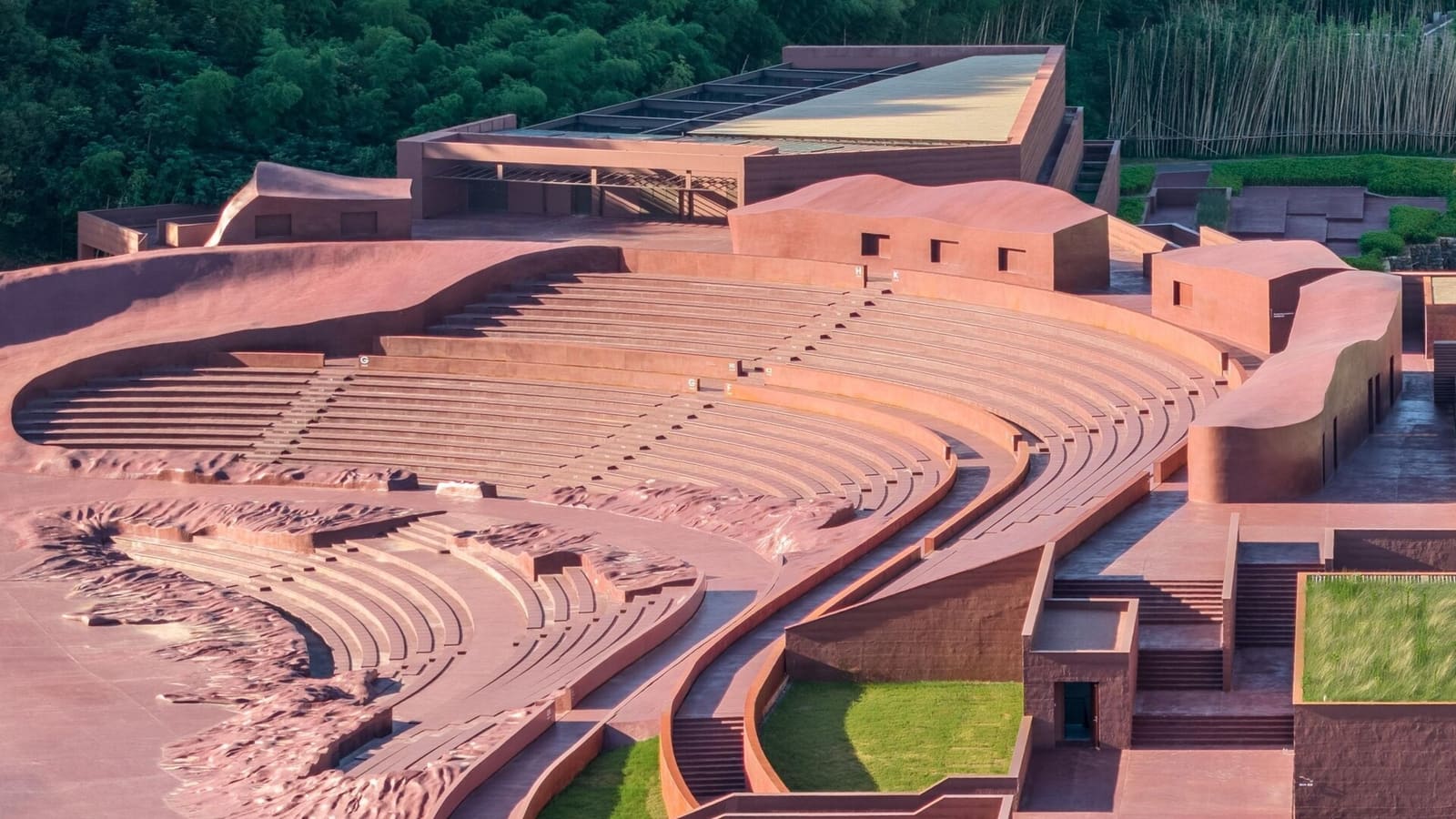
A Theatre Calibrated to Flight Trajectories
Most amphitheatres in natural settings claim to "embrace" their surroundings. Earth Valley Theater, embedded into a valley floor in China's Mingling Mountains near Yixing, was shaped by a constraint almost no architect has worked under: the seating rake was calibrated to the glide slope of raptors. Group of Architects (GOA) designed the 2,300-seat, 9,200-square-metre structure as the permanent venue for Dancing with the Birds, an ecological performance directed by Fan Yue. The brief required that birds of prey fly centimetres above spectators' heads without triggering stress responses in the animals. That single requirement rippled through every spatial decision, from sightlines to materiality to the topography of the site itself.
The result is architecture in which human occupancy is secondary. Aviaries occupy an adjacent valley, separated by natural ridgelines that double as acoustic buffers. Perches, shelters, and nesting zones were modelled in collaboration with avian-behaviour specialists before the auditorium's geometry was finalised. If the term "biophilic design" typically describes architecture that references nature, Earth Valley represents something closer to zooarchitecture: spatial planning driven by the sensory and behavioural needs of non-human species.
Precedent: When Animals Dictated Form
Designing for animals as primary users is rare, but not without precedent. Renzo Piano's California Academy of Sciences in San Francisco integrated a living roof to support native plant species and their pollinators; the roof's undulating form was optimised for drainage and microclimate rather than human aesthetics. More directly comparable is the Lied Jungle at Omaha's Henry Doorly Zoo, where the spatial envelope was determined by the flight range of free-flying birds and the climbing behaviour of primates. Yet those examples remain enclosures, spaces where animal behaviour is contained. Earth Valley inverts the model: the theatre is the enclosure, inserted into a landscape the birds already occupy.
GOA's approach recalls the work of Geoffrey Bawa, whose estate at Lunuganga in Sri Lanka dissolved boundaries between built and natural systems, though Bawa's vocabulary remained anthropocentric. Earth Valley's closest analogue may be the speculative proposals of Neri Oxman's Silk Pavilion series, where silkworms co-authored structural form. Here, however, the co-authors are wild, and their participation is behavioural rather than material.
Ceramics, Bamboo, and the Limits of Biomimicry
Yixing's ceramic tradition and the surrounding bamboo forests provided the material palette. Concrete surfaces were CNC-milled, then hand-carved by local artisans to evoke clay's rough texture. The decision was partly cultural, partly functional: the coarse finish prevents birds from slipping during landings and reduces reflective glare that can disorient avian vision. Aviary enclosures use high-density polyethylene elements moulded to resemble woven bamboo, a substitution that prioritises durability and reduces the maintenance cycle.
This is biomimicry at its most pragmatic. The polyethylene does not biodegrade, nor does it support the insect populations that natural bamboo scaffolding would. But it avoids the ultraviolet degradation that would necessitate replacement every five to seven years, a choice that trades ecological purity for long-term stability. The thermally treated timber used in aviaries eliminates the need for chemical preservatives, while frit patterns on glass reduce collision risk. Mesh apertures and substrate gravel were sized to the tarsal dimensions and foraging behaviour of the species housed.
These are tectonic decisions made legible only when one understands the non-human constraints. The rough concrete is not aesthetic rustication; it is a textured landing surface. The bamboo-patterned HDPE is not decorative cladding; it is a visual barrier that registers as solid to avian eyes while remaining translucent to human spectators.
Infrastructure Hidden in Topography
The theatre's technical systems are entirely concealed. Rainwater channels follow the natural drainage lines of the valley, feeding into an irrigation network that supports the replanted hillside vegetation. Acoustic reinforcement, lighting rigs, and projection equipment are recessed into the landform, invisible from the auditorium. This is not the expressed-structure vocabulary of high-tech architecture; it is closer to the earthworks of Michael Heizer or Robert Smithson, where infrastructure becomes inseparable from site.
The design recalls Peter Zumthor's Therme Vals, where mechanical systems are embedded within stone masses, but Earth Valley's ambition is different. Vals hides technology to preserve an atmosphere of timelessness. Earth Valley hides it to avoid interfering with animal behaviour: artificial light sources that could disrupt nocturnal species are shuttered, and speaker arrays are angled away from nesting zones to prevent acoustic stress.
Gesamtkunstwerk, Expanded
GOA describes the project as a Gesamtkunstwerk, the Wagnerian "total work of art" in which architecture, performance, and landscape fuse. But Wagner's synthesis was human-centric, a Romantic programme of sensory immersion designed to overwhelm the audience. Earth Valley's synthesis includes non-human performers whose participation cannot be scripted. The birds' flight paths, vocalisations, and movements are variables, not fixed choreography. The architecture accommodates this unpredictability by providing spatial flexibility: perches at varying heights, multiple entry points to the performance zone, and sightlines that allow birds to monitor both the audience and potential predators.
This is a departure from GOA's previous work, which spans residential towers, hospitality projects, and cultural institutions across China. The studio's portfolio generally reflects a modernist clarity - rational plans, expressed structure, controlled material palettes. Earth Valley is looser, more contingent. The aviary zones are not geometrically regular; they follow the contours of the secondary valley. The auditorium seating is asymmetrical, shaped by the topography rather than imposing a symmetrical parti onto the site.
The Question of Agency
Xu Qi, the project's lead architect, frames Earth Valley as an inquiry: "How far are we from nature, and how close are we to ourselves?" It is a question that has animated environmental design since Ian McHarg's Design with Nature in 1969, but the answer here is more ambiguous. The theatre does not restore a pre-existing ecology; it constructs a new one, purpose-built for a scripted performance. The birds are not wild in the strict sense; they are trained, housed, and managed. The landscape is replanted, irrigated, and maintained. This is not rewilding; it is a designed habitat, as controlled as any zoo enclosure, albeit with spatial parameters set by the animals' needs rather than human viewing angles.
The tension is productive. Earth Valley does not resolve the contradiction between intervention and coexistence; it makes it visible. The rough concrete and concealed infrastructure signal an attempt to minimise human dominance, but the very act of building a 9,200-square-metre structure in a mountain valley is an assertion of control. The architecture is honest about this: it does not pretend to disappear, but it does redistribute priority.
Implications for Practice
If Earth Valley has a broader lesson, it is procedural. The design process began with avian-behaviour analysis, not site analysis. Flight paths were mapped before sightlines. Perch dimensions were specified before seat widths. This inversion of the typical design sequence forced the architecture to respond to constraints that most projects never consider. The result is a building that feels unfamiliar, not because of its formal language - concrete, timber, and bamboo are hardly avant-garde - but because its spatial logic is derived from a different set of priorities.
Could this approach scale beyond a single-use performance venue? Urban projects face regulatory, economic, and programmatic pressures that Earth Valley, as a privately commissioned cultural project, did not. But elements of the methodology are transferable: behavioural modelling of non-human species, material choices informed by animal sensory perception, infrastructure designed to avoid ecological disruption rather than simply mitigate it. These are tools that could inform urban parks, green corridors, and adaptive-reuse projects where existing ecosystems must coexist with new programmes.
The risk is that Earth Valley becomes a singular experiment, admired but not replicated. Its budget, timeline, and client were all exceptional. Most projects do not have the luxury of postponing human requirements until avian ones are resolved. But the precedent is now established: architecture can be shaped by the needs of other species without sacrificing spatial coherence or experiential richness. Whether the profession takes up that challenge remains to be seen.
A Shared Stage
At World Archi Design, we have tracked projects that claim to "integrate" nature - green roofs, living walls, biophilic facades. Most are additive: nature as ornament, applied to a structure conceived without it. Earth Valley is subtractive: it removes human priority from the design process and asks what remains. The answer, in this case, is a theatre where the architecture is backdrop, the birds are co-performers, and the audience is granted the rare privilege of witnessing a space not built for them.
The project does not sentimentalise this relationship. The birds are trained, the landscape is constructed, the performance is rehearsed. But the spatial logic is genuine: the architecture accommodates avian agency in a way that most built environments do not. Whether that constitutes a "shared habitat," as GOA claims, or simply a more sophisticated form of captivity, is a question each visitor must answer. The theatre provides the stage; the interpretation is left open.
Save this story. A free account keeps your reading list and the 07:00 email in one place.
CREATE FREE ACCOUNT →SIGN IN