
The Site as Co-Author
Across the projects we've covered at World Archi Design, the rhetoric of "respecting context" appears often, usually as a polite nod to surroundings before the machinery of construction begins. Esquina Nativa, a 502-square-meter commercial center completed in 2026 by TACO taller de arquitectura contextual, takes a different approach. Here, the existing vegetation is not scenery to be framed or obstacle to be worked around. It is the primary generator of form.
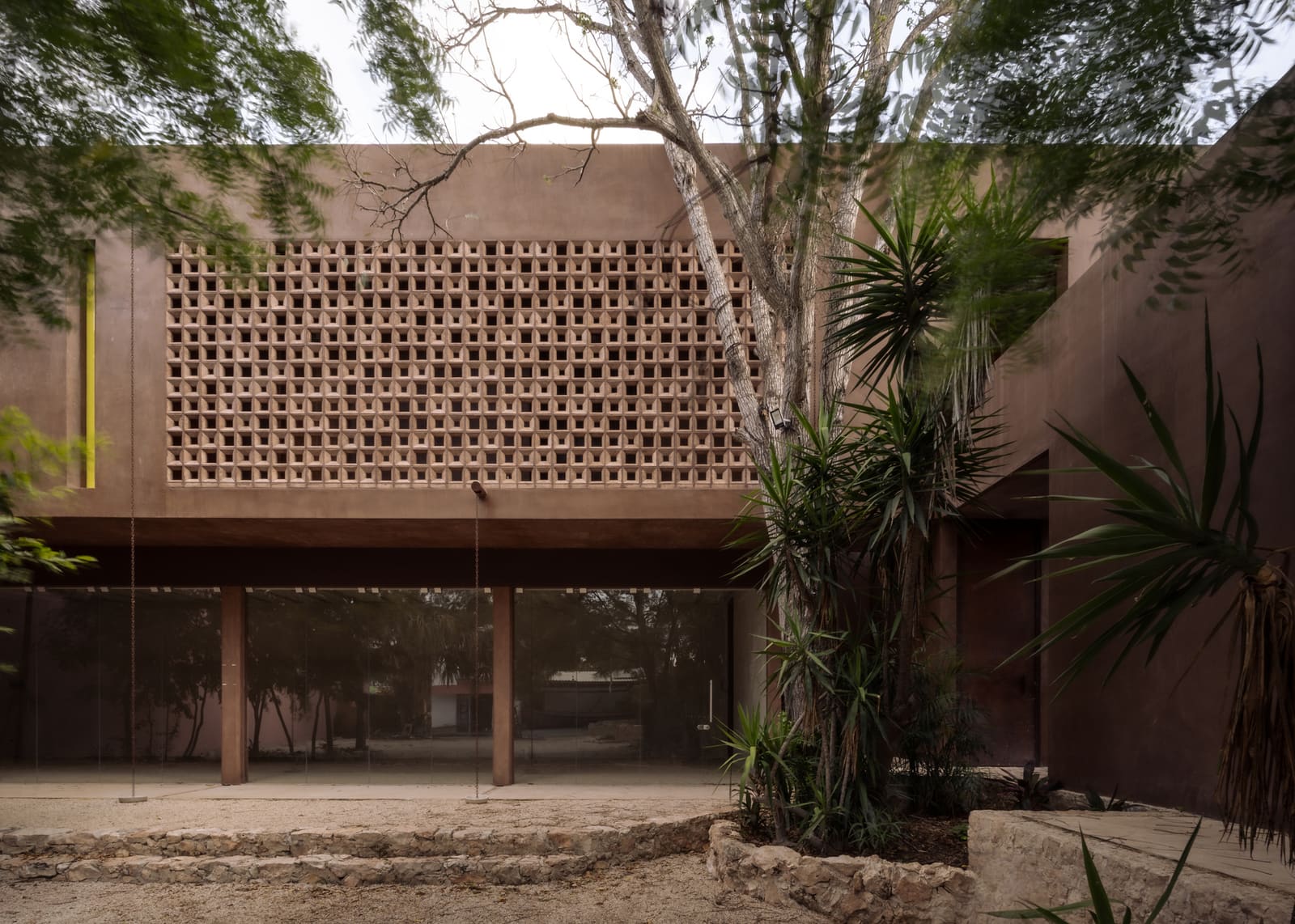
Situated on the corner of what was once the Cholul nursery in Mérida, Mexico, the project inherits a legacy of mature trees. Rather than clear the site for a blank canvas, lead architect Carlos Patrón Ibarra and his team made a foundational choice: build around what is already there. The trees dictate the layout. They organize circulation paths. They establish the shaded zones that define how people move through and occupy the space. In effect, the vegetation becomes the parti.
Landscape as Structure
This is not landscape architecture in the conventional sense, where planting follows building. At Esquina Nativa, the sequence reverses. The massing responds to the canopy. Walls curve or pause where trunks stand. Openings align with sightlines through foliage. The result is a plan that reads less like a geometric exercise and more like a negotiation with an existing ecosystem.
The strategy recalls the adaptive reuse tactics of practices such as Assemble or Rural Urban Framework, where constraints become opportunities for spatial invention. But rather than working with inherited walls or infrastructure, TACO works with inherited biology. The trees are structural in a non-load-bearing sense: they hold the project's logic together.
Functionally, the canopy does more than provide shade. In Mérida's climate, where daytime temperatures regularly exceed 35°C, the mature trees create microclimatic pockets that make outdoor circulation comfortable. The project leverages this passively, routing pedestrian movement through shaded thresholds rather than relying on mechanical cooling for transition zones. It is biophilic design by necessity, not decoration.
Commercial Space Without the Box
Retail architecture often defaults to the box: a neutral container optimized for flexibility, signage, and climate control. Esquina Nativa refuses this. The complex is fragmented, its volumes distributed across the site in a loose constellation. Each unit opens onto a shared landscape rather than a corridor or atrium. The trees mediate between them, providing continuity without enclosure.
This typology has precedents in vernacular markets and bazaars, where stalls cluster around courtyards or under trees. But it also resonates with more recent experiments in de-densifying commercial programs, seen in projects like Sou Fujimoto's House NA or Junya Ishigami's KAIT Workshop, where boundaries between inside and outside blur. At Esquina Nativa, the blurring is not conceptual but climatic. The shade is the architecture.
The fenestration follows this logic. Openings are generous but strategically placed to frame views of foliage, not neighboring storefronts. Glazing is minimal where direct sun would compromise comfort. The result is a visual language that prioritizes connection to landscape over the typical display-window logic of retail.
Public Space as Byproduct
One of the more interesting outcomes of the project is the incidental public realm it creates. By distributing the program and preserving the trees, TACO generates interstitial spaces that function as informal gathering points. These are not programmed plazas or designed seating areas. They emerge from the gaps left by the trees.
In a city where public green space is often privatized or underfunded, this approach has implications beyond the site. Esquina Nativa suggests that commercial development need not be extractive. By anchoring the project to existing landscape, it produces shared amenity as a matter of course. The trees do not belong to the tenants or the developer. They belong to the microclimate, and therefore to anyone who enters.
This is not activism. It is pragmatism. But it offers a model for how retail architecture might negotiate its role in the public realm, especially in contexts where climate and vegetation are assets too valuable to bulldoze.
Material and Tectonic Restraint
The material palette is deliberately quiet. Concrete, steel, and glass appear in their simplest forms, detailed to recede rather than compete with the landscape. Structural elements are exposed but not dramatized. The tectonics emphasize clarity: posts, beams, and planes that register as components rather than composition.
This restraint aligns with the project's broader ethic. If the trees are the main event, the architecture must know when to step back. The detailing is careful but not precious. Joints are legible. Finishes are durable and low-maintenance. There is no fetishization of craft for its own sake, a trap that plagues much contemporary "contextual" work.
The roof planes hover lightly, cantilevering where necessary to avoid root zones. Their thinness is structural honesty: these are not heavy masses but sheltering surfaces. They read as extensions of the canopy, not replacements for it.
A Question of Replicability
Whether this approach scales or translates to other sites is an open question. Esquina Nativa benefits from a specific set of conditions: a former nursery site, mature trees already in place, a client willing to accept a non-standard layout. These are not universal givens.
But the broader principle, that site-specific constraints can generate spatial richness, is applicable. It requires a shift in how architects and developers value existing conditions. Trees, in this framework, are not obstacles to be removed or amenities to be added later. They are collaborators in the design process.
At World Archi Design, we have long argued that sustainability in architecture is less about certification systems and more about intelligent use of what is already there. Esquina Nativa demonstrates this with uncommon clarity. The project does not announce its environmental credentials. It simply builds around them.
Save this story. A free account keeps your reading list and the 07:00 email in one place.
CREATE FREE ACCOUNT →SIGN IN