
A Canopy of Cloth and Memory
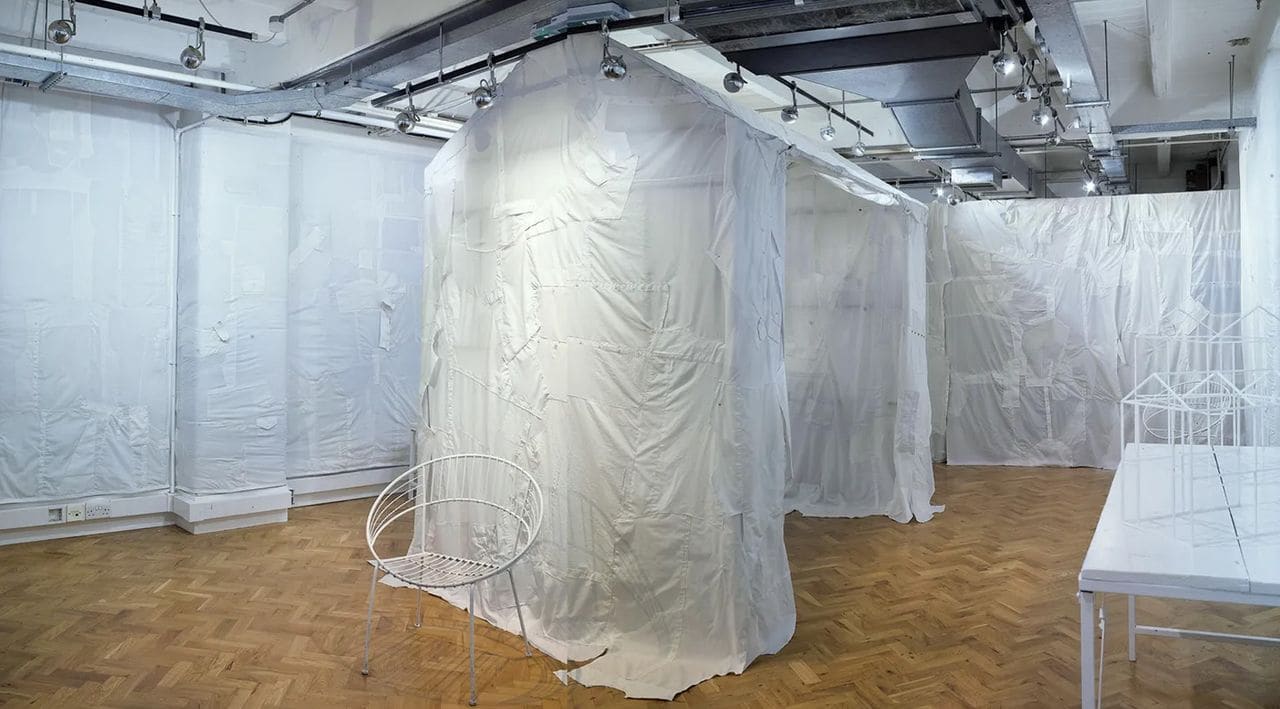
The white shirt, in its ubiquity, carries a peculiar kind of invisibility. Yet in the hands of Harris Elliott, the garment becomes something else entirely: a tectonic element, a cultural marker, a thread connecting personal history to public space. At the entrance to Le Parlour, Elliott's new evolving installation in central London, visitors encounter a warren constructed from stitched-together vintage white shirts. The effect recalls the canvas tarpaulins of open-air markets, those ad-hoc shelters that define informal commerce across continents.
For Elliott, the reference is deeply autobiographical. His childhood shirts were made by an aunt who worked in a Peckham shirt factory, and his earliest memories of wonder are tied to market visits with his mother. The rhyming slang of vendors, the collision of colour and culture, the improvisational energy of the stalls have stayed with him. In his adult travels, Elliott gravitates toward marketplaces first, seeking what he describes as the heartbeat of a city. This opening installation, titled The Collection, transforms that spatial memory into built form.
Salon Culture Through the Lens of the Front Room
Le Parlour draws its conceptual framework from the social salons that emerged in sixteenth-century Italy and flourished across France and England in subsequent centuries. These were spaces of intellectual exchange, artistic presentation, and social mixing, often hosted in the parlours of private homes. Elliott's contemporary version translates that tradition through the lens of the front room, the domestic space where gathering, conversation, and music-making happen in many British homes.
Running from late July through December 2026 at The Casbah on Little Portland Street, the project is structured as a series of evolving chapters, each transforming the space through new installations and programming. Elliott describes the initial ambition as creating an artistic environment for gathering influenced by food and play. By using his own home as a reference point, he could draw on a range of cultural narratives embedded in his African and Caribbean heritage, as well as his experience growing up in London.
The installation includes a two-metre-high mirrored panel sound system encased in a frame-like house structure, a nod to the centrality of music in domestic life. A personal family photo album is displayed on a plinth, museum-style, reinforcing the idea that the space functions as an extension of Elliott's home rather than a neutral gallery.
Material Interventions and Objects for Exchange
At World Archi Design, we have long been interested in how artists and designers employ textiles as spatial devices, and Elliott's use of the white shirt as a building block is particularly resonant. The shirts are not simply displayed but stitched together to form a continuous surface, a technique that evokes both patchwork traditions and the pragmatic assembly methods of market traders. The whiteness of the fabric creates a uniform field, allowing the texture and seams to become the primary visual language.
Beyond the installation itself, Le Parlour functions as a marketplace for one-off collectables. Tote bags crafted from the same vintage white shirts used in the installation are available for purchase, as is a T-shirt produced in collaboration with artist Ayo Banton. A miniature version of the house structure, conceived as a kind of Russian doll, offers visitors a scaled-down piece of the installation to take home. This integration of commerce and art-making reflects Elliott's broader interest in the marketplace as a site of cultural production, not just consumption.
Metamorphosis: From Shirts to Sound to Textile Art
In September, the space will undergo its first transformation. The Collection will give way to Design for Sound, an installation featuring hundreds of vintage record sleeves collected in West Africa. The sound system, dormant during the initial phase, will become active, and a series of planned events will invite figures from the worlds of sound and music to gather, dance, and converse. The record sleeves, like the shirts before them, function as both surface treatment and cultural archive, encoding histories of musical exchange and diaspora.
October will bring a third iteration, this time as a showcase for the work of Ofe Amponsah, an emerging Ghanaian textile and visual artist. Amponsah's pieces employ a traditional tufting technique and draw inspiration from Kubolor, a figure from Ghanaian folklore. By rotating the focus from Elliott's own work to that of another artist, the project reinforces its structure as a salon, a platform for exchange rather than a solo exhibition.
This model of transformation reflects a broader shift in how we think about exhibition design. Rather than static installations that occupy a space for a fixed duration, Le Parlour operates more like a performance, with each chapter building on the spatial and conceptual groundwork of the previous one. The architecture of the space remains constant, but its meaning and atmosphere shift with each new layer of material and programming.
Precedents in Participatory and Evolving Spaces
Elliott's approach has precedents in both art and architecture. The notion of the evolving exhibition recalls Cedric Price's unbuilt Fun Palace, a structure designed to be reconfigured by its users, or the participatory installations of Brazilian artist Hélio Oiticica, whose Tropicália invited viewers to move through constructed environments. More recently, the work of collectives like Assemble and Studio Morison has explored how spaces can be activated through layered programming and community engagement.
Le Parlour also echoes the salon tradition in its emphasis on intimacy and invitation. Unlike the white-cube gallery or the blockbuster museum show, the salon operates at a domestic scale, fostering conversation and connection. Elliott describes the project as based on an invitation, one that encourages exploration of different narratives and the possibilities of future ideas. The goal is for visitors to feel at home, a phrase that carries particular weight given the project's grounding in personal and familial memory.
The Marketplace as Cultural Site
Elliott's career trajectory offers useful context for understanding Le Parlour. He first gained recognition as a stylist, working with British bands and artists including Damon Albarn, Kasabian, and Noel Gallagher. That work led to curatorial projects such as Return of the Rudeboy at Somerset House in 2014, a portraiture project with photographer Dean Chalkley, and The Missing Thread: Untold Stories of Black British Fashion, also at Somerset House, in 2023. He is also the founder of Le Tings, a design studio that draws on the visual language of marketplaces across the African diaspora.
This focus on the marketplace as a cultural and aesthetic site distinguishes Elliott's practice from much contemporary design work. Where many designers look to high-modernist precedents or avant-garde movements, Elliott finds his references in the informal, the improvised, and the vernacular. The marketplace is a space of exchange, negotiation, and hybridity, qualities that Le Parlour seeks to embody.
Towards a New Model of Artistic Gathering
As we move further into 2026, questions about how art spaces function and whom they serve have become increasingly urgent. The traditional gallery model, with its emphasis on contemplation and individual viewing, often feels at odds with the social and participatory nature of much contemporary practice. Le Parlour offers one possible alternative: a space that is at once installation, marketplace, listening room, and gathering place.
The project's ambition extends beyond the physical transformation of the space. By rotating programming and inviting different voices and practices into the salon, Elliott is building a network of connections that spans disciplines, geographies, and cultural contexts. The result is less a finished work than an ongoing process, one that invites visitors not just to view but to participate, to engage, and ultimately, to feel at home.
In a city where commercial pressures increasingly dictate what kinds of spaces can exist and for whom, Le Parlour's emphasis on intimacy, memory, and invitation feels quietly radical. It suggests that the architecture of gathering need not be grand or permanent, but can emerge from the materials and memories at hand, stitched together like so many vintage white shirts into something new.
Save this story. A free account keeps your reading list and the 07:00 email in one place.
CREATE FREE ACCOUNT →SIGN IN