
The Architecture of Power, Reduced to Geometry
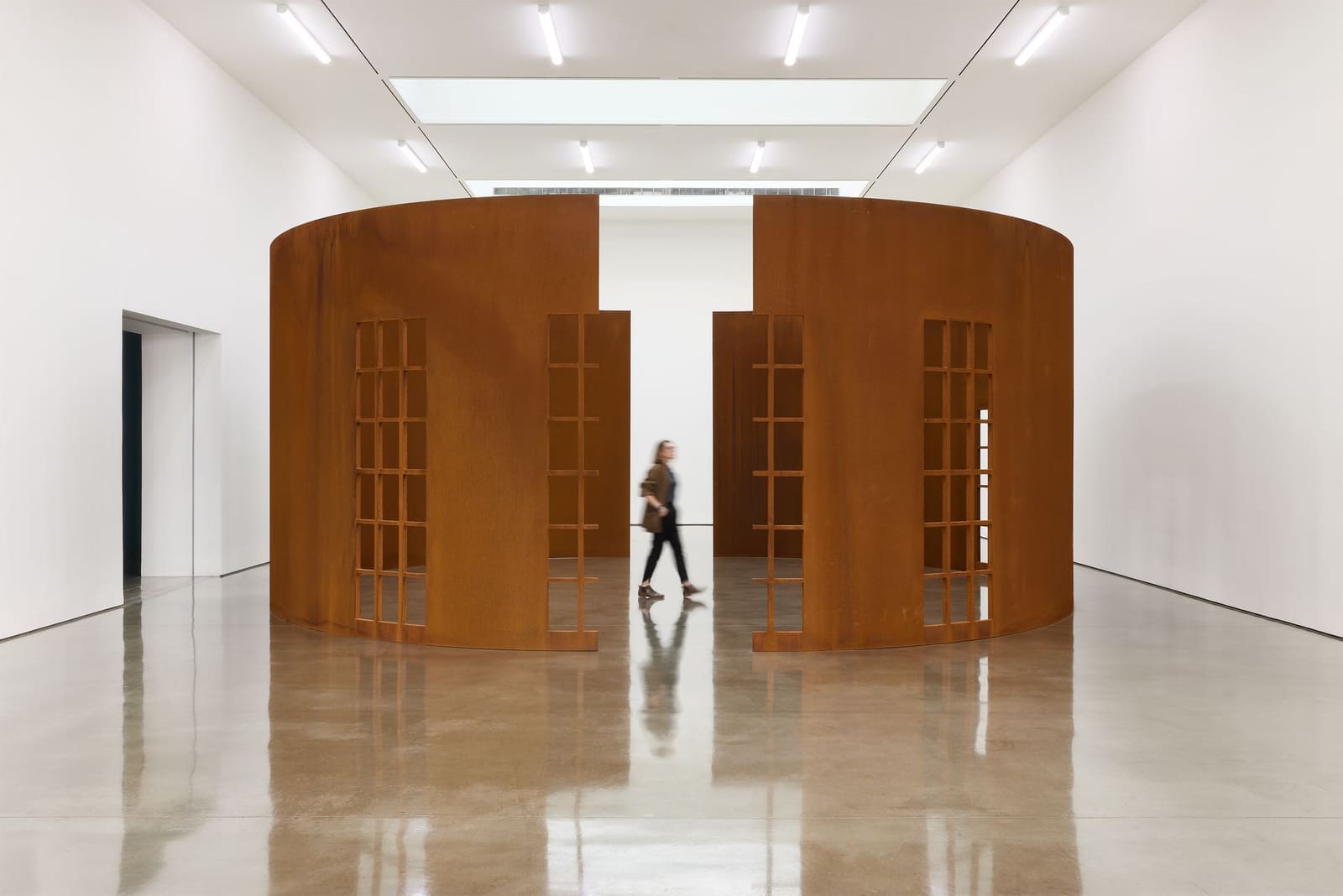
What happens when you remove every symbol of authority from the most photographed room in global politics and leave only its shape? This question drives 'TRANSITION', the latest exhibition by Elmgreen & Dragset at Pace Gallery, Manhattan, where a full-scale recreation of the Oval Office rendered in 36 tonnes of Cor-Ten steel invites visitors to walk through a space usually experienced only through screens.
The installation strips the room down to its essential geometry, a curved volume punctured by latticed openings where windows and doors would sit. No furnishings, no flags, no presidential seal. The result is an exercise in spatial subtraction that recalls Richard Serra's torqued ellipses whilst engaging directly with the architectural typology of executive power.
Fabricated in northern Germany by the same metalworkers who shape Serra's monumental forms, the two-part structure sits just below actual Oval Office dimensions. The apertures align precisely with the positions of the room's fenestration and entry points, creating a skeletal framework that maintains spatial legibility even as it negates decorative content.
Materiality as Temporal Record
Cor-Ten steel carries its own narrative. The self-weathering alloy develops a protective oxide layer that stabilises over time, a quality exploited by post-war sculptors and architects from Eero Saarinen to Maya Lin. Here, the choice does double duty: it connects the work to Minimalist precedent whilst introducing an element of unpredictability.
The variegated rust tones blooming across the curved surfaces were not planned. Transported by sea in an open crate, the steel absorbed salt spray and moisture, creating patterns that shift from amber to deep umber. This accidental patina transforms each panel into a record of its journey, a surface in constant flux that contrasts sharply with the static grandeur typically associated with presidential interiors.
The latticed openings echo Gordon Matta-Clark's subtractive interventions into architectural fabric, though where Matta-Clark carved through existing buildings to expose hidden volumes, Elmgreen & Dragset construct an absence. Walking through the installation means passing through the space where the Resolute desk would sit, standing where journalists cluster during press briefings. The structure is both monument and void, a negative cast of authority.
The Balcony as Architectural Apparatus
In an adjoining room, six large circular works from the Balcony Series examine another spatial typology of power. Each piece begins with a photograph of a head of state waving from an elevated balcony. The figure is then cut from the image and the photograph silkscreened onto mirror-polished stainless steel, creating a reflective void where the leader stood.
The architectural detail remains: ornate railings, classical mouldings, the façades that frame these moments of public address. One work shows the unmistakable ironwork of Buckingham Palace; another captures the neoclassical balustrade of Buenos Aires' Casa Rosada. The delicate rococo flourishes in a third suggest Amalienborg Palace in Copenhagen. But the human subjects have been excised, replaced by mirrored silhouettes that reflect the viewer's own face back at them.
Mounted at eye level, the works position the gallery visitor in the vacant space of authority. The effect is simultaneously playful and unsettling. The balcony, as architectural device, elevates and separates; it creates a vertical hierarchy between the figure above and the crowd below. By removing the figure, Elmgreen & Dragset foreground the structure itself as the true instrument of power.
Silence as Subject
One work occupies a wall alone: a White House balcony scene featuring two silhouettes, one human, one in an Easter bunny costume. The piece references a specific moment in American political theatre, but its inclusion carries darker resonance. For Elmgreen & Dragset, the costumed figure becomes a cipher for the Reagan administration's silence during the AIDS crisis of the 1980s, a period when official indifference allowed a public health emergency to escalate into catastrophe.
The work demonstrates how these mirror-polished surfaces function as adaptable screens. They absorb their surroundings, changing character depending on gallery conditions, adjacent works, even the clothing and posture of viewers. A piece hung opposite a window might flood with blue sky; another might capture the warm glow of interior lighting. This environmental responsiveness ensures that each installation of the series generates new readings.
Precedent and Context
Elmgreen & Dragset's practice has long interrogated the spatial politics of public and private architecture. Their 'Powerless Structures' series, initiated in 1997, includes inverted Prada storefronts in the Texas desert, a full-scale suburban home installed inside a Milanese palazzo, and a swimming pool recently installed at the Hirshhorn Museum in Washington, DC. Each project isolates a familiar architectural type and recontextualises it, exposing the social codes embedded in built form.
The Oval Office installation extends this methodology to a space that exists as much in the collective imagination as in physical reality. For most viewers, the room is known only through carefully staged photographs and televised addresses. Its dimensions, materiality, and spatial qualities remain abstract. By recreating it at near-actual scale but stripping away all ornament, Elmgreen & Dragset make the space legible in a new way. Visitors can measure it with their bodies, understand how small it actually is, recognise how camera angles and framing have shaped its perceived grandeur.
The choice of Cor-Ten steel also situates the work within a longer conversation about material honesty in architecture. The alloy's visible oxidation process aligns with Brutalist principles of truthful expression, where materials are allowed to age and weather rather than being sealed behind protective coatings. This stands in deliberate opposition to the gilded surfaces and applied ornament that have characterised certain recent iterations of the Oval Office interior.
Exhibition Mechanics
'TRANSITION' runs at Pace Gallery through 16 January 2027. The title carries obvious contemporary resonance, but the work resists easy didacticism. These are not protest pieces or partisan statements. Instead, they function as spatial and material studies that use the iconography of political power as raw material for formal investigation.
The exhibition's structure is straightforward: the large sculptural installation occupies the main gallery, whilst the Balcony Series populates a secondary space. This separation allows each body of work to operate on its own terms before the thematic connections emerge. The Cor-Ten oval is experiential, immersive, grounded in physical presence. The mirrored balconies are optical, reflective, dependent on the viewer's position and the gallery's ambient conditions.
Together, they propose that architecture does not merely house power but actively produces it. The curve of a wall, the height of a platform, the polish of a surface - each design decision reinforces or challenges existing hierarchies. By isolating these elements and presenting them as sculptural objects, Elmgreen & Dragset invite a closer examination of how space shapes authority and how form can be repurposed to question rather than reinforce institutional control.
Save this story. A free account keeps your reading list and the 07:00 email in one place.
CREATE FREE ACCOUNT →SIGN IN