A Tease That Finally Yields Form
When an automaker stretches its reveal cycle across nearly two years, the payoff needs to justify the patience. Jaguar has now released production-ready interior images of the Type 01, the electric GT slated for its New York debut in October 2026, and the cabin delivers something increasingly rare in contemporary automotive design: genuine spatial restraint.
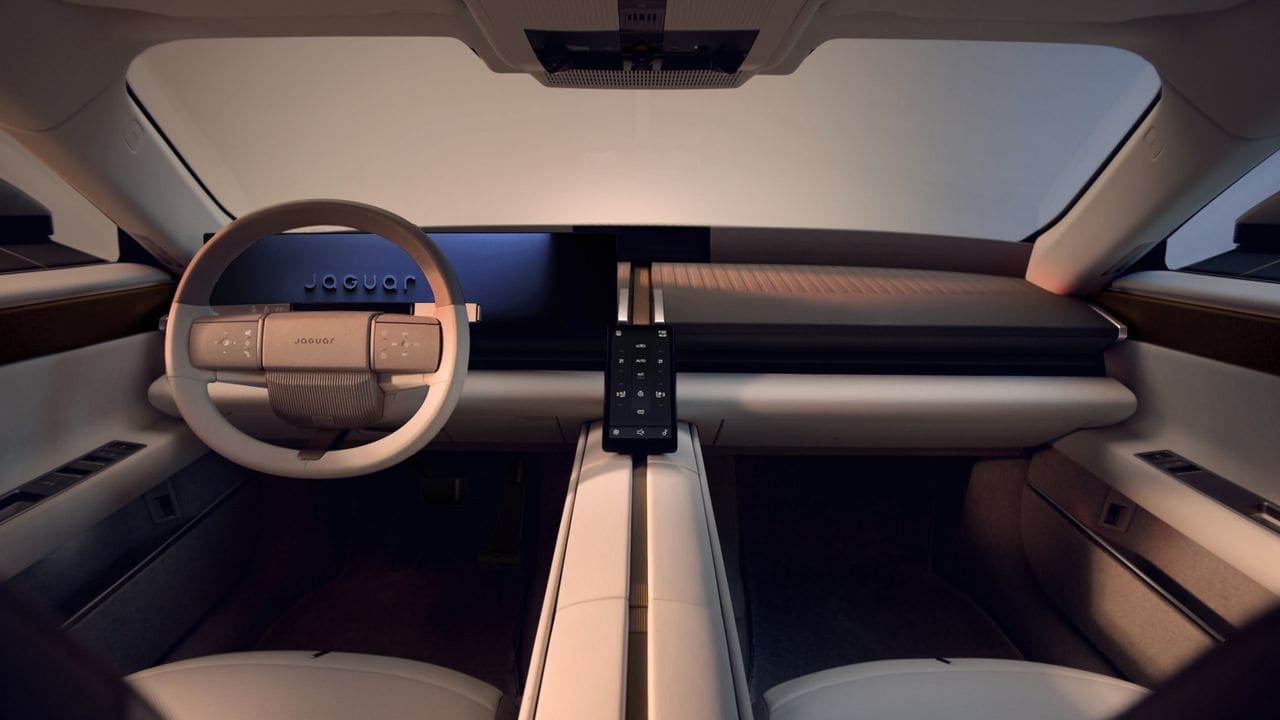
The interior revolves around a longitudinal spine that bisects the cabin into four distinct zones. This is not the vestigial transmission tunnel of combustion-era sedans, repurposed for cable routing and cupholders, but a deliberate architectural gesture rendered in a brass-inspired finish. It enforces a strict four-seat configuration and establishes hierarchy in a way that recalls the tectonic clarity of mid-1990s minimalism, when John Pawson and Claudio Silvestrin were carving out white-box sanctuaries for collectors and retailers.
Material Honesty, or the Illusion of It
The Type 00 Concept, the design study that preceded this production model, incorporated travertine, a sedimentary stone favored by mid-century architects for its warmth and texture. That material has disappeared from the Type 01's final specification. In its place, Jaguar has adopted what it describes as a palette reflecting the "enduring beauty" of masonry, without the masonry itself. The result is a cabin that gestures toward material authenticity while relying on composites, synthetics, and metal-effect finishes to evoke stone and brass.
This is a familiar tension in luxury automotive interiors: the desire to reference architecture's permanence within a product designed for obsolescence. Yet the Type 01's restraint, its refusal to pile on contrasting textures or over-stitch every surface, suggests a more disciplined approach than the typical maximalism of high-end EVs.
Thomas Holden, Jaguar's chief interior designer, frames the cabin as a counterpoint to the horizontal bias of most car interiors. The emphasis on longitudinal flow, he notes, mirrors the exterior's proportions and creates what he calls "unmistakable drama and theatre." The language is marketing-speak, but the execution appears to support it: long, unbroken surfaces, minimal control interfaces, and a glass roof that stretches the full length of the cabin.
Technology on Demand, Not on Display
One of the more intriguing decisions in the Type 01 is the near-total suppression of physical controls. A slender, smartphone-proportioned touchscreen sits in the center console, handling most interface tasks. The instrument cluster, still partially concealed, appears as a wide-angle screen behind a two-tone steering wheel. The digital rear-view mirror has been relocated to the base of the windscreen, rather than its conventional position above the driver's sightline.
This is "technology on demand," as Jaguar describes it, an approach that hides functionality until summoned. Storage compartments remain out of sight. The new Jaguar "Leaper" logo, unveiled in December 2024 as part of the brand's broader repositioning, appears on the door panels but does not dominate the interior vocabulary.
The dashboard itself picks up cues from the exterior's flanks, with edge details that echo the car's body surfacing. It is a subtle gesture, the kind of continuity that rewards close observation but does not announce itself.
Precedents in Minimalism
The Type 01's interior recalls a specific moment in design history: the late 1990s, when minimalism had migrated from art galleries into retail environments and private residences. Pawson's Calvin Klein flagship in New York, opened in 1995, established a template for luxury as absence, where spatial volume and material restraint became the ultimate signifiers of exclusivity. Silvestrin's work for Giorgio Armani and Anish Kapoor pursued a similar logic, stripping away ornament to foreground proportion, light, and texture.
Automotive interiors have periodically flirted with this aesthetic, but rarely with conviction. The temptation to fill every surface with stitching, ambient lighting, or faux craftsmanship usually wins out. Jaguar's approach here, whether it holds up under scrutiny in October, at least suggests a willingness to let space breathe.
There are risks, of course. Minimalism in architecture benefits from scale and permanence; a car cabin is neither spacious nor enduring. What reads as elegant restraint in a showroom can feel austere after 50,000 miles. The brass-toned spine, in particular, will age visibly, and the success of the interior may hinge on how well that patina is managed, or whether it becomes a maintenance liability.
The GT Driving Position and the Promise of Occasion
Jaguar's managing director, Rawdon Glover, positions the Type 01 as a car where "every journey is an occasion." The GT driving position, he notes, is confidence-inspiring, and the interior's drama is meant to match the car's dynamic character. The Type 01 has already been seen in camouflage at the Goodwood Festival of Speed earlier in 2026 and underwent cold-weather testing in the first half of the year. A wrapped prototype will appear at Monterey Car Week and the Pebble Beach Concours, alongside a retrospective of historic Jaguars.
This staging, the prolonged reveal, the curated glimpses, is deliberate brand theater. Jaguar is betting that a meticulous, architecture-forward interior will help distinguish the Type 01 in an increasingly crowded field of electric luxury sedans and GTs. Whether that bet pays off depends on execution, but the intent is legible: to design a cabin that feels less like a dashboard with seats and more like a room in motion.
What Remains to Be Seen
The instrumentation and interface details are still under wraps. How the touchscreen responds, how the digital mirror performs in varying light conditions, whether the concealed storage is genuinely useful or merely invisible, all of that awaits October's full reveal. The Type 01's success will also depend on factors beyond interior design: range, performance, pricing, and how well Jaguar's repositioned brand resonates with buyers who may not remember the marque's last great era.
But as a statement of intent, the Type 01's interior is coherent. It draws from a specific design lineage, applies it with discipline, and resists the urge to overcomplicate. In an industry that often mistakes complexity for luxury, that restraint is worth noting.
Save this story. A free account keeps your reading list and the 07:00 email in one place.
CREATE FREE ACCOUNT →SIGN IN