
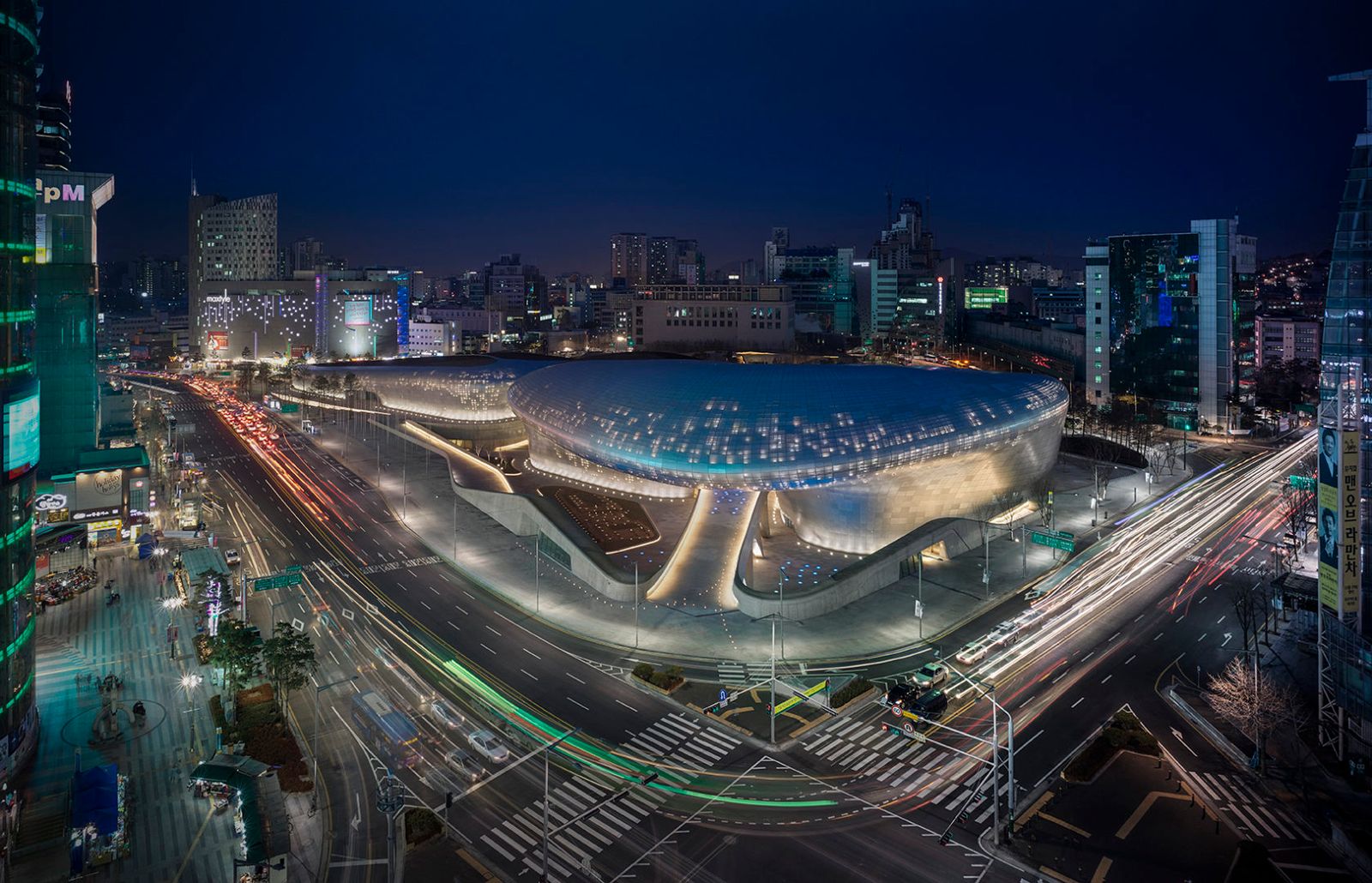
There are buildings that announce themselves immediately, and others that reveal their meaning only through movement and time. Dongdaemun Design Plaza (DDP) belongs to the latter. Rather than presenting a singular façade or a clearly defined threshold, it blurs the line between architecture and ground, between object and urban landscape.
Completed in 2014 and designed by Zaha Hadid, Dongdaemun Design Plaza has often been described as futuristic or iconic. Yet these descriptors only skim the surface. More critically, the project represents a shift in how cultural architecture can operate within a dense metropolis, using fluid spatial logic, advanced digital design processes, and material innovation to reshape public life rather than merely symbolize it.

A Building That Refuses the Object Mentality
DDP does not sit in Seoul like a monument, it flows through it. Unlike traditional civic landmarks that assert dominance through verticality or symmetry, this project dissolves architectural boundaries. Ramps replace stairs, roofs become walkable landscapes, and interiors unfold without a clear hierarchy.
This spatial strategy is not merely aesthetic. In a dense, fast-moving city like Seoul, where public space is often compressed or commercialized, DDP offers an alternative: a continuously accessible ground condition. People pass through it on the way to the subway, linger in shaded exterior pockets, or occupy it informally at night, often without consciously “entering” a building.
From a professional standpoint, this is one of DDP’s strongest achievements. It challenges the outdated notion that cultural architecture must be formally legible to be civic. Instead, it proves that ambiguity can be inclusive, encouraging participation without instruction.

Parametric Design as Urban Infrastructure
The parametric logic behind DDP is frequently misunderstood as formal excess. In reality, the geometry serves infrastructural and experiential purposes. The building’s curvature responds to pedestrian flows, sightlines, and programmatic layering rather than symbolic expression.
This approach allowed the design team to reconcile conflicting urban conditions: archaeological remains on site, adjacent markets, vehicular arteries, and massive public foot traffic. Parametric modeling made it possible to integrate these constraints into a continuous architectural system rather than a series of compromises.
For architects and urban designers, DDP offers clear proof that advanced computational tools can move beyond spectacle. When deployed responsibly, they become instruments of urban negotiation - capable of stitching together complexity instead of amplifying it.

Material Innovation Beyond the Surface
One of DDP’s most cited features is its skin: over 45,000 uniquely fabricated aluminum panels. While visually striking, their true significance lies in performance and production logic.
Each panel was digitally coordinated to manage curvature, weathering, and constructability at scale. The result is a surface that reads as seamless yet is deeply rational beneath the skin. This balance between visual continuity and fabrication intelligence marked an important shift in large-scale cultural projects in Asia, demonstrating that experimental form does not require material waste or technical opacity.
More importantly, the matte metallic surface reacts subtly to Seoul’s changing light conditions, reinforcing the idea that the building is never static. It absorbs the city’s rhythm rather than overpowering it.

A Platform for Creative Life, Not Just Design Culture
DDP’s success cannot be measured solely through architectural critique. Its real impact is cultural. Fashion shows, exhibitions, night markets, student gatherings, design fairs - these events coexist without privileging one creative discipline over another.
This flexibility was embedded in the spatial planning from the start. Large column-free halls, adaptable circulation, and layered public zones allow the building to evolve with Seoul’s creative economy rather than fossilize around a single program.
From my perspective, this is where Hadid’s vision proves most prescient. DDP does not dictate how creativity should look; it simply provides the conditions for it to emerge, collide, and reinvent itself.

What DDP Teaches Us Today
More than ten years on, Dongdaemun Design Plaza remains a critical reference point, not because of its form, but because of its urban intelligence. It teaches us that:
+ Public space can be fluid without becoming confusing
+ Parametric design can serve social behavior, not just geometry
+ Advanced materials can be expressive and efficient
+ Iconic architecture can remain open-ended rather than authoritarian
In an era when cities are racing to brand themselves through spectacle, DDP offers a quieter, more enduring lesson: architecture shapes identity most powerfully when it invites people to move, gather, and belong, without asking them to admire it first. That, perhaps, is its most radical achievement.
Save this story. A free account keeps your reading list and the 07:00 email in one place.
CREATE FREE ACCOUNT →SIGN IN