
The Portable Studio
Geography, for a growing cohort of designers, functions less as birthplace than as layered inheritance. The question is not where you are from, but what you carry with you: language, material memory, the cadence of a grandmother's folktale. At World Archi Design, we've been tracking a shift in how American studios articulate identity. Rather than assimilating into a monolithic design language, practitioners are mining their dual heritage for formal vocabularies that feel both ancient and urgent.
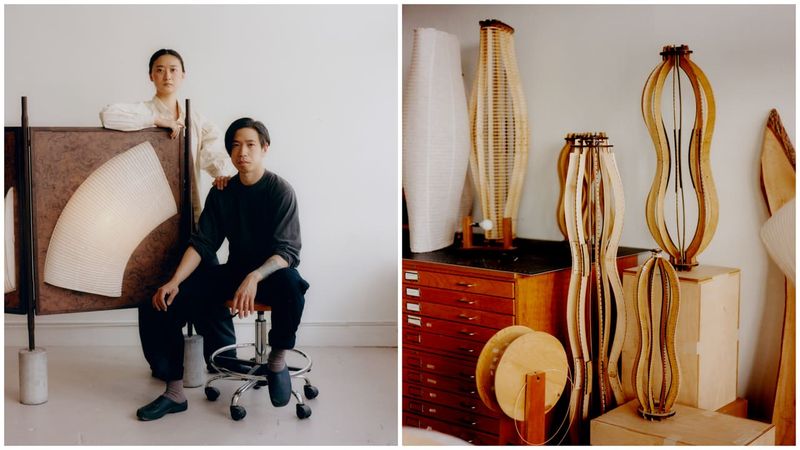
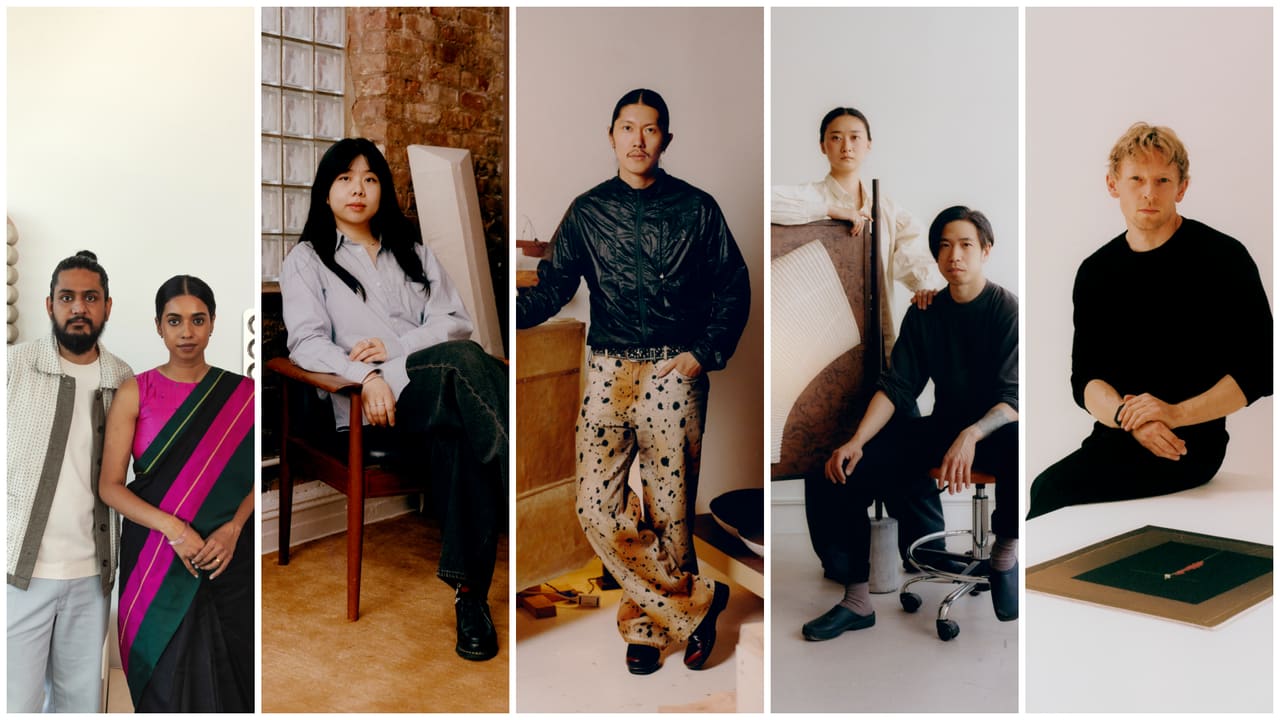
Consider the lantern. In Chinese folklore, it is a talisman that guides ancestral spirits and wards off misfortune. In the United States, it often appears in a single iteration: symmetrical, red or white, mass-produced for restaurant décor. Aaron and Irisa Chan-Kawabi, the husband-and-wife team behind New York studio Kawabi, noticed this flattening. Irisa was born in China and raised in Massachusetts; Aaron grew up in Brooklyn, the son of Hong Kong emigrants. They began asking: What would a lantern that represented their experience look like? The question became a design brief, and eventually, a studio ethos.
Their work exemplifies a broader phenomenon. Across the projects we've covered this year, from furniture to lighting to textiles, designers with transnational biographies are treating cultural typologies not as fixed artifacts but as raw material for reinterpretation. The result is a body of work that refuses easy categorization, sitting somewhere between craft revivalism and speculative design.
Soft Geometry: A Practice Built on Contrast
Utharaa Zacharias and Palaash Chaudhary, the duo behind Soft Geometry, met in Delhi and reconnected at the Savannah College of Art and Design in Georgia. Their partnership is itself a study in synthesis. Zacharias hails from Kochi, Kerala; Chaudhary from Ghaziabad, near Delhi. As Zacharias notes, it would be difficult to choose two regions more diametrically opposite within India. Different languages, different cuisines, different religious traditions. Yet their collaborative work revealed a shared formal sensibility, one that privileges curves over hard edges, warmth over industrial precision.
The studio name emerged from a brainstorming session, scribbled in a notebook: together, they made "soft geometries." The phrase captures their approach to form, which draws on Indian craft traditions, particularly textile patterns and temple architecture, but translates them into furniture and lighting with a decidedly contemporary massing. Their pieces often feature rounded profiles and tactile surfaces, materials that invite touch rather than simply visual consumption. It is design that resists the cold minimalism that has dominated American interiors for the past two decades.
What makes Soft Geometry compelling is not nostalgia but a willingness to let two distinct cultural vocabularies collide and produce something neither predictable nor purely derivative. The work does not announce its Indianness through literal motifs. Instead, it embeds a particular understanding of proportion, color, and materiality, one learned in Delhi and Kochi but articulated in a studio thousands of miles away.
Dominik Tarabański: Still Life as Constructed Reality
Dominik Tarabański was born in Radymno, a small Polish town near the Ukrainian border, and studied photography in Łódź and Warsaw. A three-week visit to New York in 2012 changed his trajectory. He describes the decision to relocate as akin to going to the moon: sudden, irrevocable, driven by instinct rather than calculation.
In New York, fashion photography paid the rent and took him between cities. But the work that mattered happened away from crowded sets. Tarabański began making large-format still lifes by hand, contorting living matter into arrangements as deliberately impossible as a Dutch Golden Age flower painting. A rubber band and a dried stem become the raw material for what he calls "a kind of magic: nothing becomes something."
His process sits at the intersection of the synthetic and the organic, a tension he identifies as foundational to his practice. He photographs these assemblages at the fleeting moment before they collapse, capturing a precarious balance between control and entropy. The finished prints are monumental, often exceeding two meters in height, and hold the wall with the presence of sculpture. They demand slow looking, a quality increasingly rare in an image-saturated culture.
Tarabański's work can be read as a commentary on migration itself: the act of taking disparate elements, holding them together through sheer force of will, and creating something that did not exist before. The arrangements are temporary, the materials humble, but the resulting image is permanent, beautiful, and strange.
Vy Voi: Vietnamese Craft as Living Archive
Steffany Tran, the Vietnamese-American founder of Vy Voi, grew up between San José, California, and Saigon, where she spent summers with extended family. After studying industrial design in the Bay Area, she moved to New York and worked in traditional firms. The pace was relentless, the briefs problem-solving exercises with little room for material exploration. She took up ceramics at a community center as a creative outlet, and eventually realized she wanted to dedicate her practice entirely to handmade objects inspired by Vietnamese craft.
Tran describes her approach as using a metal detector to find nuggets in history. Her parents are both refugees, and she grew up acutely aware of what had been lost in translation, the material culture that did not make it onto the boat. Vietnamese ceramics, lacquerware, and textile traditions were largely absent from contemporary design discourse in the United States. Tran's response was pragmatic: if you cannot find it, build it yourself.
Her objects are not reproductions but interpretations. She studies traditional Vietnamese techniques, particularly the use of lacquer and bamboo, and translates them into forms that fit contemporary interiors. A vase might reference the silhouette of a traditional water vessel but employ a color palette drawn from mid-century modernism. The result is work that feels both familiar and entirely new, a visual language that honors its sources without being constrained by them.
Tran's practice raises a question relevant to any designer working with cultural heritage: How do you honor tradition without replicating it? Her answer lies in the hand. Each piece is made slowly, with attention to the grain of the material and the rhythm of the process. The work is not about efficiency or scalability. It is about keeping a conversation alive.
Minjae Kim: Remaking the Canon
Minjae Kim was born in Seoul and first encountered the United States during a high school exchange. After studying painting and architecture, and completing mandatory military service in South Korea, he traveled to Seattle in 2008 to continue his studies. He later earned a Master of Architecture from Columbia University and spent three years at Studio Giancarlo Valle before launching his own practice from a basement apartment during the pandemic.
Kim's debut exhibition in 2021 at Marta, a Los Angeles design gallery, catalogued Western typologies. One piece adapted a chair from Sigmund Freud's personal study. These were objects that felt foreign to Kim's understanding of the world, and he made them his by remaking them. In one series, he treated fibreglass like cloth, quilting it before coating it with resin. The material became both structural and textile, rigid and soft, industrial and handmade.
His work is an act of translation in the most literal sense. He takes a canonical object from Western design history and subjects it to a process informed by Korean craft traditions, particularly the quilting techniques used in bojagi, traditional wrapping cloths. The result is uncanny: familiar forms rendered strange, Western design history filtered through an Eastern sensibility.
Kim's practice suggests that the canon is not fixed but porous, open to reinterpretation by anyone willing to engage with it critically. His work does not reject the Western tradition; it absorbs it, transforms it, and offers it back as something new.
Kawabi: The Lantern Reconsidered
The lantern project at Kawabi began as a simple observation: Why did Chinese lanterns in the United States always look the same? Aaron and Irisa Chan-Kawabi saw the question as emblematic of a larger issue. How does a typology move from one culture to another? What gets lost, and what gets amplified?
Their response was to design lanterns that reflected their own diasporic experience. The forms are asymmetrical, the materials unexpected. Some incorporate steel mesh rather than paper, others use LED strips instead of candles. The symbolism remains: light as guide, as protection, as invitation. But the formal language is entirely their own.
The Chan-Kawabis are interested in what happens when an object is unmoored from its original context. Does it lose meaning, or does it gain the freedom to signify differently? Their work suggests the latter. The lanterns they create are not less Chinese for being made in Brooklyn. They are simply Chinese in a different key, shaped by a different set of experiences and constraints.
A New Vernacular
What unites these five studios is not a shared aesthetic but a shared method: the deliberate excavation of cultural memory and its translation into contemporary form. They are not revivalists. They do not seek to recreate the past. Instead, they treat heritage as a live wire, something that can be picked up, rerouted, and made to power new circuits.
This approach has precedents. At World Archi Design, we often cite the work of Charles and Ray Eames, who drew on Japanese craft traditions, or Eileen Gray, whose lacquerwork was informed by East Asian techniques. But the current generation is operating in a different context. They are not borrowing; they are reclaiming. The difference matters.
The work emerging from these studios suggests that American design is not a singular tradition but a confluence. It has always been shaped by migration, by the collision of disparate vocabularies, by the willingness to see the familiar made strange. What is new is the confidence with which designers are asserting their right to reshape the canon, to insist that their stories belong in the archive.
The question, then, is not whether these designers are American. They are. The question is what American design becomes when it makes room for all the voices that have always been here, waiting to be heard.
Save this story. A free account keeps your reading list and the 07:00 email in one place.
CREATE FREE ACCOUNT →SIGN IN