
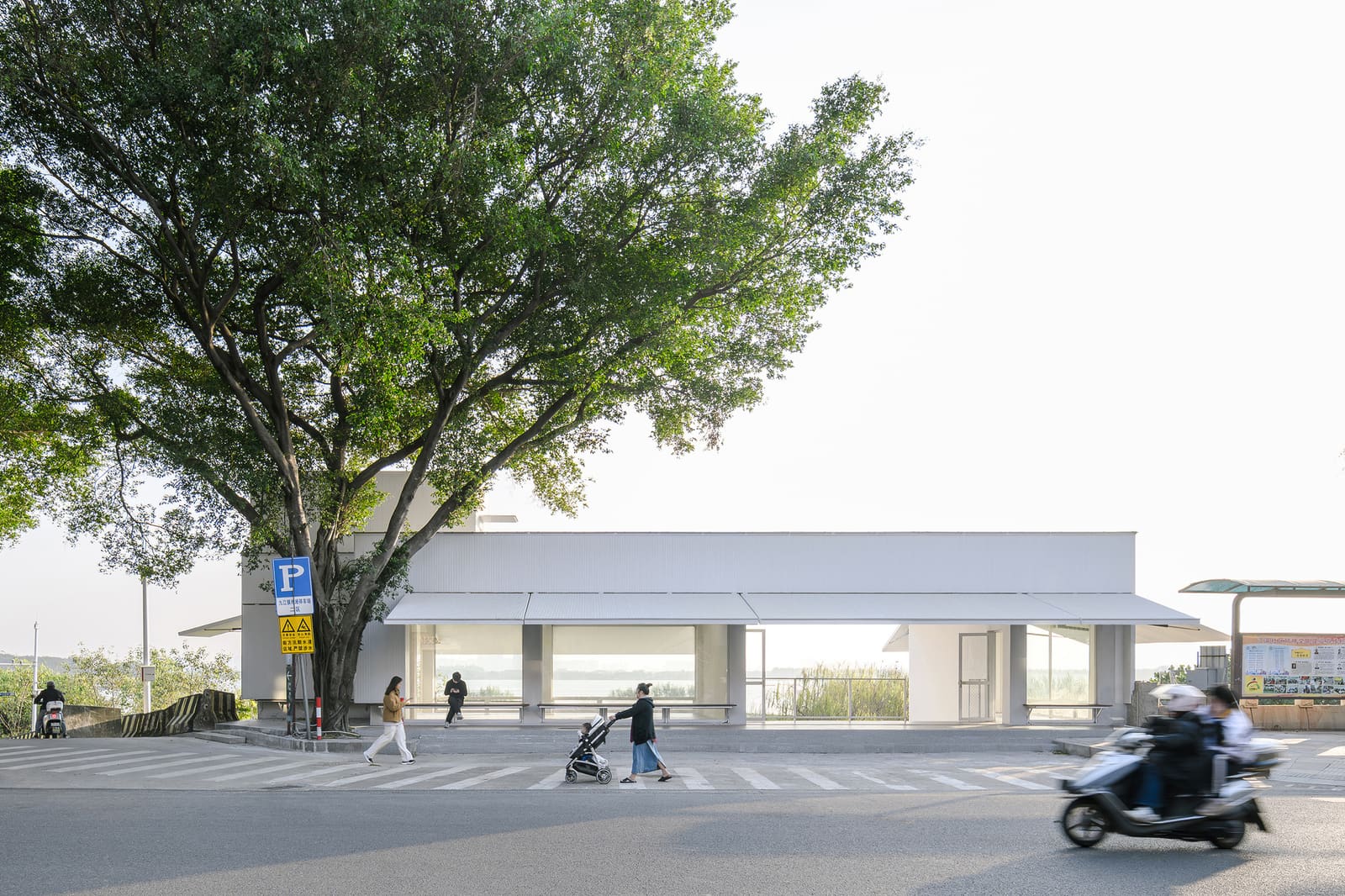
A Skeleton on the Xijiang River
Infrastructure rarely dies quietly. The ferry terminal on the Xijiang River in Jiujiang Town, Foshan, ceased operations when a replacement facility opened nearby, leaving behind a concrete frame and a pier that led to nothing. For years the structure sat at the edge of a wetland park, its steps descending toward water, its function erased. TURTLEHILL DESIGN saw in that obsolescence a different kind of potential: not restoration, but re-inhabitation.
The completed project, occupying 216 square metres, accommodates a bookstore, exhibition hall, café, and flexible space for cultural events and performance. That density of programme within such a modest footprint demanded a forensic approach to circulation, envelope, and threshold. The terminal's original concrete skeleton provided the tectonic datum; the design built inward and upward from that frame, layering new spatial logics onto the old.
Adaptive Reuse in a Transitional Landscape
The site occupies a hinge condition between wetland ecology and residential fabric. On one side, the park; on the other, low-rise housing. The design responds to both adjacencies without privileging either. Large openings frame views toward the river and the wetland, while smaller apertures modulate privacy along the residential edge. The envelope mediates rather than isolates, acknowledging the terminal's role as both ecological threshold and community amenity.
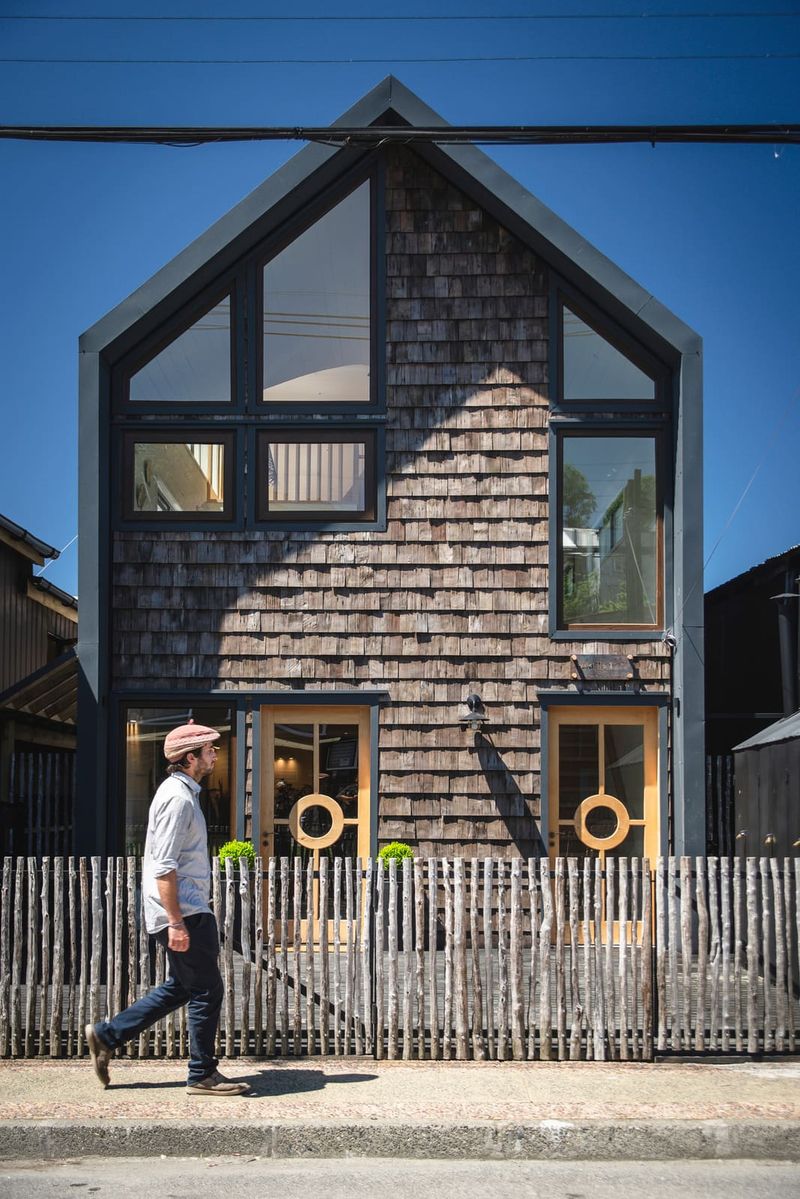
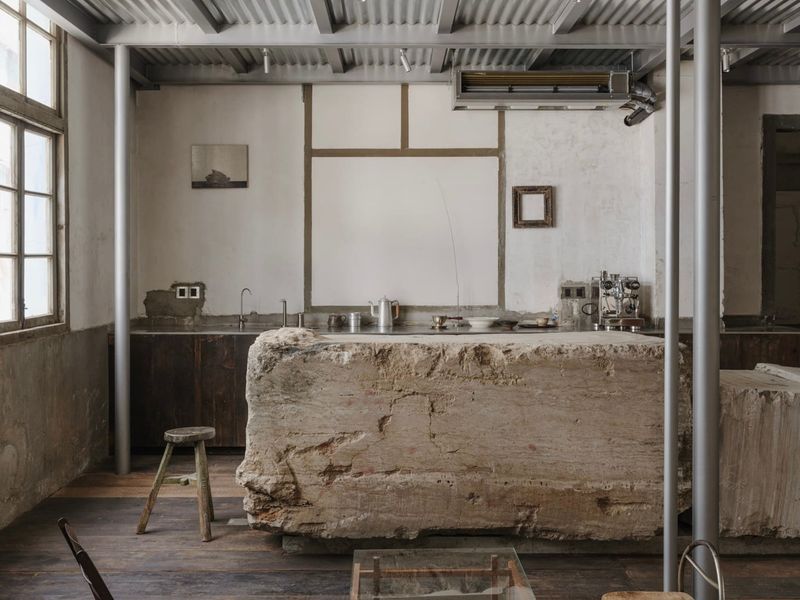
Material choices reflect this dual mandate. The concrete skeleton remains exposed, a legible record of the building's previous life. New insertions, timber cladding and steel framing, read as distinct interventions. The distinction is deliberate: the project does not attempt to erase its own history or pretend continuity where none exists. Instead, it foregrounds the act of transformation, making visible the gap between what was and what is.
Programme and Proportion
The challenge of housing multiple functions within 150 square metres of usable floor area drove the spatial strategy. Vertical stacking and overlapping zones replace conventional partitioning. The bookstore occupies the ground level, its shelving integrated into structural walls. Above, a mezzanine houses the café, its seating cantilevered to preserve sightlines. Exhibition space flows through both levels, with flexible display systems that can be reconfigured for different events.
Circulation is compressed but legible. A single stair connects the two floors, its treads cantilevered from the existing concrete core. The stair doubles as seating during performances, an economy of means that typifies the project's pragmatic ethos. Every surface performs multiple roles; nothing is purely decorative.
This density of function recalls earlier experiments in compact cultural infrastructure, notably Sou Fujimoto's House NA in Tokyo, where programme is distributed vertically across a minimal footprint. Yet where Fujimoto's project dissolves boundaries, TURTLEHILL DESIGN maintains clear thresholds between activities, recognising the need for acoustic and visual separation in a public context.
Climate and Construction
The Pearl River Delta's humid subtropical climate informed envelope design. Deep overhangs shade glazing during summer months, reducing solar gain. Operable panels allow cross-ventilation, critical in a region where mechanical cooling can dominate energy use. The design prioritises passive strategies, a necessity given the building's exposed riverside location and limited budget.
Construction employed local trades and materials. Timber cladding, sourced from regional suppliers, weathers naturally and requires minimal maintenance. Steel framing, fabricated off-site and bolted into place, accelerated the build programme and reduced on-site waste. The approach is vernacular in spirit if not in form, drawing on regional construction knowledge without resorting to pastiche.
Industrial Memory and Public Space
Jiujiang Town's economy historically centred on river transport and light industry. The ferry terminal was part of that network, a node in a system that connected villages and markets across the delta. Its abandonment reflects broader shifts: road infrastructure supplanting waterways, urbanisation eroding older patterns of movement. The renovation does not attempt to reverse those changes but instead proposes a new relationship to the site's industrial past.
The building functions as both archive and amenity. Exhibition space hosts displays on local maritime history, while the bookstore stocks texts on regional ecology and urban development. The café, oriented toward the river, invites contemplation of the landscape the terminal once served. The project asks visitors to see the structure not as ruin but as palimpsest, a surface on which multiple histories are inscribed.
This approach distinguishes the project from more nostalgic adaptive-reuse schemes. Rather than freezing the terminal in a romanticised past, TURTLEHILL DESIGN accepts its obsolescence and builds forward from that condition. The result is a building that acknowledges its origins without being constrained by them.
Threshold and Use
Since opening in 2025, the complex has drawn both residents and visitors, its programme evolving in response to user patterns. The bookstore hosts readings; the café, informal gatherings; the exhibition space, rotating installations by regional artists. The flexibility embedded in the design allows these uses to coexist and shift, a necessary adaptability for a small public building serving diverse constituencies.
The project's success lies not in formal innovation but in the clarity of its proposition: that a modest structure, carefully reconfigured, can sustain multiple publics and multiple temporalities. It demonstrates that adaptive reuse need not be monumental to be effective, and that industrial infrastructure can be re-inhabited without erasure or sentimentality. The terminal's second life is quieter than its first, but no less vital.
Save this story. A free account keeps your reading list and the 07:00 email in one place.
CREATE FREE ACCOUNT →SIGN IN