
Project Info
Project Name: Orient Express La Minerva
Location: Rome, Italy
Architect: Hugo Toro
In the heart of Rome, where centuries fold seamlessly into one another, an icon of travel has found a new form. With the opening of Orient Express La Minerva, the legendary rail brand steps off the tracks and into architecture, translating its storied legacy into a destination that is as much about arrival as it is about journey.
A Palace Reawakened
Set within a 17th-century palazzo overlooking Piazza della Minerva, just steps from the Pantheon, the hotel occupies a site layered with history. Once known as Palazzo Fonseca, the building has welcomed travelers since the early 19th century, hosting writers and intellectuals during the era of the Grand Tour.
Today, following an extensive restoration, it reopens as the first hotel under the Orient Express brand - a milestone that signals a broader evolution from rail legend to immersive hospitality experience.
The property comprises 93 rooms and 36 suites, each uniquely configured within the irregular geometry of the historic structure, reinforcing a sense of individuality rarely found in contemporary luxury hotels.

Designing a Journey, Not Just a Stay
Entrusted with shaping this new chapter, architect and designer Hugo Toro approached the project as a narrative rather than a renovation. His vision draws from the romance of early 20th-century travel while remaining deeply rooted in Rome’s tactile, sun-warmed materiality.
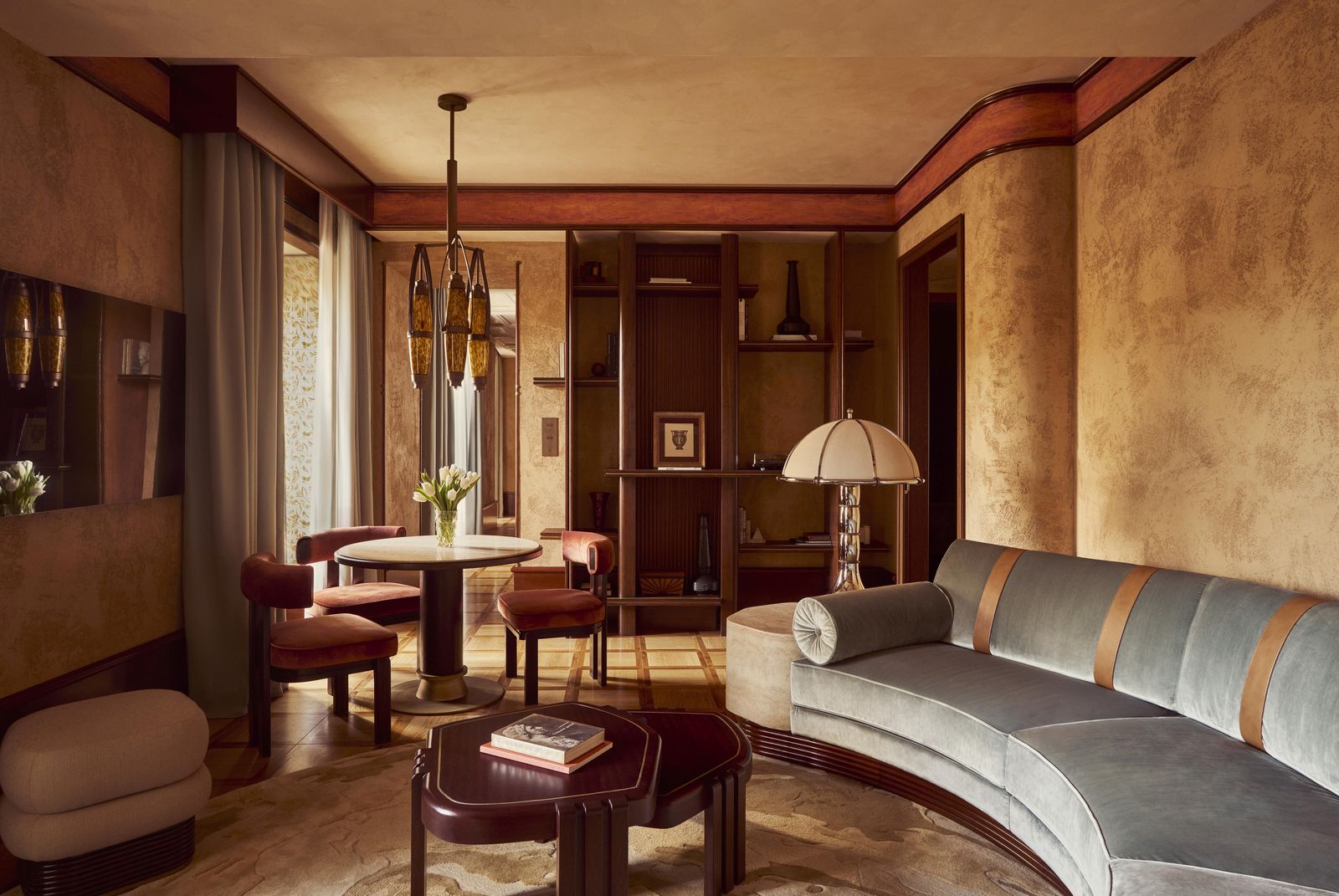
Art Deco influences thread through the interiors - curved forms, polished woods, and subtle metallic accents - yet they are softened by Roman textures: mineral plasters, marble, and a palette inspired by the city’s ochres and terracottas.
Nearly every element has been custom-designed, from hand-painted headboards that echo the Roman sky to bespoke furnishings inspired by vintage steamer trunks - a quiet nod to the golden age of train travel.
Rather than imposing uniformity, Toro embraces variation. No two rooms are alike, allowing guests to experience the building as a sequence of distinct spatial encounters, much like compartments along a train journey.


Between Heritage and Imagination
The design narrative unfolds through a careful balance of preservation and reinterpretation. Original features - 17th-century floors, sculptural details, and classical references - are not merely restored but woven into a contemporary composition.
In the suites, this dialogue becomes more pronounced. Vaulted ceilings with frescoes meet Rosso Verona marble bathrooms; sculptural elements echo Rome’s fountains and monuments; and panoramic views extend toward Bernini’s elephant sculpture in the piazza below.
The result is not nostalgia, but continuity - a layered aesthetic that mirrors the city itself.


The Hotel as a Cultural Threshold
Beyond the guestrooms, the hotel positions itself as a gateway to Rome’s cultural fabric. A glass-roofed lounge anchors the interior, while the rooftop restaurant and bar offer sweeping views across the historic skyline, transforming dining into a spatial experience.
Here, the ethos of the Orient Express - slow, sensory, and deeply experiential - translates into architecture. Guests are encouraged not simply to stay, but to inhabit the rhythms of the city, moving between interior intimacy and urban spectacle.

A New Chapter for an Icon
Since its inception in 1883, Orient Express has symbolized a certain idea of travel: elegant, immersive, and narrative-driven. With La Minerva, that philosophy finds a permanent address.
More than a hotel, it is the first step in a broader reinvention that expands the brand into a constellation of experiences, from trains to hotels and beyond.
Yet in Rome, the concept feels particularly resonant. A city built on layers of time becomes the perfect setting for a brand rooted in journeys, memory, and reinvention.
At Orient Express La Minerva, the destination is no longer the end of the journey, it is the journey itself.
Save this story. A free account keeps your reading list and the 07:00 email in one place.
CREATE FREE ACCOUNT →SIGN IN