
A Fixture We Love to Loathe
Walk through any major city and you will encounter them: skeletal corridors of metal posts and plywood panels, shadowing sidewalks and storefronts for months or years at a time. Sidewalk sheds occupy a peculiar place in the urban imagination - simultaneously essential and reviled, protective and oppressive. They are the built environment's most visible admission of imperfection, monuments to the fact that buildings age, facades crumble, and cities perpetually repair themselves.
At World Archi Design, we've observed how these temporary structures have become flashpoints in broader conversations about civic design, safety regulation, and who holds responsibility for the quality of public space. The consensus is rare but nearly universal: no one likes sidewalk sheds. Mayors across political eras have condemned them. Pedestrians duck under their low ceilings and navigate their dim passages with resignation. Architects and urban designers see them as blight, a surrender to expediency that transforms vibrant streetscapes into claustrophobic tunnels.
Yet their persistence suggests something more complex than simple negligence. Sidewalk sheds exist at the intersection of liability, building codes, and economic realities. They protect passersby from falling debris during facade inspections and repairs - a legitimate safety concern that no city can ignore. The problem is not their function but their form, and the fact that form has remained essentially unchanged for decades.
The Anatomy of Ubiquity
The typical sidewalk shed follows a standardized template: vertical steel pipes, horizontal cross-bracing, and plywood decking overhead. The materials are inexpensive, the assembly rapid, the engineering straightforward. Contractors favor them because they meet code requirements at minimal cost. Building owners tolerate them because they fulfill legal obligations without requiring custom solutions. The sheds are meant to be temporary, but "temporary" in this context can stretch across multiple seasons or even years, depending on the scope of work and the urgency with which owners address facade issues.
This longevity transforms the shed from a momentary inconvenience into a semi-permanent feature of the streetscape. Retail tenants suffer reduced visibility and foot traffic. Trees lose sunlight. The public realm becomes fragmented, a patchwork of covered and uncovered zones that disrupt the rhythm of the sidewalk. The sheds also accumulate grime, graffiti, and the general wear that comes with extended exposure to weather and urban life.
From a design perspective, the sidewalk shed represents a failure of imagination as much as a failure of aesthetics. It is a one-size-fits-all response to a condition that varies widely by building type, neighborhood character, and duration of use. A historic brownstone undergoing facade restoration has different needs than a glass-curtain-wall office tower, yet both receive the same blunt instrument.
Precedents and Parallel Efforts
Other cities have grappled with similar challenges, though not always with more success. In London, scaffolding is often wrapped in printed mesh that advertises the project or displays imagery of the building itself - a cosmetic intervention that at least acknowledges the visual impact. In Paris, regulations push for quicker turnaround times on facade work, reducing the duration of obstruction. In Tokyo, construction hoarding frequently incorporates lighting and signage, integrating the temporary structure into the commercial fabric of the street.
None of these approaches solves the underlying tension between safety and aesthetics, but they signal a willingness to treat the sidewalk shed as a design problem rather than an unavoidable nuisance. The question is whether such interventions can be scaled and standardized without losing the flexibility that makes them effective.
We have seen isolated attempts in North American cities to rethink the shed. Some involve modular systems with cleaner lines and better lighting. Others propose cantilevered canopies that reduce the footprint on the sidewalk. A few explore translucent materials that preserve sightlines and admit daylight. These experiments remain exceptions, however, constrained by cost, code inertia, and the fact that building owners have little incentive to invest in a structure they hope to dismantle as quickly as possible.
The Regulatory Bind
Part of the challenge lies in the regulatory framework itself. Building codes prioritize safety and structural performance, as they should, but they offer little guidance on aesthetic quality or pedestrian experience. Permits are granted based on engineering drawings and compliance with load requirements, not on how the shed will affect street life or whether it integrates with the surrounding architecture.
This creates a race to the bottom. Contractors compete on price, and the cheapest compliant solution wins. There is no mechanism to reward better design, no fast-track approval for sheds that exceed minimum standards, no public recognition for building owners who choose higher-quality installations. The result is a landscape of lowest-common-denominator structures that meet the letter of the law while undermining the spirit of urbanism.
Changing this dynamic would require a shift in how cities think about temporary structures. Instead of treating them as exceptions to normal design oversight, they could be recognized as significant contributors to the public realm - perhaps even subject to review in historic districts or along high-visibility corridors. Alternatively, cities could develop pre-approved prototype designs that balance cost, safety, and aesthetics, offering building owners a menu of options rather than forcing them to start from scratch.
The Economics of Improvement
Cost is the most common objection to better sidewalk sheds. Building owners, already facing the expense of facade repairs, are reluctant to spend more on the protective structure. Contractors operate on thin margins and resist anything that complicates fabrication or installation. From this perspective, the existing system works precisely because it is cheap and predictable.
Yet the broader economic impact of sidewalk sheds is rarely accounted for. Retail vacancies, reduced property values, and diminished neighborhood appeal all carry costs, even if they do not appear on a contractor's invoice. A well-designed shed that preserves storefront visibility and pedestrian comfort might justify a modest premium if it protects commercial activity and maintains the character of the street.
There is also the question of duration. If a better shed encourages building owners to complete facade work more quickly - by reducing tenant complaints or neighborhood pressure - the incremental cost could be offset by shorter rental periods. Conversely, if the shed is likely to remain in place for years, the investment in quality materials and thoughtful design becomes easier to justify.
Toward a New Typology
What would a truly successful sidewalk shed look like? It would begin with the recognition that not all sheds are the same. A structure intended for a six-month project should differ from one expected to last three years. A shed in a dense commercial district should respond to different priorities than one in a residential neighborhood. Flexibility and context-sensitivity should replace the current one-size-fits-all approach.
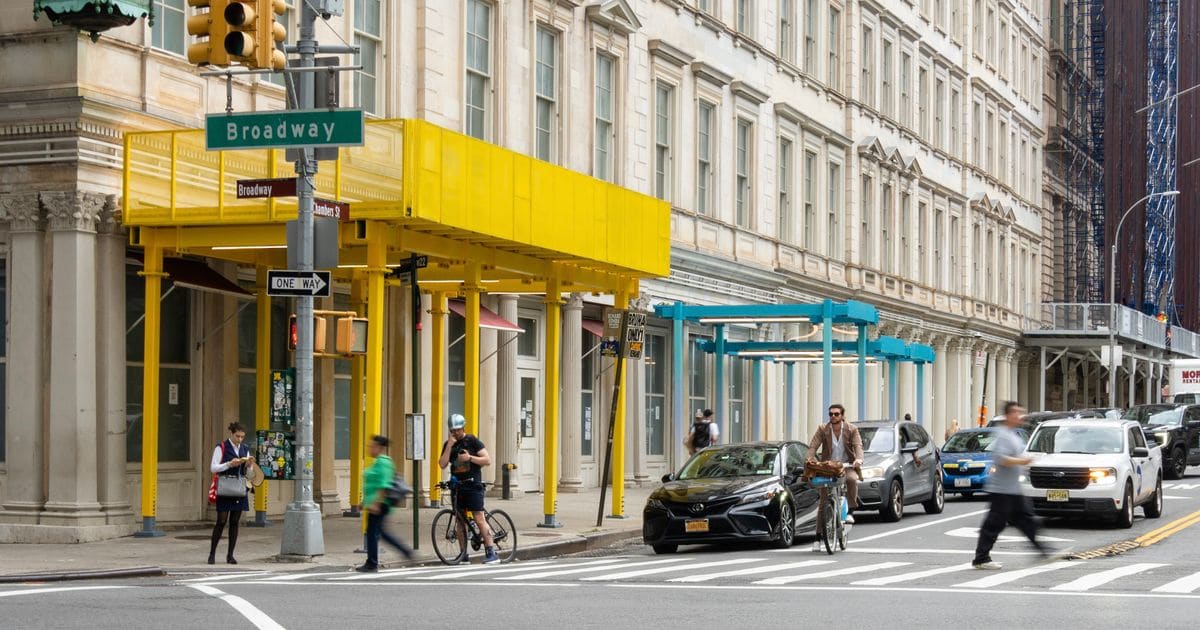
Materials matter. Translucent panels instead of opaque plywood could preserve daylight and sightlines. Powder-coated steel instead of raw metal could reduce the visual harshness. Integrated lighting could improve safety and ambiance, transforming the shed from an obstacle into a feature. Modular systems could allow for easier customization and faster installation, reducing both cost and disruption.
Design matters, too. The shed should be conceived not as a freestanding object but as an extension of the building and the street. Its proportions, detailing, and finish should acknowledge the architectural context. In a historic district, that might mean materials and colors that harmonize with masonry and cast iron. In a contemporary commercial corridor, it might mean sleek profiles and backlit signage.
Perhaps most importantly, the sidewalk shed should be understood as a communication device. It tells pedestrians that work is underway, that the building is being maintained, that someone cares. A poorly designed shed communicates neglect; a thoughtful one signals stewardship. This distinction is subtle but meaningful, particularly in neighborhoods where public confidence in building owners and city oversight is fragile.
The Role of Design Advocacy
Shifting the paradigm will require more than good intentions. It will demand collaboration among architects, engineers, fabricators, building owners, city officials, and community groups. Design competitions could generate new prototypes and raise public awareness. Pilot programs could test alternative systems in real-world conditions. Policy reforms could create incentives for better sheds and streamline approval processes.
Professional organizations - the American Institute of Architects, the Urban Design Forum, local design advocacy groups - have a role to play in framing the sidewalk shed as a legitimate design challenge rather than an irritant to be tolerated. By treating it as a problem worthy of serious attention, they can help build the case for investment and innovation.
Cities, for their part, can signal that quality matters. Publishing design guidelines, highlighting exemplary installations, and incorporating shed design into broader streetscape initiatives would all send a message that temporary structures are not exempt from urban design standards. Even small gestures - requiring better lighting, mandating regular cleaning, setting maximum durations - can begin to shift expectations.
Conclusion
The sidewalk shed will not disappear. As long as buildings age and cities enforce safety codes, some form of protective structure will be necessary. The question is whether we continue to accept the current model - cheap, ugly, and ubiquitous - or whether we recognize the shed as an opportunity to demonstrate that even the most utilitarian elements of the built environment can be designed with care.
At World Archi Design, we believe the latter is both possible and necessary. The sidewalk shed is a test case for how cities balance regulation and aesthetics, safety and experience, cost and quality. It is also a reminder that good design is not a luxury reserved for permanent buildings but a responsibility that extends to every element of the public realm, no matter how temporary.
Save this story. A free account keeps your reading list and the 07:00 email in one place.
CREATE FREE ACCOUNT →SIGN IN