
A Precedent for Mixed-Use Integration
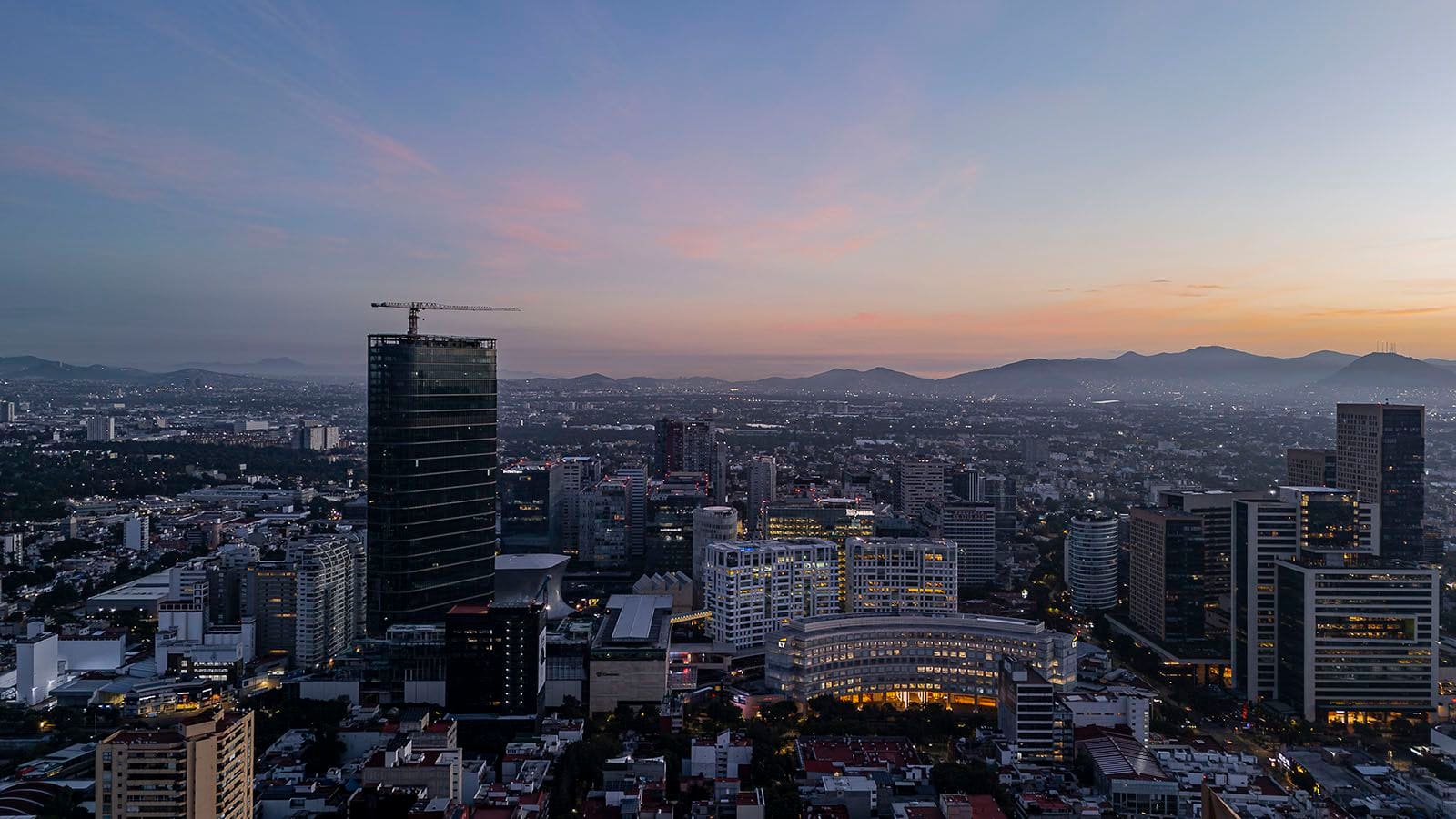
Antara has been drawing 12 million visitors annually to Mexico City's Colonia Granada for over two decades as the area's first open-air retail hub. Yet the project, built on a former industrial site by developer SOMA and designed by Sordo Madaleno Arquitectos, has recently pivoted from pure commercial programming toward what Javier Sordo Madaleno de Haro, vice-president of SOMA and third-generation principal of the 87-year-old firm, describes as "cultural placemaking." The ambition is to layer permanent and rotating art installations into the fabric of shops, restaurants, offices and a hotel, creating an architecture of encounter rather than adjacency.
The redevelopment, set to complete in the first quarter of 2027, will house brands including Brunello Cucinelli, Assouline and Zimmermann, restaurants such as Nobu and Carbone, a Rosewood hotel, and corporate tenants Google Latam and Sony Music. But the spatial logic departs from the standard podium-and-tower typology: instead of relegating art to lobbies or plazas, Sordo Madaleno and his non-profit foundation Arte Abierto have woven installations directly into circulation and programme, making them unavoidable.
The Slide as Vertical Connector
German conceptual artist Carsten Höller has installed four stainless steel slides of varying lengths that descend from different buildings and converge in the central courtyard. One originates at the Rosewood rooftop pool, another at the Google headquarters, a third at a family restaurant, and the fourth at the art centre. Each is fabricated in Germany with transparent polycarbonate upper sections, allowing riders to see out and observe others in mid-descent.
Höller, whose Test Site at Tate Modern and the ArcelorMittal Orbit slide in London established his interest in participatory infrastructure, frames the work as an equaliser. "There's a sculpture with people inside, and that is a high level of diversity," he notes. "On the other hand, it comes back to the essential: we are the same." The slides eliminate distinctions of status or income, channelling hotel guests, office workers and shoppers through the same steel tube. As circulation, they are energy-efficient; as sculpture, they foreground the body in motion.
The decision to embed slides in a commercial development has precedent in Höller's oeuvre but is uncommon in mixed-use architecture, where vertical movement is typically segregated by lift core or escalator bank. Here, the slide becomes a shared datum, knotting together otherwise discrete programmes.
Superflex and the Architecture of Accident
For the inaugural rotating commission, Copenhagen collective Superflex (Jakob Fenger, Rasmus Nielsen, Bjørnstjerne Christiansen) has created Romeo, a large pink steel pavilion on an upper-level terrace. The form was generated not by parametric modelling but by dropping clay onto a studio floor and scanning the resulting shape. "There are no fingerprints," Nielsen explains. "It looks from out of this world like an alien. In a way, it celebrates chance."
The structure casts a purple-blue glow at night and can be viewed from the street, where it contrasts sharply with the orthogonal massing of surrounding towers. Fenger describes the intent as a response to "hyper-commercial architecture" dominated by "straight lines and control." Inside, 164 hand-painted black-green flies with silver wings are arranged in two opposing lines, each insect facing the other with red eyes. The regimented formation inverts the chaotic exterior form, staging a tension between accident and order.
Outside the pavilion, a sign reads "Now What" in plain sans-serif. The phrase functions as question, provocation or statement, depending on inflection. Superflex has used pink as a recurring motif for over a decade, including in Dive-In at Desert X in California's Coachella Valley and an underwater reef off Denmark. At Antara, the colour and the gravity-formed geometry together signal a refusal of architectural convention.
Sordo Madaleno's Lineage and Method
Sordo Madaleno Arquitectos was founded in 1937 by Javier's grandfather, Juan Sordo Madaleno, a pioneer of Mexican modernist architecture influenced by Bauhaus and Le Corbusier. The elder Sordo Madaleno collaborated with artists Mathias Goeritz and Chucho Reyes, embedding art into built work at a time when such partnerships were rare in commercial practice. Javier has extended that approach through Arte Abierto, the non-profit he established roughly a decade ago to commission site-specific installations in SOMA developments.
"I like the idea of giving a platform to artists, so they can create not just a large installation, but also something that's architecturally related," he says. The foundation's model differs from museum commissioning: artists receive a budget and a site, then develop proposals without curatorial oversight. The work must be accessible to a general public, not solely to an art audience. "I want people to go shop in a store, eat at the restaurant, find a cultural space, and interact with it," Javier explains. "And I want the people who visit the cultural place to also have some amenities, have some fun and enjoy having lunch there."
The firm specialises in hotels, residential towers and mixed-use complexes, and has recently completed Ánima Village in San José del Cabo, another open-air retail and art precinct adjacent to Soho House Mexico. SOMA has nine major developments scheduled for completion in Mexico over the next year, including the country's tallest tower and retail components for Aman and Mandarin Oriental properties. In 2026, the studio opened its first office outside Mexico in King's Cross, London, signalling an expansion into Europe, the Middle East and North Africa.
Rethinking the Retail Typology
Antara's strategy tests whether art can serve as more than decoration in a commercial context. By making installations structural (the slides) or programmatic (the pavilion as gathering space), Sordo Madaleno and Arte Abierto collapse the boundary between amenity and artwork. The slides function as both sculptural object and means of egress; Romeo operates as both pavilion and provocation.
The approach has antecedents in Richard Serra's site-specific commissions for corporate plazas and in the High Line's integration of art into park infrastructure, but few examples exist within actively commercial environments. Whether the model can be replicated at scale remains to be seen. Antara benefits from a single developer and a family-run architecture practice with an 87-year track record in Mexico City, conditions that are not easily exported.
Still, the project suggests that mixed-use developments need not segregate culture from commerce. By treating art as infrastructure and infrastructure as art, Sordo Madaleno has produced a spatial condition in which encounter is unavoidable. You cannot ride the slide without becoming part of Höller's sculpture; you cannot cross the terrace without confronting Superflex's pink anomaly. In that sense, Antara is less a building than a choreography, one in which architecture, art and daily life are designed to collide.
Save this story. A free account keeps your reading list and the 07:00 email in one place.
CREATE FREE ACCOUNT →SIGN IN