
A Lens Beyond Buildings
What happens when an anthropologist curates an architecture triennial? The third edition in Sharjah offers one answer: a five-month programme that treats built form not as an end in itself but as a vessel for examining how communities organise, remember, and survive. Titled Architecture Otherwise: Building Civic Infrastructure for Collective Futures, the 2026 triennial positions architecture as inseparable from the social practices it houses.
Vyjayanthi Rao, an anthropologist who leads this year's edition, has structured the event around a simple premise: that learning from the ways people live is as central to design as any technical skill. Her curatorial approach sidesteps the discipline's tendency toward iconic objects, focusing instead on improvisation, repair, and the spatial dimensions of displacement. The result is a series of installations and exhibitions distributed across Sharjah that privilege process over product, and collective memory over individual authorship.
Improvised Pedagogy in Fabric and Sound
Curry J Hackett's Open the School occupies the Old Al Jubail Vegetable Market, where a fabric shelter stretches across the full width of the space. The work references a period in Virginia's Prince Edward County when schools closed for five years during the Civil Rights Movement, forcing the Black community to create makeshift learning environments. Hackett has interpreted the county's so-called "tar paper shacks", temporary structures funded grudgingly by local authorities to address overcrowding, as a draping enclosure that evokes both precarity and resilience.
Video projections at either end of the market screen archival material from the period, interwoven with documentation of Rosenwald Schools, a regional initiative that built thousands of schools for Black children across the American South. The sonic and visual layering collapses the local story of Hackett's home town with the broader architectural history of community-led education infrastructure. The installation operates as both memorial and argument: that pedagogy can survive the withdrawal of state support, and that architecture's role in that survival is often temporary, makeshift, and unmonumental.
Material Constraints as Curatorial Strategy
Abari, a research and construction studio, presents a single module of a larger bamboo pavilion originally designed for Nepal. The structure, a tent-like frame intended to host weaving workshops, could not be fully realised in the UAE due to difficulties meeting material import regulations within the triennial's timeline. Rao describes the decision to exhibit one repeatable unit as an improvisation: Sharjah travels to Nepal conceptually, while a fragment of the pavilion remains in the exhibition.
The module's bamboo frame and limited scale become a commentary on the global supply chain's friction with local practice. Where a conventional triennial might have commissioned a site-specific work, Abari's contribution acknowledges the constraints that shape architectural production outside idealised conditions. The pavilion's intended function, as a mobile venue for craft education, is legible even in its reduced form, a reminder that architecture's civic role often depends on portability and adaptability rather than permanence.
Brick, Cloth, and the Disruptions of Conflict
Samar Halloum's Sabeel Negotiated draws on fieldwork in Sharjah to reimagine the sabeel, a historical public drinking-water structure common in the Gulf region. The pavilion features a water fountain and wooden stools arranged for gathering, shaded by a fabric canopy overhead. Halloum originally designed the structure in brick, but supply disruptions caused by strikes in February forced a redesign. Leftover bales of cloth from another installation were cast in resin to replace some of the bricks, creating a hybrid material vocabulary that records the triennial's own production history.
The substitution is more than pragmatic. Cloth-filled bricks speak to the provisional nature of civic infrastructure in contexts where conflict interrupts material flows. The sabeel, a typology rooted in communal care, becomes a site where architecture's dependence on stable supply chains is made visible. Halloum's pavilion functions as intended, a place for people to gather and drink, but its materiality carries the trace of geopolitical disruption.
Colonial Memory and the Risk of Erasure
Kishwar Rizvi's History as Repair: Documenting Karachi examines how colonised communities in Pakistan adapted European and Mughal architectural styles to assert ownership over their urban environment. The exhibition assembles maps, photographs, sketches, and interviews to document a history at risk of being forgotten. Many colonial-era buildings in Karachi face demolition due to neglect, and Rizvi's project argues for their protection not as monuments to empire but as records of local agency.
The exhibition's title signals its method: repair as a form of historical practice. By foregrounding the ways communities modified imported styles, Rizvi reframes colonial architecture as a site of negotiation rather than imposition. The work aligns with the triennial's broader interest in how architecture records social processes, particularly those that resist or adapt dominant systems. Documentation becomes a form of preservation when physical structures are under threat.
Displacement and the Materials of Shelter
Patch-Time, a collaboration between researchers Hiba Bou Akar and Mohamad Hafeda and artist Nathalie Harb, addresses displacement in Lebanon from the 1970s to the present through the materials used to protect and repair homes. Displaced women, working in workshops organised by Lebanese non-profit Ahla Fawda, crocheted tarpaulin, sand-bag cloth, and sheeting into panels that form a canopy in the courtyard of the triennial's Al Qasimiyah School venue.
Beneath the canopy, a table constructed from breeze blocks, wood, and a central mirror displays fabric artwork and personal narratives from women and children affected by war. Harb describes the project as operating on two levels: the collective canopy and the individual stories embedded in the table's surface. The work traces how relationships to home shift across generations, and how material practices of repair carry both practical and symbolic weight. Tarpaulin and sand-bag cloth, typically read as signs of emergency, are transformed through crochet into a communal structure that asserts continuity in the face of displacement.
The Night Sky as Military Archive
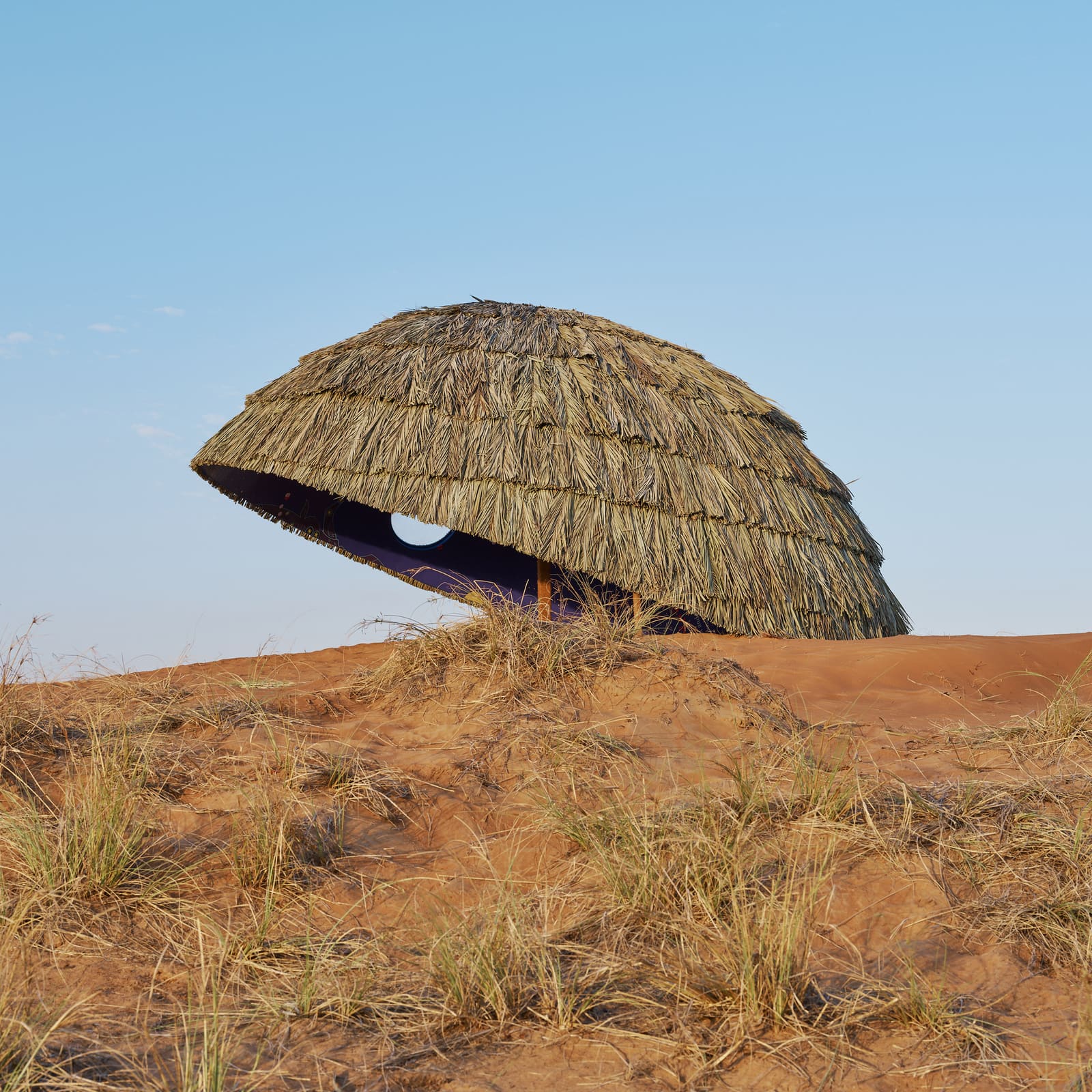
Mohamad Nahleh and Ozayr Saloojee's After Night There is Nothing splits a giant globe of the night sky into three parts, scattered across different locations at the triennial. The outer shells are wrapped in thatch, while the interiors feature vinyl surfaces printed with designs that reimagine military objects in the sky as creature-like constellations. Nahleh describes the project as "night sky optimism", an attempt to reckon with the contemporary sky's saturation by drones, satellites, rockets, and missiles.
The designers note that in geographies experiencing prolonged violence, these objects produce new mythical creatures in the popular imagination. The constellations in After Night There is Nothing attempt to tame what Nahleh calls "the military brightness" populating the sky. The project's fragmented structure mirrors the way such objects are experienced: not as a unified system but as scattered presences that intrude on daily life. By splitting the globe and distributing its parts, Nahleh and Saloojee refuse a totalising view, instead offering partial perspectives that acknowledge the limits of comprehension in the face of pervasive surveillance and violence.
Solar Data as Analogue Device
Badriyah Alsalem's As the Sun Rests plots 41 medieval Arabic poetic names for the sun as cut-outs on an astronomical graph that forms a circular canopy. The canopy casts patterns of shadow in the sand below, with three suns embroidered in red to depict the sharaq rising sun, saqa'a noon sun, and gharab setting sun. Markers on the ground indicate where these highlights will fall on different dates during the triennial, creating what Alsalem describes as an analogue device to read historical data.
The pavilion operates in two registers: the static visualisation overhead and the animated shadow play below, driven by the sun's movement. The work recovers a pre-modern taxonomy of solar observation, embedding it in a structure that functions as both sundial and archive. Alsalem's use of embroidery and shadow aligns with the triennial's interest in craft practices and temporal experience, treating the sun not as a constant but as a variable that medieval Arabic poets understood through multiple names and shifting qualities.
Retreat Within Retreat
Lalla Alwyia Khalwa, designed by Ziad Jamaleddine, Makram el Kadi, Iheb Guermazi, and Beya Othmani, occupies Sharjah's Al Khan Open Beach. The installation is dedicated to the saint Lalla Alwyia Kasserine and conceived as a place for reflection. Dried plants form a grid of columns on a raised platform, with stone slabs marking places of pause and a metal stool providing a space to listen to an accompanying sound installation.
The design team describes the beach as already a space for retreat, and the installation as a retreat within that retreat. The structure carves a series of spatial conditions: one for prayer, one for sitting, and a courtyard open to the sky. The use of dried plants and stone slabs evokes vernacular building practices while maintaining a minimal material palette. The installation's dedication to a saint frames the work within a tradition of sacred architecture, but its openness and lack of enclosure suggest a more inclusive interpretation of retreat, one that accommodates multiple forms of reflection without prescribing ritual.
Civic Infrastructure as Curatorial Frame
The 2026 Sharjah Architecture Triennial runs from 14 November 2026 to 14 April 2027 across various locations in Sharjah. Rao's curatorial framework treats civic infrastructure not as a fixed category but as a set of practices that emerge in response to displacement, material scarcity, and the withdrawal of state support. The eight projects highlighted here share an interest in architecture's capacity to record social processes, whether through improvised pedagogy, material substitution, or the documentation of threatened histories. By positioning anthropology as a lens through which to understand architecture, the triennial argues that the discipline's value lies not in iconic buildings but in the ways it enables communities to organise, remember, and imagine collective futures.
Save this story. A free account keeps your reading list and the 07:00 email in one place.
CREATE FREE ACCOUNT →SIGN IN