
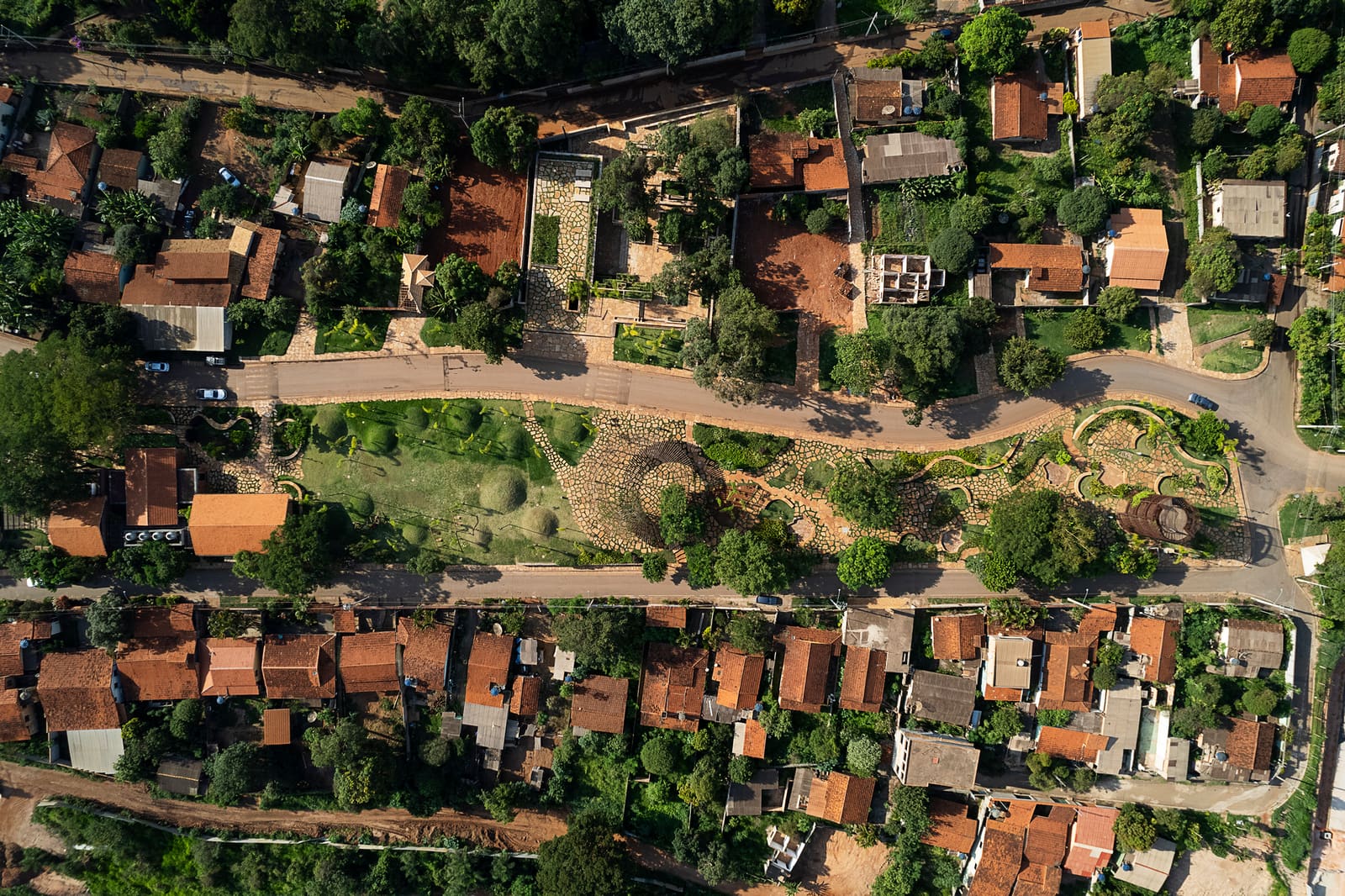
A Discipline Under Pressure
Brazilian architecture this November offers less a snapshot of formal innovation than a record of pressures: the weight of collective grief, the recurring threat of water, the contested inheritance of mid-century planning. Three projects completed or opened recently, a biennial held in the capital, and two ongoing reconstruction efforts in the south together sketch a profession obliged to reckon with forces that exceed the boundaries of any single site.
The question running through these developments is not whether architecture can solve such problems, but what role it assumes when the problems themselves, whether historical injustice or hydrological failure, have already reshaped the ground beneath it. The answers emerging from Brasília, Porto Alegre, Brumadinho and elsewhere suggest a turn towards restraint, towards projects that acknowledge limits and losses rather than proclaim solutions.
Brasília's Biennial: Territory as Programme
The XIV Ibero-American Biennial of Architecture and Urbanism convened in Brasília from 3 to 6 November under the theme "Cuidar la Vida". Organised around water, vegetation, housing and communities, the programme positioned territory not as backdrop but as subject, a framing that invited scrutiny of the city's own modernist origins and the gap between planned order and lived reality.
Twelve works received recognition across project and publication categories, with five additional mentions. The selection addressed housing access, environmental systems and community infrastructure, themes that resonate with ongoing debates about the social and ecological costs of rapid urbanisation. Venues included SESI Lab, the University of Brasília and the Teatro Nacional Cláudio Santoro, each hosting exhibitions, lectures and tours that doubled as critiques of the capital's spatial hierarchies.
What distinguished this edition was its willingness to foreground tension, to treat Brasília itself as a case study in the friction between utopian ambition and territorial transformation. The biennial's structure, dividing its attention among four elemental concerns, reflected a broader shift in Latin American discourse towards architecture as stewardship rather than authorship.
Rebuilding After Floods: Two Strategies in Rio Grande do Sul
More than two years after the May 2024 floods submerged large areas of Rio Grande do Sul, reconstruction in Porto Alegre and Cruzeiro do Sul continues along divergent paths. Porto Alegre has concentrated on reinforcing existing flood defences and upgrading drainage networks, a strategy that accepts the city's low-lying geography while attempting to harden it against future inundation. Cruzeiro do Sul, by contrast, has relocated the Passo de Estrela neighbourhood to higher ground, abandoning the floodplain altogether.
The difference is instructive. Porto Alegre's approach privileges continuity, the preservation of established urban fabric and social ties, even at the cost of perpetual vigilance. Cruzeiro do Sul's relocation acknowledges that some sites are untenable, that retreat can be a form of planning. Both cities face the same underlying challenge: how to rebuild in ways that address the planning decisions that amplified the disaster in the first place, not merely replace what was lost.
Nature-based solutions, more flexible zoning and the protection of community networks have entered the conversation, though implementation remains uneven. The reconstruction is less a technical problem than a political one, requiring decisions about risk, investment and who bears the burden of adaptation.
Assis Reis: A Modernist Archive Finds a Home
October marked the centenary of Francisco de Assis Couto Reis, a Salvador-based architect whose career spanned the mid-twentieth century and whose work has received renewed attention following the donation of his archive to Casa da Arquitectura in Portugal. The collection, comprising more than 3,000 items, documents a practice rooted in the negotiation between modernist doctrine and the specific demands of Bahia's climate, topography and culture.
Assis Reis's headquarters for the São Francisco Hydroelectric Company (CHESF), along with residential projects and urban proposals, demonstrate a designer attentive to solar orientation, natural ventilation and material economy. His work resists easy categorisation, neither purely rationalist nor vernacular, but instead occupying a middle ground where international principles were tested against local conditions.
The archive's transfer to Portugal, a former colonial power, raises questions about the geography of architectural memory and the institutions that claim authority over it. Yet the donation also ensures preservation and access, creating an opportunity to reassess Assis Reis's contribution to a generation of Brazilian architects who sought to reconcile modernism with place.
Brumadinho: Architecture as Witness
Gustavo Penna Arquiteto e Associados completed the Brumadinho Memorial in 2025 at the site of the 2019 Córrego do Feijão dam collapse in Minas Gerais, which killed 272 people. Developed in consultation with victims' families, the 1,220-square-metre project organises its programme along a 230-metre path cut into the hillside, linking an entrance pavilion to a viewpoint overlooking the scarred landscape.
Concrete mixed with pigment derived from mining waste forms the primary material, a deliberate incorporation of the disaster's residue. A reflecting pool and carefully controlled daylight shape the sequence of spaces, while 272 yellow ipê trees, one for each victim, establish a living register of loss. The memorial does not attempt consolation; it offers instead a structure for grief, a place where remembrance can occur without resolution.
The project's restraint, its refusal of monumental gesture, aligns it with a lineage of memorials that privilege absence over presence. In a country where extractive industries remain central to the economy, the Brumadinho Memorial stands as both commemoration and indictment, a reminder that the built environment is implicated in the systems that produce such tragedies.
Three Projects: Materiality, Topography, Community
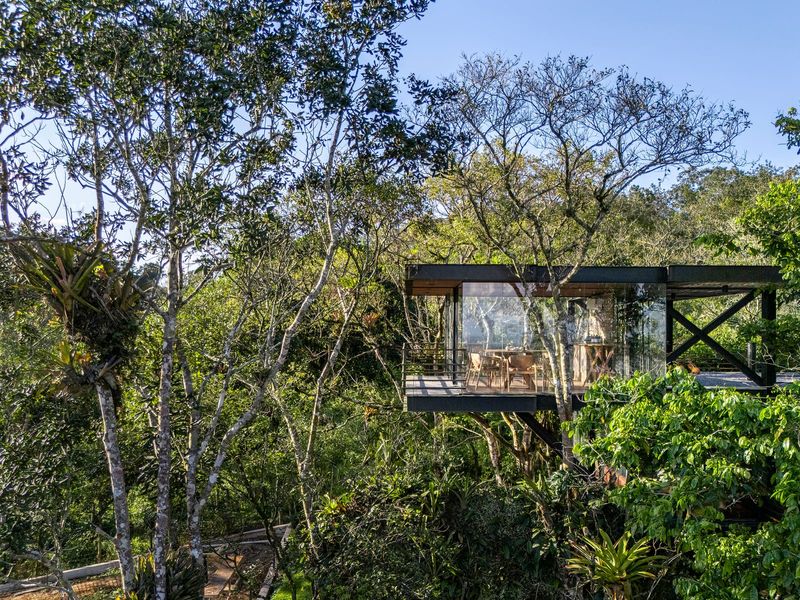
Asa Arquitetos completed Sertão Block and Amparo House in 2026 in the Paraíba hinterland, a 622-square-metre residence organised into separate volumes connected by verandas and courtyards. Built directly on a rocky outcrop, the project responds to the region's arid climate through deep overhangs, hollow brick elements and large openings that promote cross-ventilation. Natural stone, wood and ceramic bricks establish continuity with local building traditions, while the spatial arrangement recalls the layout of traditional rural estates.
The separate Sertão Block functions as a private lookout, a retreat within a retreat. The project demonstrates that regionalism need not be nostalgic; it can instead be a method for engaging site-specific constraints through contemporary means.
Terra e Tuma Arquitetos Associados designed the Veras Cultural Center in Florianópolis, completed in 2023, as a 1,100-square-metre vertical structure accommodating exhibition spaces, workshops, a restaurant, a market and a rooftop garden. Located on the urban fringe of the Córrego Grande hills, the centre uses exposed brick and concrete to mediate between interior programmes and surrounding green areas. Its vertical organisation maximises programme density on a constrained site, while openings are positioned to manage western sun exposure.
Conceived as a platform for cultural and environmental education, the centre brings diverse practices into proximity, fostering exchange among artists, educators and residents. The project's ambition lies not in formal innovation but in its commitment to access, to creating space for activities that might otherwise lack institutional support.
Heritage and Memory: Three Sites Join UNESCO Network
UNESCO added three Brazilian sites to its Network of Historic and Memorial Sites Related to Slavery and the Slave Trade: Valongo Wharf in Rio de Janeiro, Sociedade Protetora dos Desvalidos in Salvador, and Serra da Barriga in União dos Palmares, Alagoas. Valongo Wharf served as one of the Americas' principal landing points for enslaved Africans; Sociedade Protetora dos Desvalidos is a historic Black civil institution; Serra da Barriga was the territory of Quilombo dos Palmares, a centre of resistance to slavery.
The network, established in 2024, promotes preservation, interpretation and education related to sites associated with the transatlantic slave trade. The inclusion of these three locations acknowledges their role in Afro-Brazilian history and connects them to a broader international effort to recognise and commemorate the legacies of slavery.
The designation does not resolve the political and social tensions surrounding these sites, but it does formalise their significance and may attract resources for conservation and public programming. The question remains how such recognition translates into sustained engagement with the histories these places embody.
A New Cultural Centre for Fortaleza
Yuri Vital Arquiteto won the national competition for the Arts, Culture and Events Center at the Federal University of Ceará in Fortaleza, announced on 5 November. Selected from 64 submissions, the preliminary design will occupy the site of the former São Pedro Building on the university's Iracema Campus. The approximately 11,000-square-metre, 14-storey complex is planned to include a cinema, exhibition spaces, a library, multipurpose rooms and a performance hall.
At ground level, the proposal introduces a public square with shaded pathways and gathering spaces, while terraces, a rooftop garden and an open-air amphitheater extend the cultural programme vertically. The design also incorporates a tribute to artist Sérvulo Esmeraldo, acknowledging the site's history.
The project's scale and programme signal an institutional commitment to cultural infrastructure, though its success will depend on how effectively the building integrates with the surrounding campus and city. The competition's outcome reflects a broader trend towards mixed-use cultural facilities that blur the boundaries between academic, civic and artistic functions.
What November Reveals
Taken together, November's developments in Brazilian architecture reveal a discipline under pressure to respond to forces, historical and environmental, that exceed the conventional scope of design. The Brumadinho Memorial confronts the consequences of extractive industry; the reconstruction of Porto Alegre and Cruzeiro do Sul grapples with hydrological failure; the Brasília biennial interrogates the legacy of modernist planning; the UNESCO designation formalises the recognition of sites central to Afro-Brazilian history.
These are not problems architecture can solve, but they are problems architecture must address. The projects and initiatives documented this month suggest a profession increasingly willing to acknowledge its limits, to work within constraints rather than against them, and to accept that the most meaningful contributions may be those that preserve memory, mitigate harm and create space for communities to define their own futures.
Save this story. A free account keeps your reading list and the 07:00 email in one place.
CREATE FREE ACCOUNT →SIGN IN