
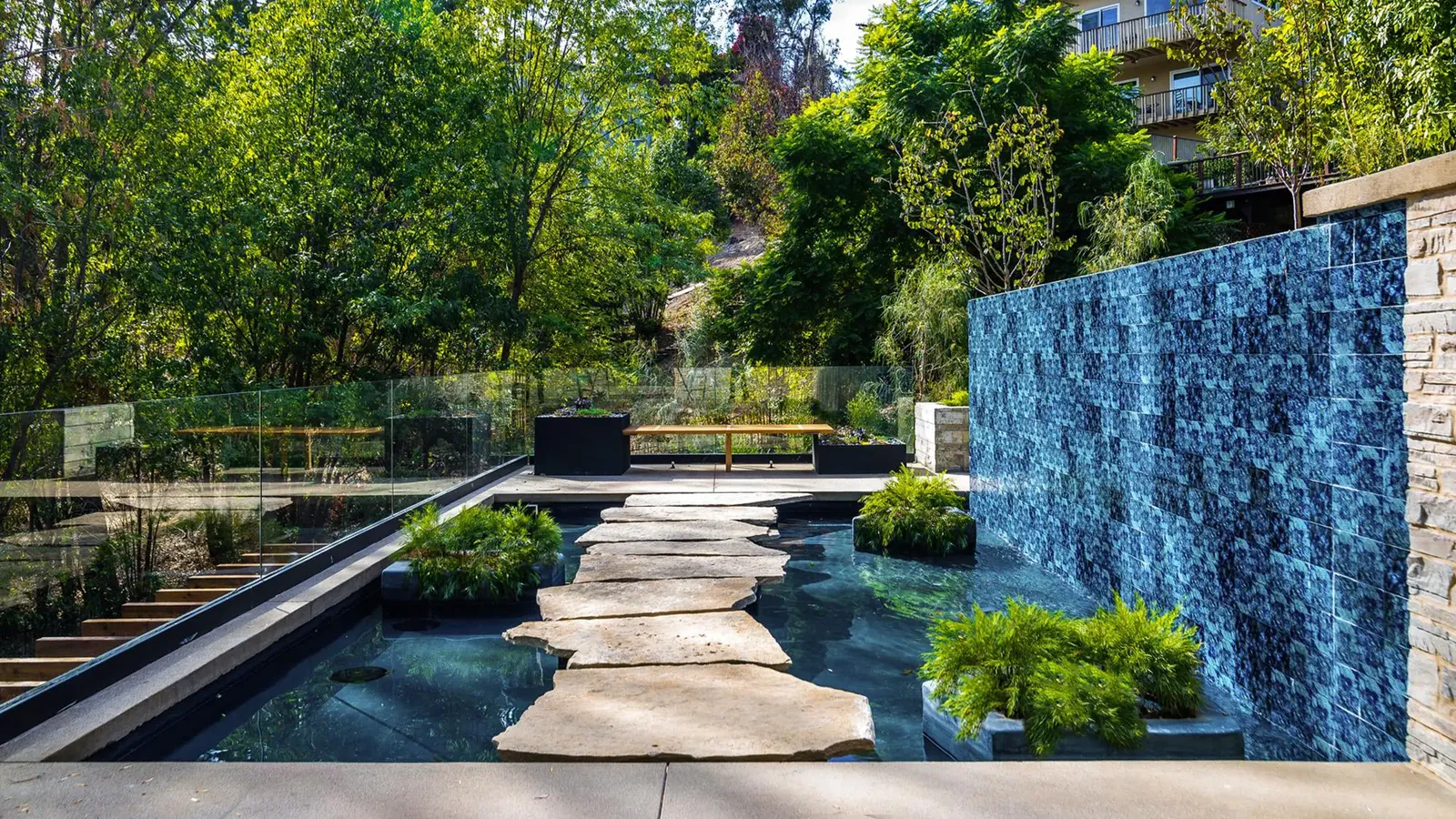
The Quiet Resurgence of Water as Architectural Material
In the evolving vocabulary of contemporary residential design, water has moved decisively from ornamental afterthought to primary design material—one capable of structuring space, modulating light, and fundamentally altering the phenomenological experience of a garden or terrace. The question is no longer whether to include water, but how to integrate it with the same rigor applied to massing, fenestration, or material palette.
This shift reflects broader currents in landscape architecture and site-specific design, where the boundary between interior and exterior dissolves not through glass alone, but through choreographed sensory experiences. Water, with its capacity for movement, sound, and reflection, becomes a mediating layer—neither purely architectural nor purely natural, but occupying a liminal zone that contemporary designers are learning to exploit with increasing sophistication.
Minimalism and the Logic of Restraint
Consider the minimalist wall spill: three equally spaced spouts delivering water into a narrow reflecting pool against a white facade. This is not decoration—it is spatial punctuation. The repetition establishes rhythm; the monochrome palette eliminates distraction; the horizontal plane of still water becomes a datum line against which the vertical architecture reads more clearly.
The design recalls the courtyard fountains of Luis Barragán, where water was treated as both acoustic and optical device, but strips away the saturated color and emotional intensity in favor of gallery-like restraint. Here, the water feature functions similarly to a Donald Judd installation: seriality, material honesty, and the refusal of ornament create a contemplative field rather than a focal object.
This approach works best in contexts where the surrounding architecture already speaks a language of reduction. When paired with low, mass-planted groundcovers—think Ophiopogon japonicus or clipped Buxus—the feature becomes legible as part of a larger compositional strategy rather than a singular decorative gesture.
Immersive Environments: Water as Spatial Envelope
At the opposite end of the spectrum lies the resort-style water curtain—a full-height sheet of falling water that transforms the pool edge into a threshold experience. This is water as architectural element, creating not just visual interest but an actual spatial boundary, one that can be passed through, stood beneath, or observed from multiple vantages.
The precedent here extends to Tadao Ando's water courts and the immersive installations of James Turrell, where environmental media (water, light, sky) are used to construct phenomenological experiences that exceed the purely visual. The curtain modulates sound, filters light, and introduces kinetic variability into what might otherwise be a static composition.
Layering becomes critical in these environments. The water curtain is rarely sufficient alone; it must be orchestrated with secondary features—spa spillovers, stepping stones, integrated seating—to create a sequence of spatial moments rather than a single effect. This is landscape architecture as choreography, where movement through space is as carefully considered as the space itself.
Material Honesty and Vernacular Reinterpretation
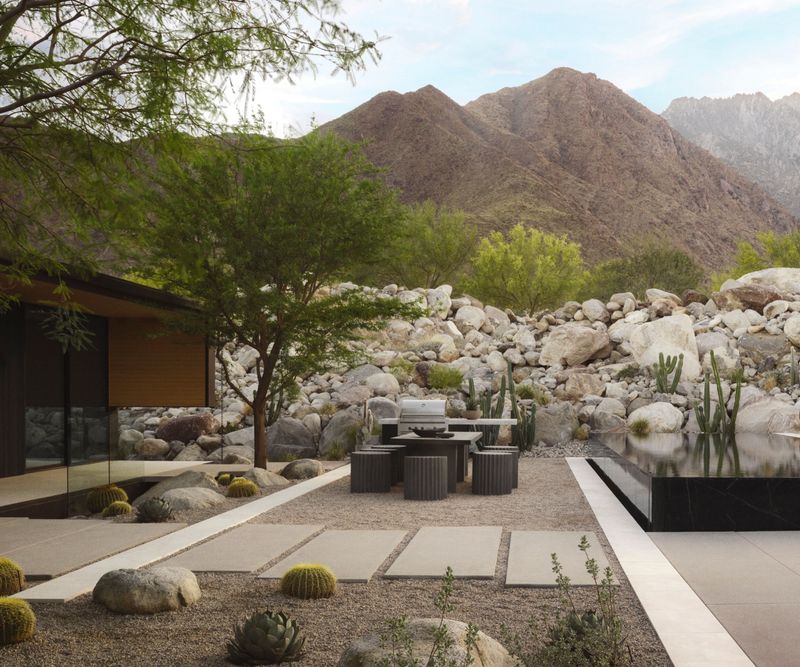
The desert spa cascade exemplifies a different approach: material-driven design that responds directly to climatic and cultural context. Warm wood fencing, sculptural Carnegiea gigantea (saguaro), and a raised spa that spills into a narrow channel—this is not generic modernism transplanted, but a regionally inflected interpretation that acknowledges the material palette of the American Southwest.
The contrast between rough stone, smooth concrete, and soft planting creates textural complexity within a restrained formal language. Water becomes part of a larger narrative about place, where the feature is not imposed upon the landscape but emerges from it. This approach has affinities with the work of Steve Martino and Ten Eyck Landscape Architects, studios known for integrating contemporary design vocabularies with desert-adapted planting and water-conscious strategies.
In Southeast Asian contexts, a parallel might be drawn to the adaptive reuse of traditional water elements—kolam pools in South Indian courtyards, genkan water basins in Japanese entries—where historical typologies are reinterpreted through contemporary detailing and materials. The cultural memory of water as purifying, cooling, and spiritually significant persists, but the formal expression evolves.
Vertical Integration and Biophilic Density
The living wall waterfall represents another trajectory: the vertical integration of water and planting to create biophilic density in constrained footprints. Stacked planters with ferns and orchids frame a cascading water wall, collapsing garden and fountain into a single vertical plane.
This strategy has particular relevance in high-density urban environments—Singapore, Hong Kong, Bangkok—where ground area is scarce but vertical surfaces are abundant. The typology recalls Patrick Blanc's murs végétaux, but here water is not merely irrigation infrastructure hidden behind foliage; it is a visible, audible component of the composition.
The challenge lies in detailing: ensuring adequate drainage, managing root systems, and maintaining plant health in a vertical orientation require technical sophistication. But when executed well, the result is an immersive, multi-sensory installation that addresses both aesthetic and environmental performance criteria—cooling through evapotranspiration, filtering air, and providing acoustic buffering.
Fire and Water: Elemental Contrast as Design Language
Several examples employ the deliberate pairing of fire and water—flickering flames along pool edges, glowing water below sleek waterfalls. This is contrast as compositional strategy: the stillness of water against the dynamism of flame, the coolness of one against the warmth of the other.
The archetype extends to ancient Persian gardens, where water channels and fire pits coexisted as elemental symbols. In contemporary residential design, the pairing is less symbolic than experiential, creating environments that engage multiple senses and read differently across the diurnal cycle. At night, with lighting integrated into each element, the space becomes theatrical—a curated environment that borrows from hospitality design's emphasis on ambiance and atmosphere.
This approach works best when restrained. Too many competing effects risk sensory overload; the power lies in precise calibration, allowing each element to register without overwhelming the composition.
Sculptural Installations and the Art - Architecture Threshold
The sculptural fountain moment—a circular metal feature sending a gentle bubble upward, centered within a long pool—occupies the threshold between functional landscape element and art object. Placement is critical: not hidden, but showcased, treated with the same intentionality as a Richard Serra plate or an Isamu Noguchi stone.
This recalls the long tradition of artist-designed fountains, from Noguchi's own water gardens to George Rickey's kinetic sculptures. The distinction between art and architecture blurs, and the water feature becomes a device for slowing perception, encouraging contemplation, and marking a specific point in space with heightened attention.
In residential contexts, this approach requires confidence—both in the object itself and in the surrounding restraint necessary to let it read clearly. The risk is that the feature becomes precious or self-conscious; the reward is a space that feels curated, intentional, and spatially legible.
Toward a Language of Contemplative Landscape
What unites these varied approaches is a shared emphasis on restraint, materiality, and experiential depth. Contemporary water features are less about spectacle and more about creating conditions for slowness—spaces that invite pause, that reward sustained attention, that modulate the sensory environment in subtle, cumulative ways.
This aligns with broader trends in residential design: the move away from maximalist display toward environments that support ritual, reflection, and embodied presence. Water, with its inherent capacity for movement and transformation, becomes a key instrument in this shift—a material that can structure time as well as space, sound as well as sight.
For designers working in this territory, the challenge is calibration: knowing when to let water dominate and when to let it recede, when to embrace theatricality and when to pursue quietude. The most successful examples are those that feel inevitable, as if the water was always meant to be there, integral to the architecture and landscape rather than applied to it.
Save this story. A free account keeps your reading list and the 07:00 email in one place.
CREATE FREE ACCOUNT →SIGN IN