
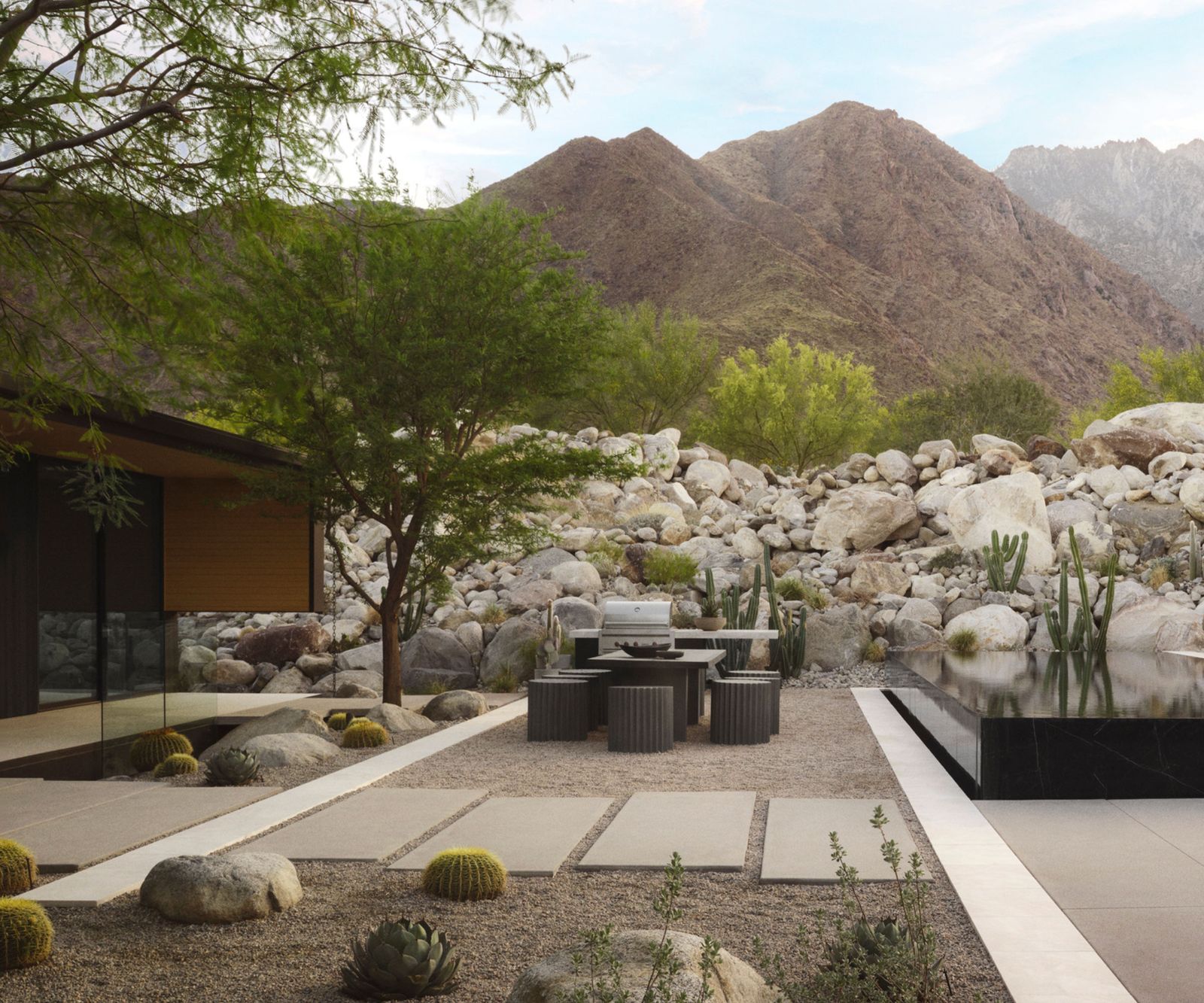
The Shift from Ornament to Organism
In a region where annual precipitation rarely exceeds 250 millimeters, the question is no longer whether to design with drought in mind, but how to make aridity legible as beauty. Across the American Southwest and increasingly in Mediterranean climates globally, a vernacular is emerging that treats the desert garden not as a diminished version of the lawn, but as a distinct formal language—one defined by material honesty, spatial restraint, and biophilic precision.
This is not the rock-and-cactus cliché of mid-century modernism. The current iteration, visible in projects from Scottsdale to San Diego, operates with a softer hand. Designers are layering native grasses with sculptural succulents, using decomposed granite as a textural field, and treating water features as punctuation rather than centerpiece. The result is a landscape aesthetic that reads as both elemental and refined, where every plant earns its place not through color alone, but through form, shadow, and seasonal performance.
Massing and Negative Space: Lessons from Japanese Dry Gardens
One of the most compelling aspects of contemporary desert landscaping is its kinship with karesansui—the Japanese dry garden tradition. In both cases, gravel becomes a neutral plane that allows singular elements—a boulder, a yucca, a cluster of barrel cacti—to register as compositional anchors. The Santa Fe Botanic Garden's gravel pathways, for instance, employ river stone not as fill but as deliberate field, guiding circulation while activating negative space.
This approach demands restraint. Where traditional American suburban landscapes tend toward abundance—layered shrubs, seasonal color rotations, expansive turf—the arid garden operates through subtraction. Each element must justify its presence. A single Opuntia cluster, backlit at dusk, can carry an entire courtyard. The absence of ornament becomes the ornament.
Such restraint echoes the spatial strategies of Luis Barragán, whose Mexican modernist gardens employed water, wall, and sky as co-equal materials. In the desert context, designers are now extending that logic to plantings themselves, treating agave rosettes as volumetric sculptures and saguaro as vertical accents that frame views rather than block them.
Material Palette: From Adobe to Corten
The material language of these landscapes is equally deliberate. Decomposed granite, crushed sandstone, and river cobble provide a warm, tonal ground that contrasts with the cooler hues of blue agave and Senecio mandraliscae. Where hardscape is required, rammed earth, flagstone, and unfinished concrete dominate—materials that age gracefully and absorb rather than reflect heat.
Recent projects have also introduced weathering steel planters, whose rust patina echoes the iron oxide tones of desert soil. These elevated beds serve a dual function: they lift plantings to eye level, creating moments of intimacy, and they delineate space without the visual weight of masonry walls. The effect is one of permeability—boundaries that suggest rather than enforce.
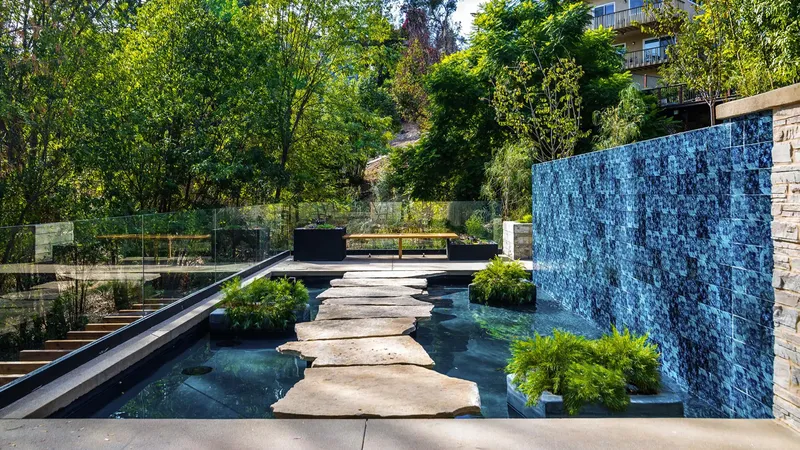
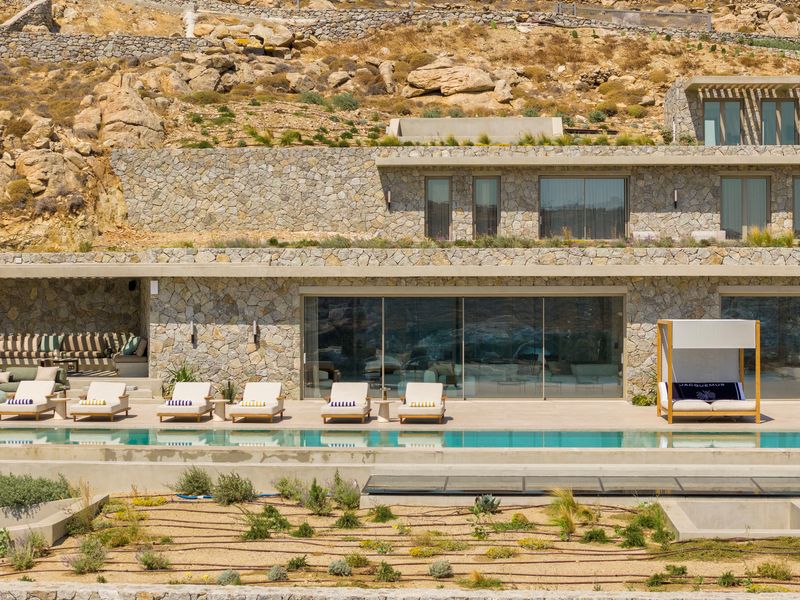
In poolside applications, the material contrast becomes even more pronounced. The juxtaposition of chlorinated blue water against warm stone coping and spiny cacti creates a sensory tension that defines the Southwestern outdoor room. It's a strategy borrowed from mid-century Palm Springs, but executed today with greater ecological awareness. Native plantings replace thirsty lawn, and permeable paving allows runoff to infiltrate rather than drain.
Fenestration and Light: The Role of Shadow in Arid Design
Desert landscapes are fundamentally about light—not just its abundance, but its modulation. The best examples use vertical plantings to cast dynamic shadows across horizontal planes. Ocotillo stems, palo verde canopies, and columnar cacti all function as natural louvers, filtering harsh midday sun while preserving views.
This interplay of light and shadow recalls the work of Carlo Scarpa, whose Venetian courtyards used water and stone to choreograph daylight. In the desert, the medium shifts—gravel replaces water, succulents replace moss—but the principle holds. A well-placed boulder at sunrise becomes a sundial; a cluster of golden barrel cacti at dusk glows as if internally lit.
Designers are also leveraging artificial lighting with increasing sophistication. Uplighting at the base of tall cacti or agave creates dramatic silhouettes after dark, transforming the garden into a nocturnal theater. The effect is subtle but powerful: the landscape continues to perform even when unoccupied.
Cultural Context: Xeriscaping as Regional Identity
The rise of desert minimalism in residential design is inseparable from the climate realities of the 21st century. As water costs rise and municipalities impose irrigation restrictions, what was once a niche aesthetic is becoming mainstream. Phoenix, Las Vegas, and Tucson have all introduced turf-removal rebate programs, accelerating the shift from lawn to low-water alternatives.
But this is not merely pragmatic. There is a growing cultural embrace of aridity as identity. In the same way that Scandinavian design celebrates hygge and Japanese design celebrates wabi-sabi, the American Southwest is articulating its own spatial ethos that values endurance, texture, and the beauty of things that survive.
This vernacular is also increasingly visible in Southeast Asia, particularly in Thailand and Vietnam, where architects like Vo Trong Nghia have long championed climate-responsive planting. The parallel is instructive: both regions are learning to design with their environments rather than against them, treating scarcity as a generative constraint.
Precedent and Evolution: From Garrett Eckbo to Contemporary Practice
The lineage of modern desert landscaping can be traced to mid-century figures like Garrett Eckbo and Thomas Church, who rejected the formal symmetry of European gardens in favor of organic, site-responsive layouts. Eckbo's work in California and Arizona emphasized native plantings and informal circulation, principles that remain foundational today.
What has evolved is the level of material refinement. Contemporary practitioners are pairing Eckbo's ecological ethic with the spatial rigor of minimalism, producing landscapes that are both functional and photogenic—a necessity in an era where Instagram visibility often drives design decisions. The challenge is maintaining depth while satisfying the demand for immediate visual impact.
A Landscape of Consequence
The desert garden, at its best, is a landscape of consequence. Every stone, every plant, every shadow carries weight. It is a design approach that privileges clarity over abundance, endurance over spectacle. And as climate pressures intensify globally, its lessons extend far beyond the American Southwest. From the Mediterranean to the Australian Outback, designers are discovering that working within ecological limits can yield not compromise, but a new kind of beauty—one that is patient, textured, and profoundly grounded.
Save this story. A free account keeps your reading list and the 07:00 email in one place.
CREATE FREE ACCOUNT →SIGN IN