
Geometry as a Lens
Architecture has long served as more than shelter or monument. In certain contexts, it becomes an instrument - a calibrated device for reading phenomena beyond human scale. Observatories and planetariums represent this convergence: spaces where built form and cosmic inquiry meet, where walls and apertures frame not daily life but the mechanics of the universe itself.
The question is not merely aesthetic. These buildings must reconcile two demands: the precision required to track celestial events and the experiential quality that makes such tracking legible to human observers. The result is a typology in which geometry, orientation, and materiality operate as functional parameters, not stylistic choices.
Precedent: The Jantar Mantar Observatories
India's 18th-century Jantar Mantar observatories, commissioned by Maharaja Jai Singh II across multiple cities, offer a historical benchmark. These complexes employed masonry structures - sundials, quadrants, and celestial coordinate instruments - built at monumental scale. Each element was positioned and dimensioned to measure solar and stellar positions, predict eclipses, and calculate time with remarkable accuracy for the pre-telescope era.
What distinguishes the Jantar Mantar is its directness. Architecture here is not housing for instruments; it is the instrument. The Samrat Yantra sundial in Jaipur, for instance, rises nearly 27 metres, its hypotenuse aligned to the Earth's axis. Shadows cast across calibrated marble arcs translate solar movement into readable data. Form follows not function in the Sullivanesque sense, but measurement - every angle and surface serves a computational purpose.
This approach contrasts sharply with later Western observatory models, where domed structures shelter separate telescopic equipment. The Jantar Mantar demonstrates an alternative lineage: architecture as primary technology, legible and monumental, embedding scientific method into civic space.
Contemporary Planetariums: Enclosing the Infinite
Modern planetariums invert the observatory's outward gaze. Rather than frame the actual sky, they simulate it, projecting celestial mechanics onto interior domes. This shift introduces new architectural challenges: acoustic control, sightline geometry, and the creation of an immersive environment that suspends disbelief.
The dome itself becomes the central design problem. Hemispherical or tilted, its interior surface must be seamless and uniformly reflective to prevent distortion. Seating arrangements require careful calibration - too steep, and viewers lose comfort; too shallow, and peripheral vision fails to engage the projected field. The architecture must disappear, allowing the simulation to dominate perception.
Recent projects have pushed beyond the dome. Some incorporate hybrid volumes that combine planetarium functions with exhibition space, lecture halls, and public observation decks. This programmatic expansion reflects a broader shift: from specialised scientific facility to public education infrastructure, where architecture mediates between expert knowledge and lay curiosity.
Observatories in the Age of Light Pollution
Contemporary astronomical observatories face constraints their 18th-century predecessors did not. Urban light pollution has rendered many historical sites obsolete for serious observation, pushing new facilities to remote locations - deserts, mountains, islands - where atmospheric conditions and darkness permit precision work.
This geographic displacement affects architectural expression. Observatories built in isolated environments often adopt minimal forms, prioritising environmental resilience and operational efficiency over civic presence. The dome-and-cylinder typology persists, but materials shift: reinforced concrete gives way to insulated metal panels, and motorised shutters replace manually operated apertures.
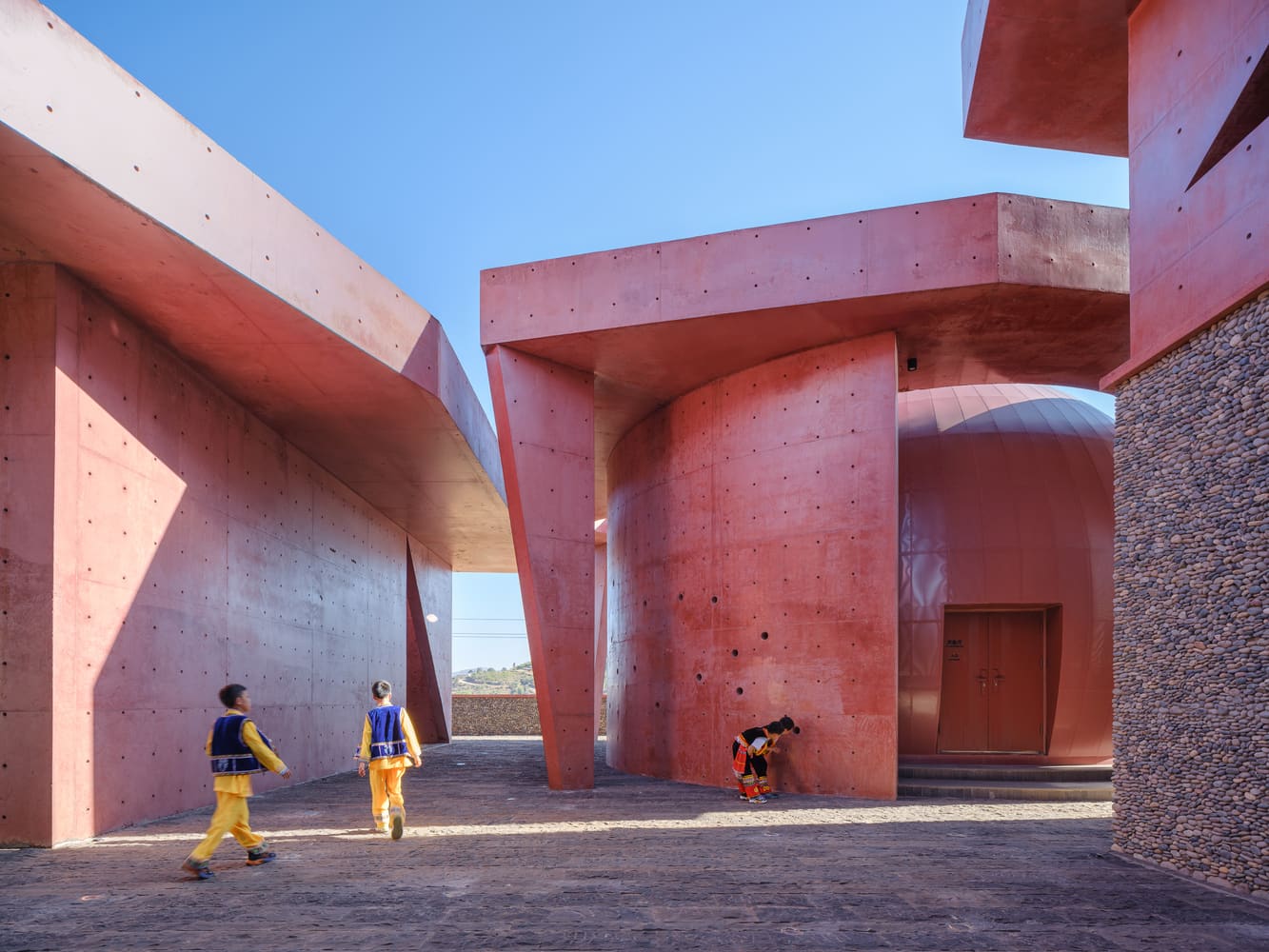
Yet isolation also permits formal experimentation. Freed from urban context, some observatories engage landscape directly, embedding structures into topography or cantilevering observation platforms over voids. The Red Village Observatory in China, for instance, integrates observation spaces with a visitor centre that responds to local terrain, using rammed earth and exposed concrete to anchor the facility within its arid setting.
The Spatial Experience of Scale
What unites these projects - historical and contemporary, observatory and planetarium - is their negotiation of scale. Astronomical architecture must operate across orders of magnitude: the intimacy of individual observation and the vastness of cosmic distance. This tension manifests spatially.
Approach sequences often emphasise ascent. Ramps, stairs, or elevators lift visitors above ground level, a choreographed transition from terrestrial reference to celestial orientation. Once elevated, the architecture frames specific views - a window aligned to a solstice sunrise, a dome oculus tracking the zenith, a platform offering 360-degree horizon access.
Materiality reinforces this shift. Polished stone, dark metal, and glass dominate, surfaces that reflect or absorb light with minimal texture. The palette is deliberately restrained, avoiding distraction. In planetariums, interiors often employ charcoal or black finishes to eliminate ambient reflection, ensuring projected imagery reads cleanly.
Public Access and the Democratisation of Astronomy
Historically, observatories were elite spaces, accessible only to trained astronomers and their patrons. The rise of public planetariums in the 20th century marked a democratisation of celestial knowledge. Architecture played a key role in this shift, creating spaces where non-specialists could engage astronomical concepts through immersive experience rather than technical training.
This accessibility imperative introduces new design considerations. Circulation must accommodate school groups and diverse mobility needs. Interpretation spaces require flexibility for changing exhibitions. Outdoor observation areas need lighting controls that balance safety with night-sky visibility. The architecture must be pedagogical without becoming didactic, inviting exploration while maintaining scientific rigour.
Some recent projects integrate community programming beyond astronomy - hosting concerts under projected starfields, offering rooftop gathering spaces, or incorporating cafés and maker-spaces. This programmatic hybridity reflects a pragmatic recognition: specialised facilities require broader public engagement to justify their construction and operation.
Forward-Looking Trajectories
Advances in digital projection and virtual reality suggest future planetariums may abandon the dome altogether, offering individually customised experiences through wearable displays. If this shift occurs, the architectural typology will need reinvention. What form does a planetarium take when the projection surface is a headset, not a building?
Observatories, meanwhile, increasingly rely on remote sensing and space-based telescopes, reducing the need for ground-based facilities. The James Webb Space Telescope and similar instruments operate beyond Earth's atmosphere, transmitting data to control centres that bear little resemblance to traditional domed observatories. The architectural expression of astronomy may migrate from monumental structures to distributed data centres.
Yet the impulse to gather in physical space, to look upward together, persists. Even as technology decentralises observation, public observatories and planetariums continue to attract visitors seeking shared experience of the cosmos. Architecture's role in this context may shift from instrument to theatre - a stage for collective wonder rather than individual measurement.
Measuring the Immeasurable
Astronomical architecture operates at the boundary of human comprehension. It takes phenomena that occur at scales beyond direct perception - planetary orbits, galactic rotation, the expansion of spacetime - and renders them accessible through built form. This is architecture at its most ambitious: not shaping space for human activity, but shaping human understanding of space itself.
The success of these projects lies not in formal innovation alone, but in their capacity to maintain precision while fostering awe. They must be accurate enough to serve scientific purposes and evocative enough to engage public imagination. That balance - between instrument and monument, measurement and experience - defines the typology and ensures its continued relevance.
Save this story. A free account keeps your reading list and the 07:00 email in one place.
CREATE FREE ACCOUNT →SIGN IN