
An Unlikely Forest in Southern California
Coastal redwoods belong to fog belts and the northern half of the state, yet here they stand in the Pacific Palisades, a mature grove planted as a botanical experiment more than a century ago. The trees survived last year's wildfires and now form a living ceiling over a house that fashion designer Lela Becker, cofounder of Mother, describes as nearly invisible until you're standing at its threshold. The property came to market in 2019 while the Becker family lived nearby, and the combination of shaggy bark, creek sounds, and a chorus of frogs and parrots proved irresistible to someone raised in Sonoma. But it was the house itself - a 1955 design by San Francisco modernist Mario Corbett - that made the sale inevitable. Corbett brought Bay Area sensibilities south, and the structure still carries that regional DNA.
Steamship Geometries and the Corbett Parti
Architect Mario Corbett practiced out of San Francisco during the postwar decades when Northern California modernism was codifying its vocabulary: wood-clad volumes, horizontal lines, integration with landscape, and a tectonic honesty that eschewed ornament. His Pacific Palisades commission embodied those principles. Designer Jed Lind, hired by the Beckers to restore and expand the house, calls the original form "like a steamship" - a comment on its streamlined massing and nautical rigor. Lind's brief was to update without erasing soul, a delicate operation that required adding windows to increase daylight penetration, completing an unfinished second story, and slightly enlarging the footprint to strengthen connections with the woodland surrounds.
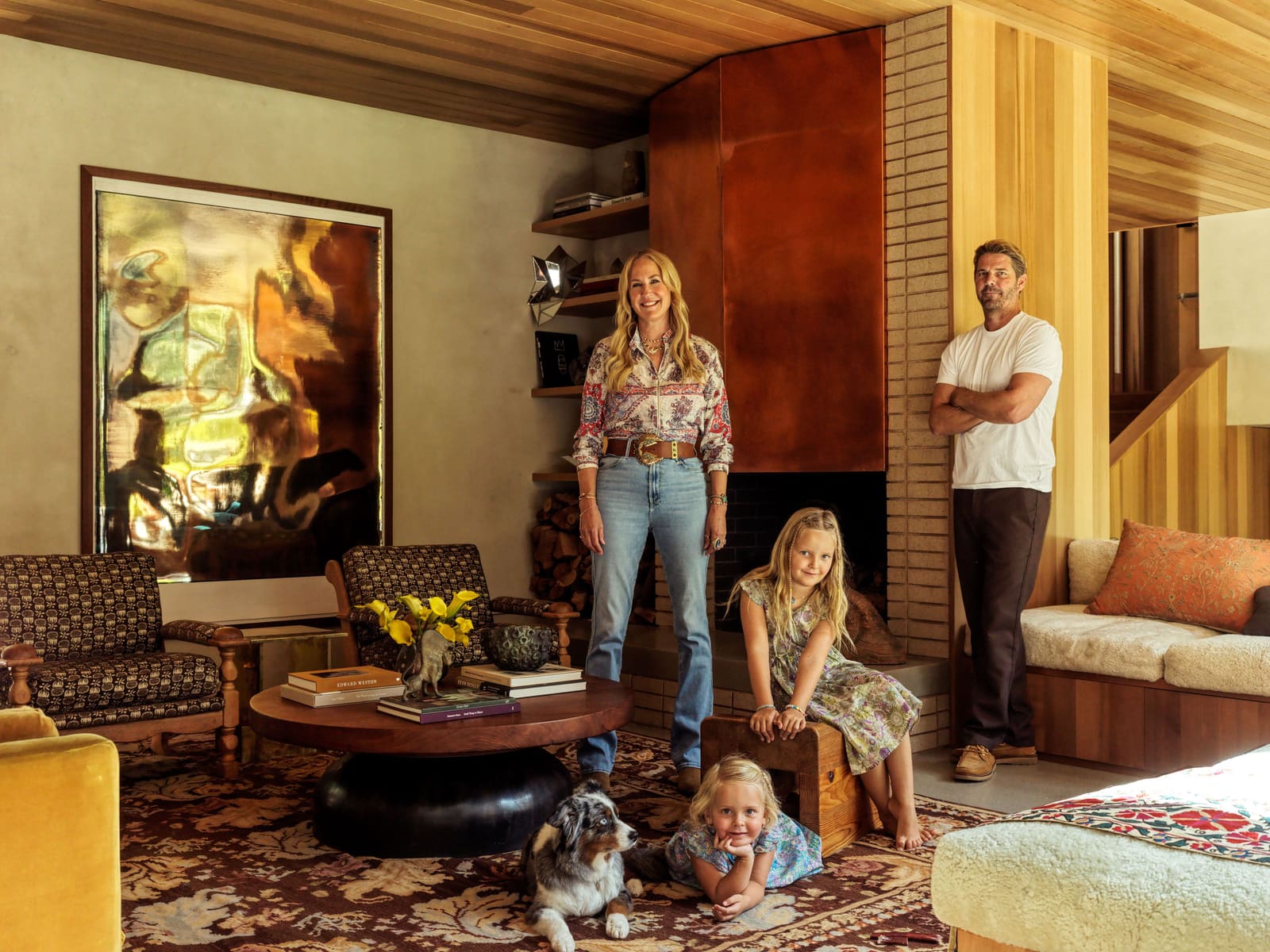
Material choices reinforced continuity. Lind specified redwood cladding, cedar, eucalyptus, teak, concrete, and metal - many of them present in Corbett's original palette - selected for their ability to weather gracefully. A copper fireplace hood, for instance, nods to Rudolph Schindler's 1922 Kings Road house, another Southern California landmark where exposed metal was allowed to patinate. The objective, Lind explains, was to sustain "the aura and vibe of a mid-century Northern California home" while accommodating contemporary family life.
West Côte: A Fabricated Narrative
To furnish the restored envelope, the Beckers engaged designer Kelsey Sundberg, formerly of the AD100 firm Studio Shamshiri and now an independent voice. Sundberg proposed a backstory: expatriates who had circled the globe before returning to Los Angeles to occupy their ideal residence. That narrative license allowed her to blend French Provençal rusticity, Scandinavian restraint, and California modern ease into what she terms "west côte" - a playful coinage that captures the hybrid sensibility.
In the living room, 1950s Danish oak easy chairs and a custom sectional upholstered in shearling gather around the fireplace, joined by a Lisa Johansson-Pape brass floor lamp from the same decade. The entry hall juxtaposes a Jean Lurçat tapestry with a BDDW console decorated with botanical and zoological motifs. Sundberg collaborated with fabricators Dusk - with whom she shares showroom space - to produce custom woodwork: ebonized-oak dining tables, woven-rush chairs inspired by Charlotte Perriand, and cedar outdoor seating. A single-trunk bench carved by Angel City Lumber from a felled tree anchors the entrance, a sculptural gesture that underscores the materiality Corbett championed.
Crystals, Lalique, and the Mother Ethos
Lela Becker's personal collections function as connective tissue throughout the interiors. She accumulates crystals, gemstones, rocks, and shells her daughters have gathered, arranging them as informal still lifes. Recently she has been acquiring vintage Lalique glass, which in this light-dappled setting takes on the translucent quality of sea glass. The aesthetic aligns with Mother's brand philosophy, which Becker summarizes as "easy California, based on growing up in the 1970s." That ethos finds its fullest expression in the family room, a Southern California interpretation of Renzo Mongiardino's tented sitting room for Lee Radziwill. A sofa slipcovered in patchwork paisley tablecloths shares space with a Dan John Anderson table inset with abalone shell and brass, a straw artwork from the Purhépecha region of Mexico, and beanbags upholstered in shearling. Sundberg notes that the clients kept requesting more shearling, and Becker insists that nothing be too precious - comfort trumps formality.
Terremoto's Amplification of Site Character
The landscape that initially captivated Becker has been reworked by Terremoto, the AD100 studio known for ecologically informed planting schemes. Project lead Samuel Webb describes the firm's mandate as doing right by the redwoods and amplifying the site's inherent qualities. Terremoto introduced ferns and live oaks in drifts that echo the understory of Northern California forests, reinforcing the sense that the house occupies a microclimate distinct from the rest of Los Angeles. On typical afternoons, surfboards lean against the outdoor shower, the pizza oven heats up, and children cycle between the pool and the creek, which remains audible through open windows. Becker remarks that the constant murmur of water creates the feeling of being immersed in wilderness, despite the urban context just beyond the property line.
Precedent and Place
At World Archi Design, we've been tracking the persistence of Bay Area modernism in projects far from its geographic origin. Corbett's Pacific Palisades house is a useful case study. Unlike the steel-and-glass vocabularies that dominated Los Angeles during the same period - think Pierre Koenig's Case Study Houses or Neutra's transparent pavilions - Corbett's work privileges wood, mass, and a more grounded relationship to terrain. The house reads less as a machine for viewing the landscape than as an extension of it, a distinction that aligns with the Northern California tradition of architects like William Wurster and Joseph Esherick.
Jed Lind's restoration respects that lineage. By choosing materials that age rather than resist weathering, he acknowledges the tectonic philosophy embedded in Corbett's original design. The copper hood, for example, will continue to darken, its patina a record of time passing. This approach contrasts sharply with the maintenance-intensive finishes common in contemporary luxury residential work, where surfaces are expected to remain pristine indefinitely.
Kelsey Sundberg's interiors, meanwhile, demonstrate how narrative can organize eclecticism. Her "west côte" framework provides enough conceptual structure to justify the coexistence of Danish chairs, French tapestries, and Mexican straw art without lapsing into incoherence. The trick lies in calibrating scale, texture, and tone so that disparate objects feel like chapters in a single story rather than items on a mood board. The family room's Radziwill reference is instructive: Mongiardino's tented interiors were theatrical constructions, yet Sundberg translates that theatricality into something relaxed and child-friendly, substituting beanbags for formality.
Material Honesty and the Long View
One of the most enduring principles of mid-century Northern California modernism is the idea that buildings should age honestly. Corbett's use of redwood cladding, which weathers to silver-gray, exemplifies this philosophy. Lind's decision to continue that logic with cedar, eucalyptus, and teak suggests a commitment to the long view - a recognition that architecture is not a fixed object but a process unfolding over decades. The house will look different in ten years, and different again in fifty, and that transformation is considered desirable rather than a failure of maintenance.
This stands in contrast to much contemporary residential work, where materials are selected for their ability to resist change. Powder-coated metals, synthetic cladding, and sealed stone are engineered to look the same in 2050 as they do today. There is a case to be made for durability, but the Bay Area tradition argues for something else: an architecture that participates in natural cycles, that records the passage of seasons and years in its surfaces. Corbett understood this, and Lind has extended that understanding into the present.
The Redwood Question
The presence of coastal redwoods in the Pacific Palisades raises questions about transplantation and adaptation. These trees were planted experimentally in the late nineteenth century, likely by horticulturalists curious whether the species could survive outside its native range. That they have thrived - and survived recent wildfires - suggests either remarkable luck or a microclimate more hospitable than expected. The grove creates a localized fog effect, trapping moisture beneath its canopy and lowering ambient temperatures, conditions that approximate the trees' natural habitat farther north.
For the Beckers, the redwoods are not merely aesthetic amenities but acoustic and atmospheric ones. The trees filter light, muffle sound, and create a sense of enclosure that transforms the experience of the house. Architecture often treats landscape as backdrop, but here the relationship is more reciprocal: the house responds to the trees, and the trees, in turn, define the house's character. Terremoto's planting reinforces this reciprocity, layering ferns and live oaks beneath the redwoods to thicken the understory and deepen the sense of immersion.
A House That Listens
Lela Becker's comment about keeping windows open to hear the creek is telling. In an era when residential design increasingly prioritizes climate control, acoustic isolation, and hermetic sealing, a house that invites ambient sound feels countercultural. The Corbett house does not insulate its occupants from the environment; it mediates between interior and exterior, allowing frogs, parrots, and water to compose a shifting soundtrack. This porosity is central to the Bay Area modernist ethos, which valued connection over separation and transparency over enclosure.
Jed Lind's restoration preserved that porosity while improving thermal performance and structural integrity - a balance that required careful detailing. New windows were sized and positioned to maximize cross-ventilation, reducing reliance on mechanical cooling. Materials with high thermal mass - concrete floors, for instance - moderate temperature swings without active systems. The result is a house that breathes, both literally and metaphorically, maintaining the experiential qualities Corbett intended while meeting contemporary expectations for comfort.
Forward
As climate patterns shift and wildfires become more frequent across California, the survival of the Pacific Palisades redwood grove takes on additional significance. These trees, planted as curiosities, now function as firebreaks and microclimatic stabilizers. The Corbett house, nestled beneath them, benefits from that protection. Future projects in fire-prone regions might look to this precedent, considering how strategic planting and material choices can reduce vulnerability without sacrificing architectural character.
Kelsey Sundberg's interiors, with their emphasis on natural materials and personal collections, suggest another direction: a move away from the curated perfection that dominates high-end residential design toward something more lived-in and idiosyncratic. The piles of crystals, the vintage Lalique, the patchwork paisley - these are not designer moves in the conventional sense. They resist the Instagram-ready tableaux that have become the default language of luxury interiors, proposing instead that a house should accumulate meaning over time, shaped by the people who inhabit it.
Mario Corbett's 1955 design endures not because it was preserved in amber but because it was flexible enough to accommodate change. Jed Lind's restoration honors that flexibility, and the Becker family's occupancy animates it. The house remains what it always was: a Bay Area modernist transplant, thriving improbably in Southern California soil.
Save this story. A free account keeps your reading list and the 07:00 email in one place.
CREATE FREE ACCOUNT →SIGN IN