
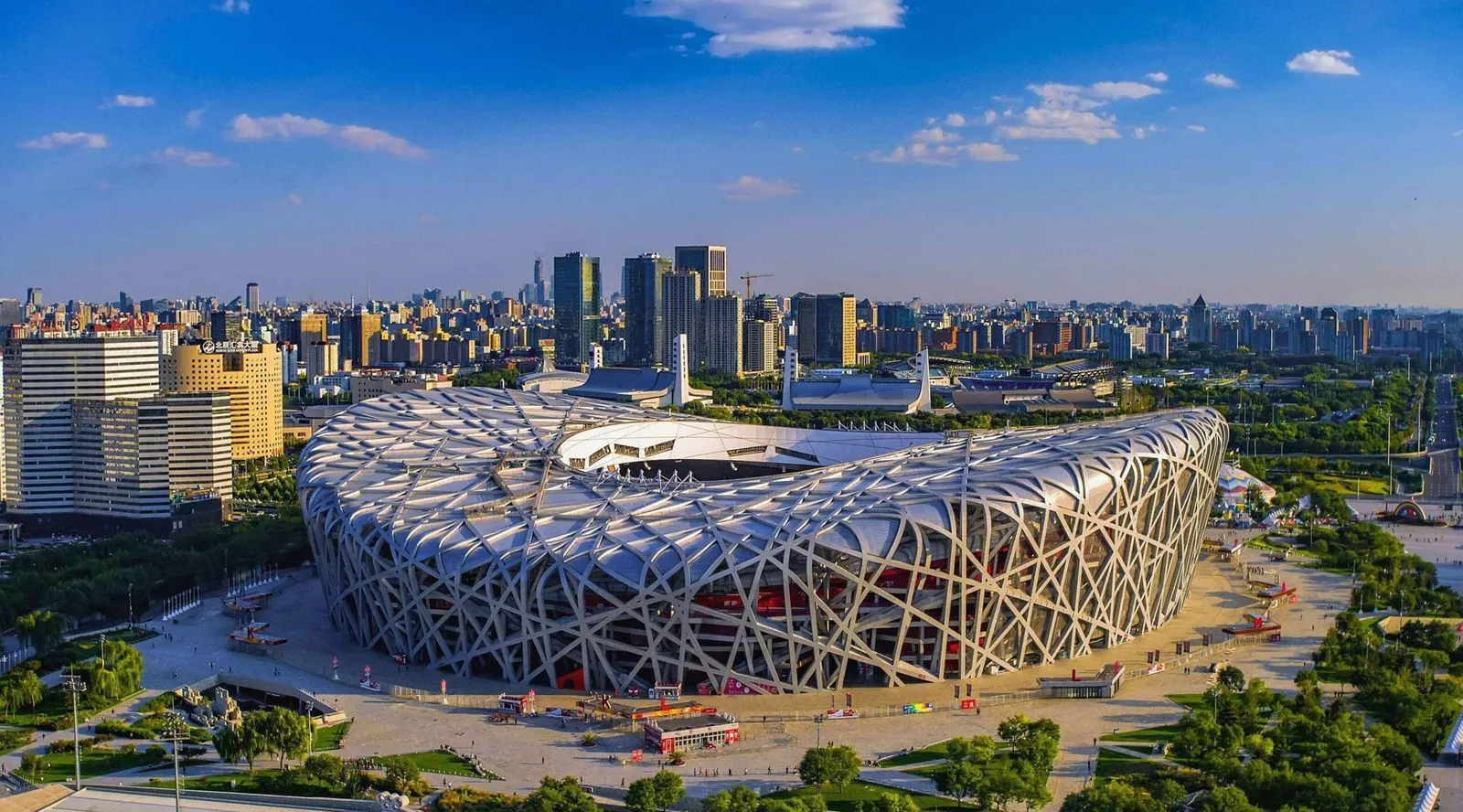
Beijing’s National Stadium - widely known as the Bird’s Nest - stands as a defining symbol of 21st-century architecture. Designed by Herzog & de Meuron with Ai Weiwei, the stadium embodies a delicate balance between artistic spectacle and environmental responsibility. Conceived for the 2008 Olympic Games, it continues to evolve as a civic and cultural landmark, demonstrating how large-scale design can unite aesthetic ambition, structural ingenuity, and long-term sustainability in the global eye.
When one first approaches the National Stadium in Beijing, known globally as the Bird’s Nest, it is difficult not to be struck by how it balances two seemingly opposing ideals: spectacle and sustainability. Conceived for the 2008 Olympic Games, the structure was intended to symbolize China’s arrival on the world stage, yet its enduring relevance lies in how it continues to adapt within an evolving urban and environmental context.

From an architectural standpoint, the Bird’s Nest embodies a careful harmony between artistic expression and engineering precision. Designed by Herzog & de Meuron in collaboration with artist Ai Weiwei and the China Architecture Design and Research Group, the project aimed to transform a massive infrastructural typology - the Olympic stadium - into a sculptural icon. The interlacing steel lattice that gives the building its nickname is not merely ornamental; it functions as both structure and façade. This integration of form and performance demonstrates how visual and structural systems can be synthesized to achieve both beauty and efficiency.

Designing for a global audience presented significant challenges. The stadium needed to accommodate 91,000 spectators, withstand Beijing’s extreme climate, meet international broadcasting requirements, and maintain symbolic legibility even from aerial perspectives. The architects’ solution was a form that performs across multiple scales, from the tactile texture of the steel trusses to the recognizable silhouette captured in satellite images. This multi-layered design approach contributes to the Bird’s Nest’s ongoing resonance as a cultural and architectural landmark long after the Olympic Games concluded.

Sustainability considerations were integral to the project. Nearly half of the steel was sourced locally, and the bowl was designed with a passive ventilation system to minimize reliance on mechanical cooling. In the years since 2008, the stadium has undergone a process of adaptive reuse, hosting concerts, football matches, and public events. Its surrounding Olympic Green has become an expansive urban park that contributes to Beijing’s ecological and social vitality. Although operational costs remain a topic of debate, the continued use of the complex demonstrates an effort to counter the “white elephant” fate that has affected other Olympic venues worldwide.
Viewed through a design research lens, the Bird’s Nest stands as a case study in balancing symbolic ambition with environmental and civic responsibility. The outer shell conveys cultural aspiration; the interior bowl delivers technical precision; and ongoing public programming reinforces long-term value. Together, these elements form a cohesive architectural ecosystem rather than a fleeting spectacle.

Ultimately, the Bird’s Nest represents a pivotal moment in contemporary architecture - a recognition that global icons must not only captivate but also endure. Its legacy lies not only in the visual drama of 2008 but in its continued evolution as an active civic landmark. In this way, Beijing’s Bird’s Nest remains both a symbol and a test case for how architecture can engage the world’s gaze while sustaining its own purpose over time.
Save this story. A free account keeps your reading list and the 07:00 email in one place.
CREATE FREE ACCOUNT →SIGN IN