
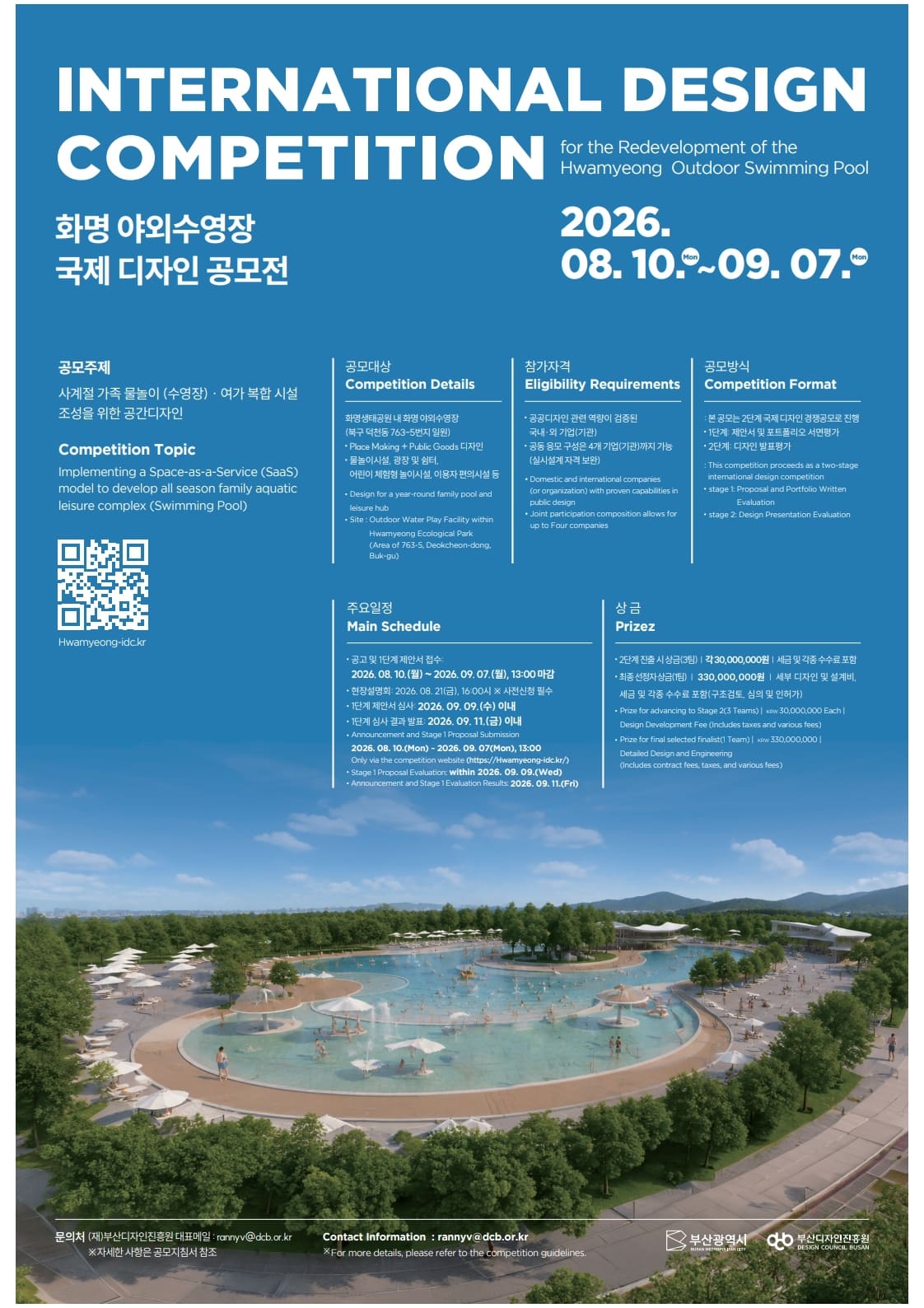
A Competition Rooted in Urban Resilience
Public swimming facilities in temperate climates face a predictable dilemma: they lie dormant for nine months of the year, occupying valuable land while generating no revenue and little community engagement. Busan Metropolitan City and the Design Council Busan are now confronting this issue head-on with an international design competition for the redevelopment of the Hwamyeong Outdoor Swimming Pool, a summer-only facility situated within the ecological park of the same name.
The brief asks entrants to reconsider the program entirely, shifting from a seasonal amenity to a year-round family leisure complex that respects the ecological and cultural context of the site. This is not simply an exercise in adaptive reuse; it is part of a coordinated effort to integrate waterfront infrastructure into Busan's larger urban vision, one that emphasizes sustainability, public access, and the layering of recreation with environmental stewardship.
At World Archi Design, we have been tracking the evolution of public aquatic facilities, particularly those that attempt to bridge the gap between landscape architecture and program-driven design. The Hwamyeong competition offers a compelling test case: how do you activate a site without erasing its ecological identity?
The Site and Its Constraints
Hwamyeong Ecological Park occupies a unique position within Busan's urban fabric. It is a green corridor that buffers the city's dense residential zones from the Nakdong River estuary, a critical wetland habitat. The existing outdoor pool is embedded within this landscape, and any proposal for its redevelopment must navigate the tension between intensifying use and preserving ecological function.
The competition organizers have framed the challenge around three interlocking values: ecological integrity, environmental responsibility, and cultural resonance. These are not abstract aspirations; they are constraints that will shape massing, material selection, and program distribution. The site's proximity to wetland ecosystems means that stormwater management, habitat connectivity, and biophilic design principles will need to be legible in the submitted schemes.
The challenge is compounded by the requirement for year-round operation. In a climate with distinct seasons, this necessitates careful consideration of thermal comfort, enclosure strategies, and energy systems. The architecture must accommodate both open-air summer use and enclosed or semi-enclosed winter programming without compromising the site's permeability or visual lightness.
Program and Precedent
The competition theme explicitly calls for "a spatial service model" for family water recreation and leisure. This language signals a desire for innovation not just in form, but in how the facility is used and managed. The organizers are looking for proposals that go beyond the conventional lap-pool-plus-splash-pad formula and explore hybrid typologies: perhaps a combination of therapeutic bathing, play zones, fitness infrastructure, and social gathering spaces.
Precedents exist, though they are scattered. The Laugardalslaug complex in Reykjavik successfully operates year-round by integrating geothermal heating with outdoor pools, creating a model that is climatically specific but conceptually transferable. Closer to home, the Gangneung Unification Park Aquatics Center by HAEAHN Architecture demonstrates how aquatic facilities can be embedded within larger park systems without disrupting landscape continuity.
What distinguishes the Hwamyeong brief is its emphasis on family orientation and ecological integration. This is not a competition for a high-performance training facility or a resort-style water park. The architecture must feel domestic, accessible, and rooted in place. It should encourage multi-generational use and foster a sense of stewardship toward the surrounding wetland.
Design Considerations
Participants will need to address several overlapping design problems. The first is the relationship between built form and landscape. Heavy-handed enclosures risk severing the visual and ecological connections that make the park legible as a continuous system. A more effective approach might involve low-profile structures, green roofs, or semi-submerged volumes that minimize their footprint above grade.
Material choice will be equally critical. The brief's emphasis on environmental values suggests a preference for low-carbon materials, locally sourced timber, or recycled aggregates. Transparency will also play a role, particularly in mediating between indoor and outdoor spaces. Glazing systems that can open fully in summer and provide thermal performance in winter offer one avenue; operable facades and transitional zones offer another.
Water management presents both a technical and a symbolic opportunity. Proposals that integrate rainwater harvesting, greywater recycling, or constructed wetlands as part of the facility's infrastructure will align with the ecological mandate of the site. These systems can be made visible, turning water treatment into a pedagogical tool that reinforces the park's environmental mission.
Finally, there is the question of program distribution. A successful scheme will likely resist the temptation to concentrate all activities into a single monolithic structure. Instead, it might distribute functions across multiple pavilions or clusters, allowing for phased use and creating a variety of spatial experiences. This approach also offers greater flexibility in managing seasonal operation, as individual elements can be opened or closed depending on demand.
Busan's Waterfront Strategy
The competition does not exist in isolation. Busan Metropolitan City has been pursuing an ambitious agenda of waterfront redevelopment, aiming to transform its coastline into a continuous network of public spaces, cultural amenities, and ecological infrastructure. Projects like the Busan Opera House competition and the North Port redevelopment signal a broader commitment to design-led urban transformation.
The Hwamyeong redevelopment is intended to complement these efforts, extending the logic of waterfront activation inland to the city's river and wetland systems. By creating a year-round destination within an ecological park, the city is betting that public investment in recreational infrastructure can drive both environmental restoration and community engagement.
This is a strategy with risks. Increased visitation can strain fragile ecosystems, and the pressure to generate revenue can push programming toward commercial models that compromise the site's public character. The competition brief acknowledges these tensions, but ultimately it will be up to designers to propose solutions that balance access with protection, intensity with restraint.
Submission and Timeline
Busan Metropolitan City and the Design Council Busan have established an online portal for submissions, which must be uploaded through the official competition website. The digital submission process is standard for international competitions of this scale, allowing for broad participation while streamlining administration.
The competition's focus on "synergy" with existing redevelopment initiatives suggests that jurors will be looking for proposals that are contextually responsive rather than formally autonomous. Schemes that ignore Busan's larger urban agenda or treat the site as a blank slate are unlikely to succeed. The winning proposal will need to demonstrate how a single project can contribute to a network of interventions, reinforcing the city's identity as a waterfront metropolis with a commitment to ecological resilience.
Forward Implications
The Hwamyeong competition arrives at a moment when cities across Asia are grappling with the legacy of mid-century recreational infrastructure. Many of these facilities were built quickly, with little regard for environmental impact or long-term adaptability. Redeveloping them offers a chance to correct past mistakes, but it also raises difficult questions about program, density, and public investment.
Busan's approach, embedding the redevelopment within a larger ecological and urban strategy, offers a model worth watching. If successful, the Hwamyeong project could demonstrate that aging aquatic facilities are not liabilities but opportunities, sites where architecture, landscape, and public policy can converge to produce something genuinely new. The competition itself is a signal: cities are willing to invest in design thinking, and they are looking for architects who can respond to complexity with clarity, ambition, and care.
Save this story. A free account keeps your reading list and the 07:00 email in one place.
CREATE FREE ACCOUNT →SIGN IN