
The Democratic Gaze
What happens when architectural judgement shifts from a panel of experts to a dispersed global audience? The results of this year's architecture public vote - spanning nineteen categories and drawing from a shortlist of nearly four hundred projects - offer a rare glimpse into collective taste at a moment when the discipline finds itself increasingly scrutinised for its social relevance. Across the projects that emerged as favourites, a pattern crystallises: readers are drawn to works that negotiate between economy and ambition, that embed themselves into existing urban or rural fabrics, and that foreground material honesty over technical bravura.
This is not to suggest that public preference is inherently virtuous or that professional judgement is obsolete. Rather, the divergence between what a jury might champion and what a broad readership selects reveals the multiple value systems currently competing within architectural discourse. At World Archi Design, we have tracked this tension for years, and the 2026 voting results underscore it with particular clarity.
Adaptive Reuse as Public Favourite
One project claimed victory in two separate categories: a former industrial warehouse in Oloron-Sainte-Marie, France, transformed by Collectif Encore into open civic infrastructure. The project won both the mixed-use and sustainable renovation categories, a rare double that signals the public's appetite for projects that repurpose rather than replace. The warehouse, once a relic of twentieth-century manufacturing, now functions as a flexible communal space, its original steel trusses and brick envelope preserved and reinterpreted.
This preference for adaptive reuse is not merely sentimental. It reflects a growing awareness that the embodied carbon in existing structures often outweighs the efficiency gains of new construction. Collectif Encore's intervention is legible as architecture - new insertions are distinct from the old fabric - but it refuses the rhetoric of erasure. The project joins a lineage of European adaptive reuse work, from Herzog & de Meuron's Tate Modern to Lacaton & Vassal's Tour Bois le Prêtre, yet its smaller scale and civic programme resonate differently with a lay audience. It is architecture as stewardship, not as monument.
Regional Identity and Material Vernacular
Another studio to secure multiple wins was ZAV Architects, based in Tehran. Readers selected two of the practice's projects: Golmorad, a house extension in Tehran, and Olive Leaf, a landscape and urban design project in Minoudasht. Both works are characterised by a rigorous engagement with Iranian vernacular traditions - courtyards, water features, and modular brick construction - yet neither is historicist. The Golmorad extension, for instance, employs a contemporary steel frame to support a cantilevered volume clad in terracotta, creating a dialogue between old and new that respects the existing dwelling without mimicking it.
ZAV's work is part of a broader resurgence of regionalism within contemporary practice, one that seeks to recover local construction knowledge without retreating into kitsch. This is particularly resonant in Iran, where international sanctions have paradoxically insulated the profession from global homogenisation. The materials are local, the labour is local, and the architectural language is rooted in climatic necessity. For a global readership, these projects offer a counterpoint to the placeless glass-and-steel typologies that dominate commercial architecture.
Small-Scale Interventions and Social Infrastructure
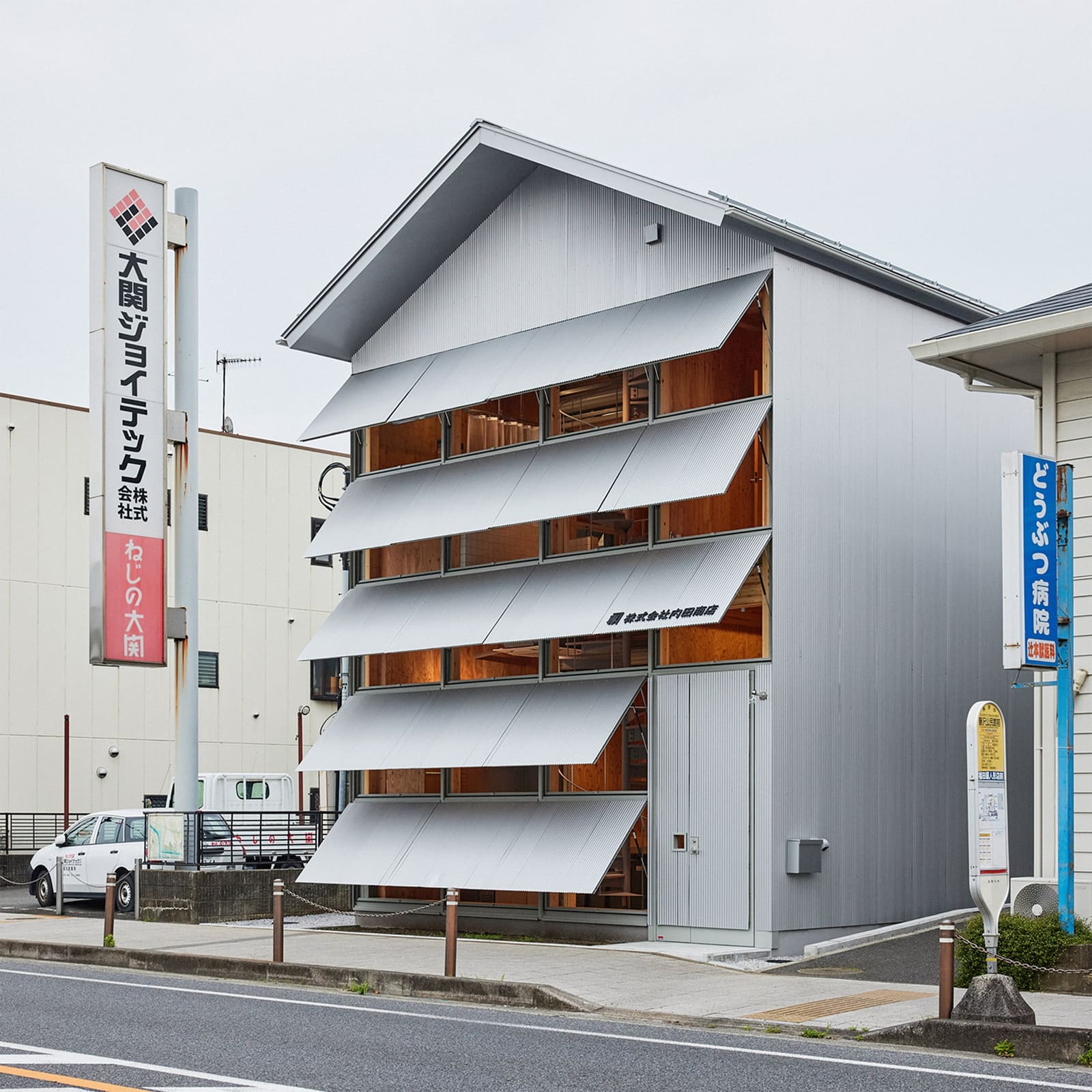
The public vote also favoured projects that operate at intimate scales. Schemata Architects' Uchida Shōten New Head Office in Fujisawa, Japan, won the small workplace category. The project, a modest two-storey structure for a traditional sake brewer, is clad in vertical timber battens and features an open-plan interior that prioritises natural ventilation and daylight. It is architecture in service of craft, a building that frames the activity within rather than asserting its own presence.
Similarly, the small project category was won by Arkibygg Arkitektar's Ring of Bjólfur, a circular timber structure in Seyðisfjörður, Iceland. The project, a public viewing platform, is constructed entirely from locally milled larch and employs traditional joinery techniques. Its form is derived from the topography, and its material palette is dictated by availability. This is architecture as infrastructure, not as object.
These small-scale winners suggest that public taste is attuned to the social function of architecture in ways that professional juries, often dazzled by technical innovation or formal complexity, may overlook. The projects are accessible, legible, and grounded in their contexts. They do not require extensive theoretical scaffolding to be understood, yet they are no less rigorous for it.
The Spectacle of Infrastructure
Not all public favourites were modest in scale or ambition. Foster + Partners' Techo International Airport in Phnom Penh, Cambodia, won the infrastructure and transport category. The project, a sweeping terminal building with a sinuous roof inspired by Angkorian temple complexes, is precisely the kind of high-budget, high-profile work that global audiences associate with architectural achievement. The roof structure, a diagrid of steel and glass spanning over one hundred metres, is a feat of engineering as much as design.
Yet even here, the public preference is instructive. The project's visual identity is explicitly tied to Cambodian cultural heritage, and its environmental strategy - natural ventilation, solar shading, and rainwater harvesting - aligns with the sustainability priorities evident elsewhere in the voting. Foster + Partners, often criticised for producing generic corporate architecture, here demonstrated that large-scale infrastructure can engage with place and climate without sacrificing technical sophistication.
Sustainability as Non-Negotiable
The sustainable building category was won by Tuckey Design Studio's Rammed Earth House in Wiltshire, United Kingdom. The project, a single-family residence constructed almost entirely from earth extracted on-site, is a testament to low-tech construction methods. The walls, nearly half a metre thick, provide thermal mass that moderates interior temperatures year-round. The material palette is deliberately restricted: earth, timber, and glass. No concrete, no steel, no imported finishes.
This is architecture at the opposite end of the spectrum from Foster + Partners' airport, yet both projects signal a shift in public expectation. Sustainability is no longer a niche concern or a marketing angle; it is a baseline criterion. The rammed earth house is not an experiment or a prototype; it is a fully realised dwelling that meets contemporary performance standards without recourse to industrialised materials. It is also, crucially, beautiful - a reminder that ecological responsibility and aesthetic ambition are not mutually exclusive.
What Juries Miss
The divergence between public and professional taste is not a new phenomenon. Juries, composed of architects, critics, and academics, tend to privilege formal innovation, theoretical coherence, and technical virtuosity. Public audiences, by contrast, respond to legibility, materiality, and perceived authenticity. Neither framework is superior, but the tension between them is productive.
Across the projects we have covered this year, a pattern emerges: the works that resonate most broadly are those that refuse the polarity between tradition and innovation, that engage with place without lapsing into pastiche, and that demonstrate that sustainability and beauty are not separate pursuits. The public vote, for all its limitations, offers a corrective to the insularity of professional discourse. It reminds us that architecture is not merely an academic discipline or a technical practice; it is a cultural force, subject to the judgements of those who inhabit and encounter it.
The Question of Precedent
Several of this year's winners invite comparison with canonical works. Blight Rayner Architecture's Glasshouse Theatre in Brisbane, which won the cultural project category, recalls the transparency and structural expressiveness of Renzo Piano's Menil Collection, yet it is adapted to a subtropical climate and a civic brief. The building's skin, a double layer of perforated aluminium, provides solar shading while maintaining visual permeability. The interior is a flexible black-box theatre, but the envelope is porous, integrating the building into the surrounding parkland.
Mold Architects' Perma, a hospitality project on Serifos Island, Greece, won in its category by employing a strategy of radical simplicity. The structure, a series of interconnected volumes clad in local stone, is nearly indistinguishable from the landscape. This is architecture as camouflage, a strategy with precedents in the work of Dimitris Pikionis and more recently in the landscape-embedded projects of RCR Arquitectes. The public vote suggests that this approach - architecture that defers to site - retains a powerful appeal.
The Global and the Local
One of the more intriguing aspects of this year's results is the geographic distribution of winning projects. While European works dominate, projects from Iran, Japan, Iceland, Greece, India, Lithuania, and Cambodia also feature prominently. This distribution reflects both the global reach of the voting platform and a growing interest in architectural production outside the traditional centres of London, New York, and Tokyo.
The inclusion of projects from smaller nations and less-documented contexts is significant. It suggests that public audiences are increasingly attuned to the diversity of architectural practice worldwide, and that the hegemony of Western models is, if not collapsing, at least being interrogated. The Iranian and Icelandic projects, in particular, offer models of practice that are place-specific and resource-constrained, yet architecturally ambitious.
The Limits of Popularity
It would be naive to suggest that public voting is a panacea for the elitism often associated with architectural awards. Popularity contests favour the photogenic and the easily communicable; they are vulnerable to campaigns, social media networks, and the inequities of global internet access. A project with a compelling narrative or a visually striking image may outperform a more rigorous but less telegenic work.
Yet the value of public voting lies not in its accuracy but in its transparency. It makes visible the criteria by which non-specialists judge architecture, and those criteria - material honesty, social function, environmental responsibility, cultural legibility - are not trivial. They are, in many ways, the same values that modernism once championed before the discipline turned inward.
What Comes Next
The final results of this year's programme will be determined by a professional jury and announced in November. It will be instructive to compare the jury's selections with the public favourites. Will the jury affirm the public's preference for adaptive reuse and material vernacular, or will it champion more formally adventurous work? Will sustainability remain central, or will it be treated as one criterion among many?
At World Archi Design, we remain agnostic about the superiority of either judgement. What interests us is the conversation between them - the recognition that architecture operates in multiple registers simultaneously, and that its success cannot be measured by a single metric. The public vote is a reminder that the discipline does not belong to architects alone. It is a collective endeavour, shaped by the values and desires of those who commission, inhabit, and simply observe the built environment.
The projects that won this year's public vote are not radical departures from established practice. They are, for the most part, careful, contextually responsive works that balance ambition with constraint. They suggest that the public appetite is not for spectacle but for substance - for architecture that is legible, durable, and attuned to the social and environmental challenges of the present moment. Whether professional juries will follow that lead remains to be seen.
Save this story. A free account keeps your reading list and the 07:00 email in one place.
CREATE FREE ACCOUNT →SIGN IN