
An Architectural Movement Reimagined
Brutalism in the Western imagination often conjures images of monolithic housing estates and civic centres in post-war Britain, raw concrete surfaces weathering under grey skies. Yet across Asia, the movement evolved along trajectories that challenge this narrow framing. The newly released Brutalist Asia publication, edited by Bob Pang and Derek Lamberton through Blue Crow Media, documents 140 structures spanning 28 countries, and in doing so, maps a counter-narrative: one in which brutalism's formal language was neither imported wholesale nor passively adopted, but actively reinterpreted through diverse cultural, climatic, and political contexts.
At World Archi Design, we have long argued that architectural movements are not static exports but living practices that mutate as they cross borders. The projects catalogued in this volume bear that thesis out. What emerges is not a single brutalist aesthetic but a constellation of approaches, each responding to specific site conditions and cultural imperatives while maintaining dialogue with the movement's core principles of structural honesty and material expression.
The Corbusian Lineage and Its Transformations
The influence of Le Corbusier on Asian brutalism is undeniable, yet the relationship is more complex than simple master-disciple transmission. Takamasa Yoshizaka, who trained directly under Le Corbusier at the Rue de Sèvres studio alongside Kunio Maekawa and Junzo Sakakura, played a crucial role in translating Corbusian theory into Japanese practice. His Inter-University Seminar House in Hachioji, Tokyo, completed in 1965, demonstrates this synthesis. The complex features an inverted pyramid main hall, a form that recalls Corbusian experiments with geometric primacy whilst addressing the specific programmatic needs of an academic institution. Student pavilions are embedded into the hillside, a gesture towards contextual integration that tempers brutalism's tendency towards object-building.
Yoshizaka's contribution extended beyond built work; his translations of Towards an Architecture and The Modulor into Japanese created the theoretical infrastructure for brutalism's reception in Japan. This intellectual labour is often overlooked in architectural histories that privilege built form over discourse, yet it was essential to establishing a shared vocabulary.
Kenzo Tange's Sacred Heart High School for Girls in New Taipei City, Taiwan, completed in 1967, represents another strand of this lineage. As Tange's first commission outside Japan and his sole surviving work in Taiwan, the building occupies a unique position in his oeuvre. The project demonstrates how brutalist principles could be adapted to institutional programmes beyond the civic and cultural buildings that dominated the movement in Europe.
Self-Taught Practices and Structural Experimentation
One of the volume's most compelling revelations concerns architects who arrived at brutalism without formal training. Amorn Srivong's trajectory from construction labourer to draftsman to designer challenges assumptions about architectural education and practice. His Round Building at the Faculty of Science, Mahidol University, completed in 1968, features cantilevered structures and organic geometry that demonstrate sophisticated spatial thinking.
Srivong's lack of formal training may have paradoxically freed him to experiment with forms that conventionally educated architects might have deemed too risky. During the 1960s and 1970s, as Thai universities expanded rapidly, institutions including Chiang Mai University, Khon Kaen University, and Thammasat University became testing grounds for his ideas. This pattern, whereby educational building programmes provided opportunities for architectural innovation, recurs across the Asian brutalist canon.
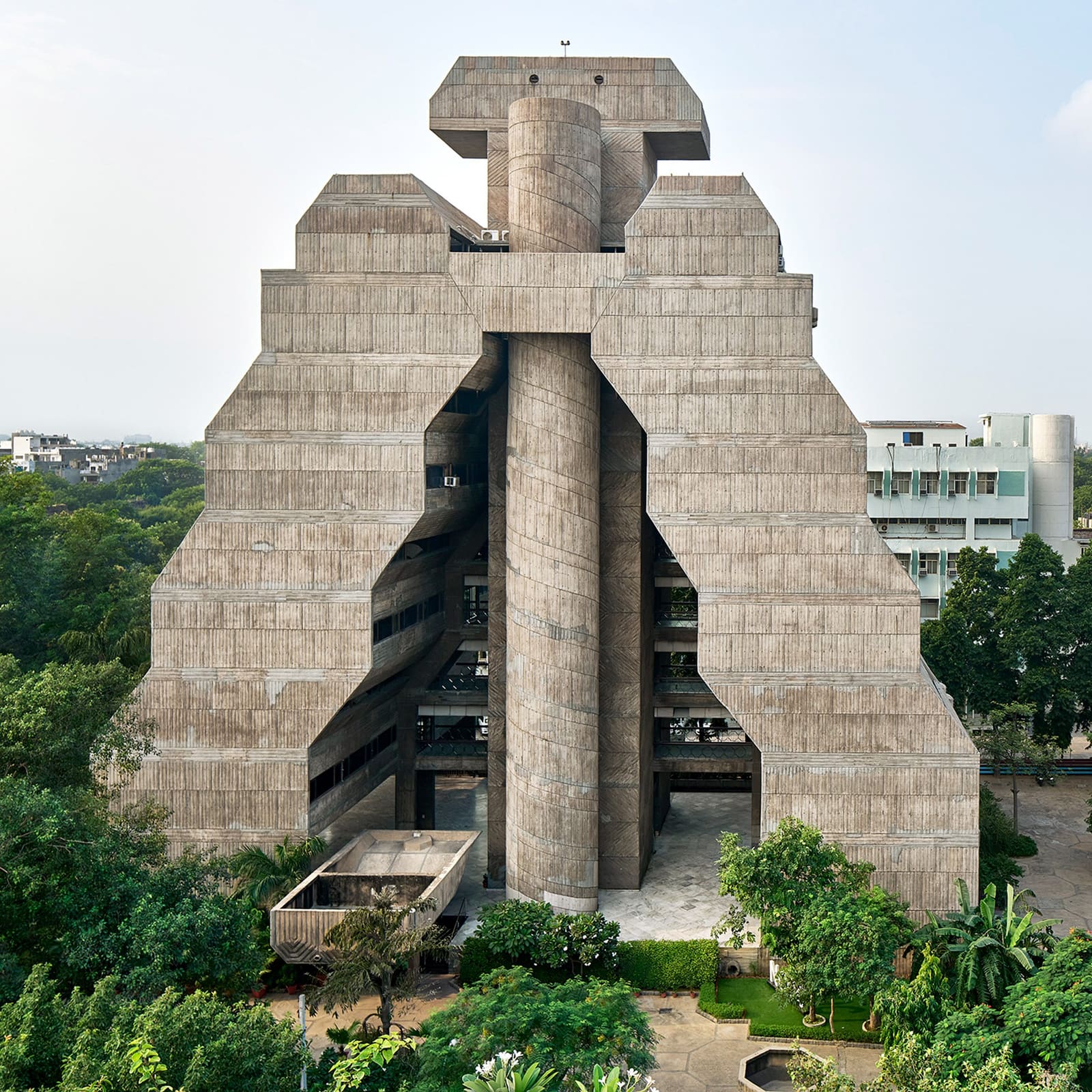
The collaboration between form and engineering is particularly evident in the work of Indian architect Kuldip Singh, whose National Cooperative Development Corporation building in New Delhi was completed in 1980. Educated at both the School of Planning and Architecture in New Delhi and University College London, Singh developed a highly stylised approach characterised by bold geometry and challenging structures. His partnership with structural engineer Mahendra Raj, who had worked on Le Corbusier's Chandigarh project, pushed the technical boundaries of what reinforced concrete could achieve in the Indian climate.
Cultural Metaphor and Symbolic Form
Several projects in the catalogue demonstrate how brutalism's formal vocabulary was inflected with local symbolic content. Kim Swoo-geun's Kyungdong Presbyterian Church in Seoul, completed in 1981, exemplifies this approach. Kim, whom Time magazine once dubbed the "Lorenzo de' Medici" of South Korea, conceived the church as an abstraction of praying hands, a gesture common across Korean and broader Asian religious practice. The building's vertical volumes represent fingers, whilst the interior space evokes a whale's belly, a metaphor that resonates with biblical narrative.
This symbolic deployment of form distinguishes Kim's work from the more functionalist strains of brutalism. The church is not merely an efficient enclosure for worship but a three-dimensional representation of devotion itself. Such projects suggest that brutalism's emphasis on structural legibility could be harnessed for iconographic purposes, transforming abstract geometry into culturally specific meaning.
Adaptation to Climate and Context
The General Post Office in Doha, Qatar, designed by British architects Twist and Whitley and completed in 1985, illustrates how foreign practitioners adapted brutalist principles to Gulf climates and local architectural traditions. The firm, whose portfolio includes the Arts and Social Sciences Library at the University of Bristol and the Science Library at Queen's University Belfast, developed a refined approach that blended brutalist tectonics with the domestic language of traditional Qatari architecture.
This cross-pollination challenges simplistic narratives of Western architectural imperialism. Whilst Twist and Whitley brought expertise in concrete construction and institutional typologies, the project's success depended on their willingness to engage with local building cultures. The result is a hybrid that belongs neither wholly to British brutalism nor to Gulf vernacular but occupies a productive middle ground.
Similarly, the Dafineh Museum in Tehran, completed in 1978 by Nezam Ameri, Kamal Kamooneh, and Hormozdyar Khosravi, demonstrates Iranian engagement with brutalist principles filtered through the influence of Frank Lloyd Wright. Kamooneh had established his practice in the 1960s alongside Ameri, a former Wright student, and their work bears traces of Wrightian horizontality and integration with landscape. The museum represents a synthesis of these influences, adapted to Tehran's urban context.
Institutional Interventions and Urban Strategies
Tao Ho's additions to St Stephen's College in Hong Kong, completed in 1981, demonstrate how brutalist architecture could address problems of institutional legibility and campus coherence. Founded in 1903 as a British-style institution, the college had developed in a scattered and unstructured manner. Ho's Special Room Block and Tang Shiu Kin Hall were conceived as focal points to organise the campus spatially.
The design comprises three classroom blocks and a standalone indoor sports hall connected by arched staircases and elevated walkways. These circulation elements do more than move people; they create a legible diagram of institutional hierarchy and spatial relationships. Ho's strategy recalls the megastructural ambitions of 1960s metabolism and archigram, wherein circulation infrastructure becomes the primary architectural gesture.
Sculpture, War, and Incomplete Histories
Two projects in the catalogue speak to brutalism's relationship with disruption and incompletion. Le Huu Thang's Cua Tung Writers' House in Vietnam, completed in 1992, was sponsored by the regional Literature and Arts Association during the early post-Đổi Mới transition era. Thang approached the design as sculpture rather than conventional architecture, a strategy that reflects brutalism's affinity with the plastic arts.
Even more poignant is Khalil Khoury's Interdesign Building in Beirut, which took 23 years to complete due to the Lebanese Civil War. Construction began in 1973 but was interrupted by the outbreak of conflict in 1975; the building was not finished until 1997 and has never been fully occupied. Despite this, it is widely regarded as one of the most remarkable brutalist structures in the Middle East according to those familiar with the project.
The Interdesign Building embodies architecture's vulnerability to historical forces beyond its control. Its incomplete narrative raises questions about how we assess buildings that never fulfilled their intended functions. Is architectural significance inherent in formal qualities, or does it depend on social use? The building's reputation suggests that, at least within specialist discourse, formal and spatial innovation can be recognised independently of programmatic success.
Rethinking Brutalism's Geography
The projects assembled in Brutalist Asia collectively argue for a more geographically and culturally nuanced understanding of the movement. Rather than a monolithic style exported from Europe, brutalism emerges as a set of principles, material preferences, and formal tendencies that were variously adopted, adapted, and transformed across Asia.
This diversity challenges teleological narratives that position Western modernism as origin and non-Western practices as derivative. Architects like Amorn Srivong, who arrived at brutalist forms without direct exposure to European precedents, suggest that the movement's formal logic had an internal coherence that could be independently discovered. Others, like Kim Swoo-geun and Kenzo Tange, deliberately synthesised Corbusian principles with local symbolic and spatial traditions, producing work that cannot be neatly categorised as either Eastern or Western.
At the same time, the catalogue does not romanticise these projects or present them as unproblematic. Many brutalist buildings in Asia, as elsewhere, have aged poorly, suffered from deferred maintenance, or failed to achieve the social ambitions their architects articulated. The movement's legacy is contested, and rightly so. What the publication offers is not an argument for brutalism's rehabilitation but a more complete picture of its global extent and local variations.
As architectural discourse continues to grapple with questions of regionalism, climate adaptation, and the relationship between tradition and innovation, the projects documented in Brutalist Asia offer valuable precedents. They demonstrate that architectural movements are not fixed templates but evolving conversations, shaped as much by the contexts into which they are introduced as by their points of origin. In an era increasingly sceptical of universal architectural languages, this historical perspective feels particularly relevant.
Save this story. A free account keeps your reading list and the 07:00 email in one place.
CREATE FREE ACCOUNT →SIGN IN