
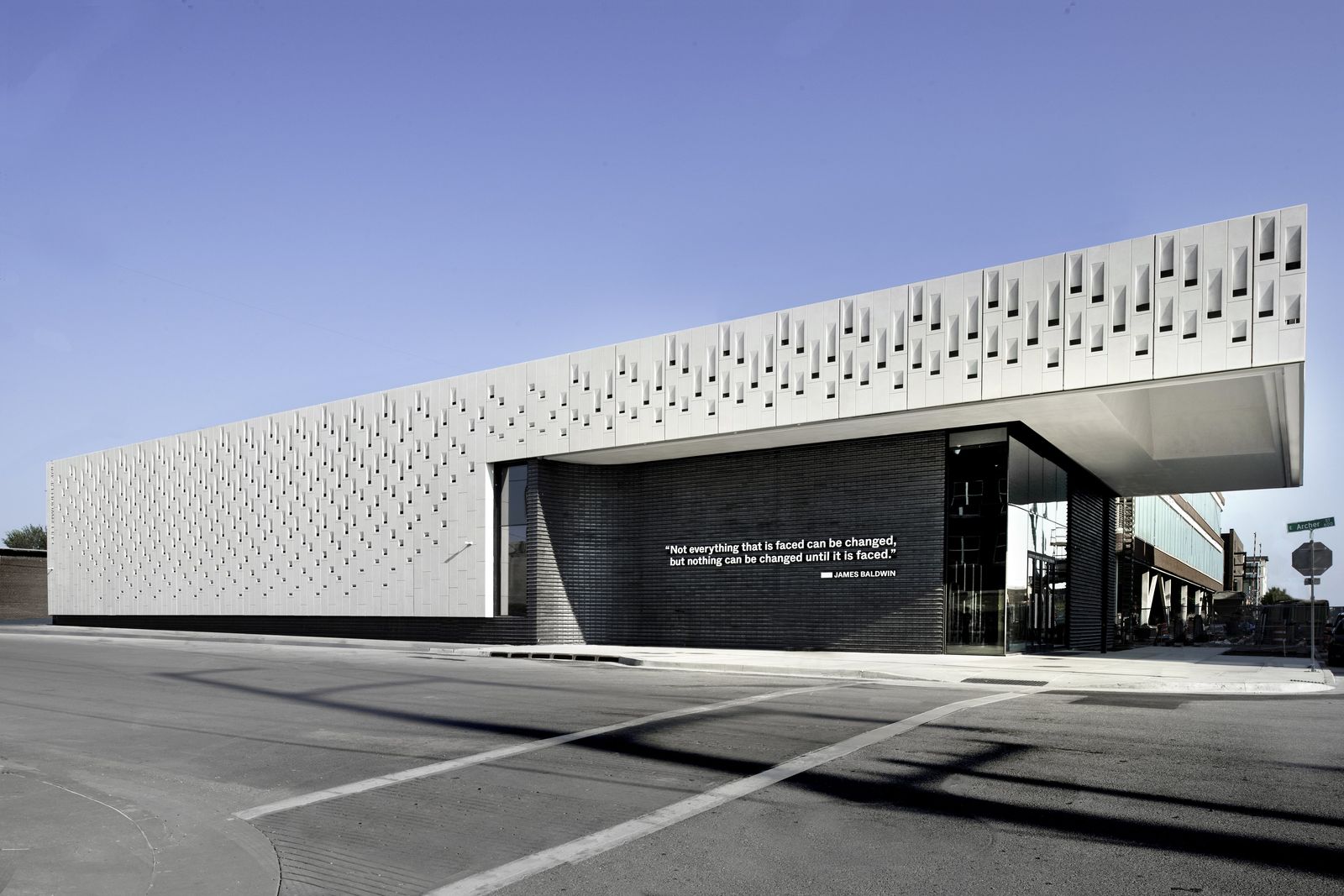
Project Info
Project Name: Greenwood Rising Black Wall Street History Center
Location: Tulsa, Oklahoma, USA
Architects/Designers: Local Projects in collaboration with Selser Schaefer Architects
Client/Owner: 1921 Tulsa Race Massacre Centennial Commission
Architecture as Memory and Healing
Greenwood Rising stands at the gateway to Tulsa’s Greenwood District—once home to “Black Wall Street,” one of the most prosperous African-American communities in the early 20th century. The 1921 Tulsa Race Massacre destroyed hundreds of businesses and lives, leaving scars still felt today. Local Projects approached the commission not only as a museum design but as a civic responsibility: to create a space that could hold memory while pointing forward toward justice.

The exterior architecture uses dark masonry and reflective surfaces, invoking both strength and contemplation. Its angular geometry suggests resilience—an upward, forward motion even in the face of tragedy. Transparent entryways invite openness, signaling that this is not a sealed memorial but a living place of encounter and learning.
A Journey Through Narrative Space
Inside, the design choreographs an experience in three acts—acknowledgment, remembrance, and reimagination. Visitors begin with an immersive introduction to the thriving businesses and cultural vibrancy of pre-1921 Greenwood. Interactive media, archival footage, and oral histories reconstruct a world erased by violence. The journey then moves into a solemn memorial chamber—its dim light, tactile materials, and reflective walls fostering quiet confrontation with loss. Finally, the path opens into spaces of dialogue, with digital installations and communal rooms encouraging conversation about racial justice today. This narrative progression is not linear alone but spatially felt. Ceiling heights shift, acoustics alternate between hushed and resonant, and lighting transitions from shadow into brightness—architecture itself becomes a storytelling medium.

Material and Symbolism
The palette of materials reinforces the project’s symbolic weight. Charred wood evokes buildings set aflame, while polished concrete floors reference both durability and the streets once lined with thriving shops. In contrast, luminous screens and glowing installations represent resilience, technology, and the living presence of Greenwood’s legacy today. A central memorial wall inscribed with names of survivors and victims anchors the space. Its rough stone surface allows visitors to physically trace memory through touch, reinforcing the intimate bond between history and the body.

Civic Presence and Urban Dialogue
Beyond the interior, Greenwood Rising anchors the Greenwood District as both marker and gathering place. Its plaza connects with John Hope Franklin Reconciliation Park and other historic landmarks, forming a cultural corridor that integrates memory into the city’s fabric. The building does not dominate the landscape but participates in it, acting as a gateway that frames both past and present.

A Platform for Equity and Future Visions
Local Projects emphasized that Greenwood Rising is not solely about commemoration—it is also about envisioning equitable futures. The final galleries invite visitors to engage with ongoing conversations around systemic racism, economic justice, and civic responsibility. Through digital storytelling platforms, guests can share commitments to change, making the building not only a memorial but an active tool for social transformation.

Why Greenwood Rising Matters
By weaving together architecture, technology, and narrative, Greenwood Rising redefines what a cultural center can be. It is at once a museum, a memorial, and a civic catalyst. In honoring the legacy of Black Wall Street, the building ensures that memory becomes a foundation for dialogue—and that architecture itself can serve as a bridge from mourning to empowerment.
Save this story. A free account keeps your reading list and the 07:00 email in one place.
CREATE FREE ACCOUNT →SIGN IN