
A Studio That Reflects Its Mission
There's something revealing about the way creative agencies choose to house themselves. For Public Art Company, an LA-based firm that conceives and curates large-scale artworks for public spaces and corporate campuses, the answer arrived in the form of a compact studio on Hyperion Avenue that refuses to take itself too seriously. Founder Raffi Lehrer describes the aesthetic as "muppets on acid," a phrase borrowed from a friend that captures the space's joyful irreverence. It's a fitting backdrop for a team whose work lives at the intersection of art, urbanism, and spatial experience.
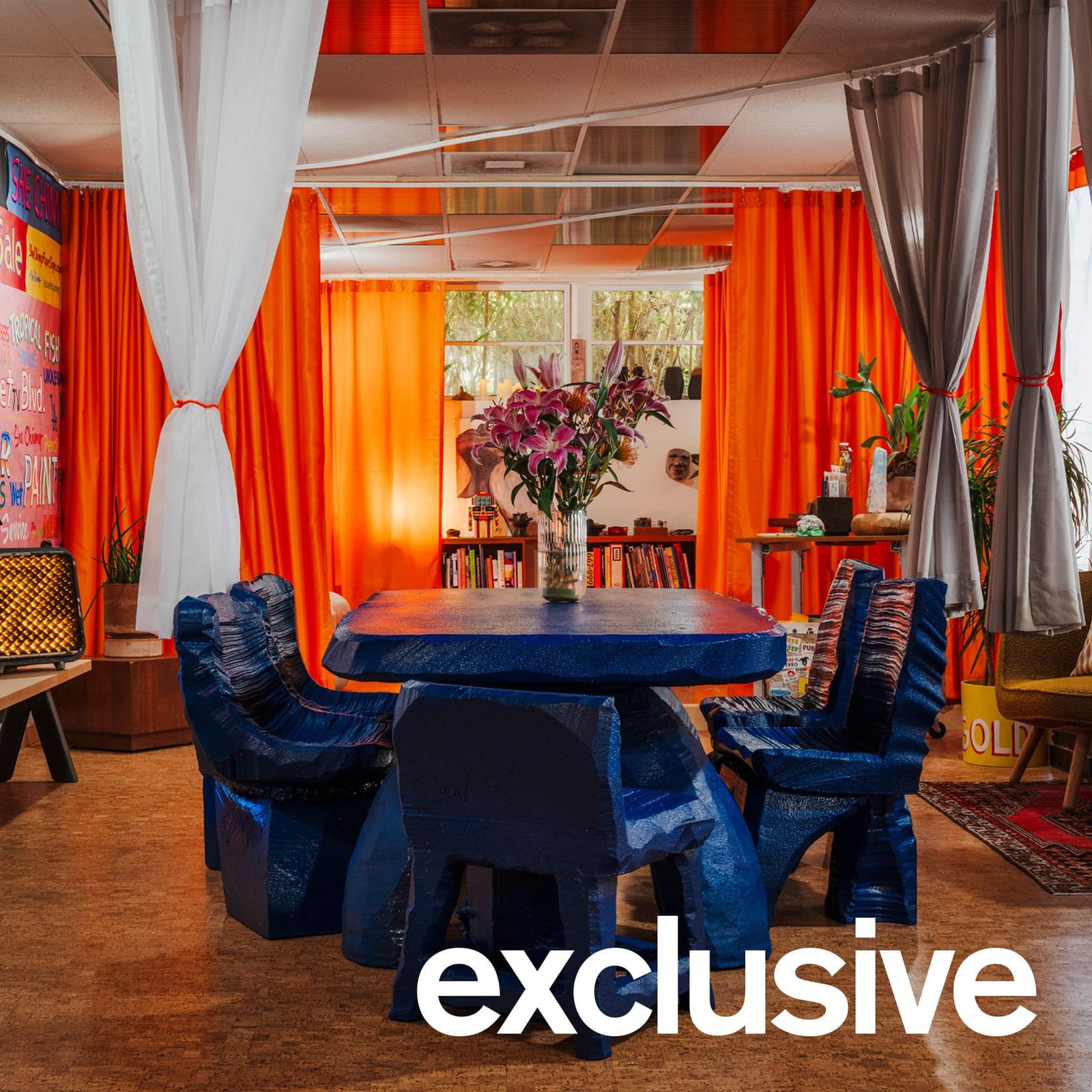
Since establishing the company in 2020, Lehrer has been methodical about building an environment that serves both practical needs and creative ambition. The renovation stripped away conventional office trappings, replacing drop-ceiling panels with polycarbonate sheets that expose the structural skeleton overhead. Cork tiles underfoot soften sound and footfall, creating an acoustically tuned environment that feels as considered as it is playful.
Curtains as Architecture
The defining gesture is a system of translucent drapes designed by Carlos Medellin. Mounted on ceiling tracks, these curtains in white, blue, grey, and orange slice diagonally through the room, curve around corners, and trace the perimeter in fluid arcs. The result is a space that can morph from open studio to intimate meeting room to party venue, all through the simple act of pulling fabric across a track.
This flexibility matters in a workspace that must accommodate everything from client presentations to team critiques to after-hours gatherings. The curtain system avoids the rigidity of fixed partitions while maintaining the ability to define zones when privacy or focus is required. It's a low-tech solution that aligns with a broader shift we've been tracking in adaptive workspace design, where reconfigurability is prized over permanence.
At the back of the studio, a raised platform creates a distinct zone elevated just enough to signal a change in function without isolating it behind walls. This area hosts Katie Stout's Pepita the Couch, a humanoid sofa whose anthropomorphic form brings warmth and humor to the space. A small pink lamp, also by Stout, shares the platform alongside a NeuroWeave carpet by Güvenç Özel, whose algorithmic patterning adds a layer of digital craft to the otherwise analog environment.
Furniture as Protagonist
In many offices, furniture serves as backdrop. Here, it takes center stage. A chunky blue table and chair set by Matt Nichols anchors the central area, offering a casual meeting spot that feels more like a kitchen table than a conference room. The scale and color of these pieces assert their presence without overwhelming the room, a balance that requires both confidence and restraint.
Near the window, a pair of green chairs designed by Bjarke Ingels for Fritz Hansen provide a counterpoint to the bolder gestures elsewhere. These pieces, with their sculptural lines and muted palette, ground the space and offer a moment of visual respite. The window itself is adorned with text graphics by Ben Klevay, whose colorful, paper-based typographic works also cover another wall, injecting language and narrative into the visual field.
Lehrer's own contributions include a desk he built himself and a green candelabra, both of which speak to a hands-on approach that blurs the line between curator and maker. This DIY ethos runs through the project, suggesting that the space is less a finished product than an ongoing experiment in how creative teams can shape their surroundings.
Art in the Everyday
Sculptures by Misha Kahn punctuate the studio, their idiosyncratic forms adding layers of texture and surprise. Works by Julieta Gil, Kumkum Fernando, and Philip Mueller further populate the walls and surfaces, turning the office into a rotating gallery that shifts as new pieces are acquired or loaned out for projects.
This density of art and design objects could easily tip into visual chaos, but the polycarbonate ceiling and cork floor provide neutral planes that allow the colorful interventions to breathe. The material palette is intentionally restrained where the architecture meets the ground and sky, creating a stable framework within which the furniture and art can perform.
Context Within LA's Studio Culture
Los Angeles has long been a city where creative studios double as manifestations of brand identity. From the sculptural wood staircase at Puma Studios to the futuristic workstations at Charlap Hyman & Herrero's office, the city's design agencies understand that space is communication. Public Art Company's studio fits within this tradition while carving out its own territory, one that prioritizes flexibility, collectibility, and a certain irreverent joy.
The Hyperion Avenue location situates the studio within a neighborhood that has become a hub for creative production, from animation studios to independent galleries. This context informs the project's openness to experimentation and its willingness to embrace aesthetics that might feel too bold in a more conservative setting.
Making Space for Change
What distinguishes this project is its acknowledgment that creative work demands spatial variability. The curtain system, the raised platform, the mix of furniture scales, all point to an understanding that different tasks require different environments. A client meeting demands enclosure and focus; a team brainstorm benefits from openness and visual stimulation; an evening event calls for a complete reconfiguration.
By embedding this flexibility into the architecture rather than treating it as an afterthought, Lehrer and his collaborators have created a workspace that can evolve alongside the practice. As Public Art Company's portfolio expands and its team grows, the studio on Hyperion Avenue will adapt, its translucent curtains sliding into new configurations, its platform hosting different gatherings, its walls rotating through new artworks.
In an industry where creative environments often feel either sterile or overly precious, Public Art Company's studio offers a third path: one that is playful without being frivolous, curated without being rigid, and deeply personal without losing its utility. It's a space that understands that the best creative work often happens at the edges, where discipline meets improvisation and where color, humor, and a bit of acid-tinged whimsy can coexist with serious ambition.
Save this story. A free account keeps your reading list and the 07:00 email in one place.
CREATE FREE ACCOUNT →SIGN IN