
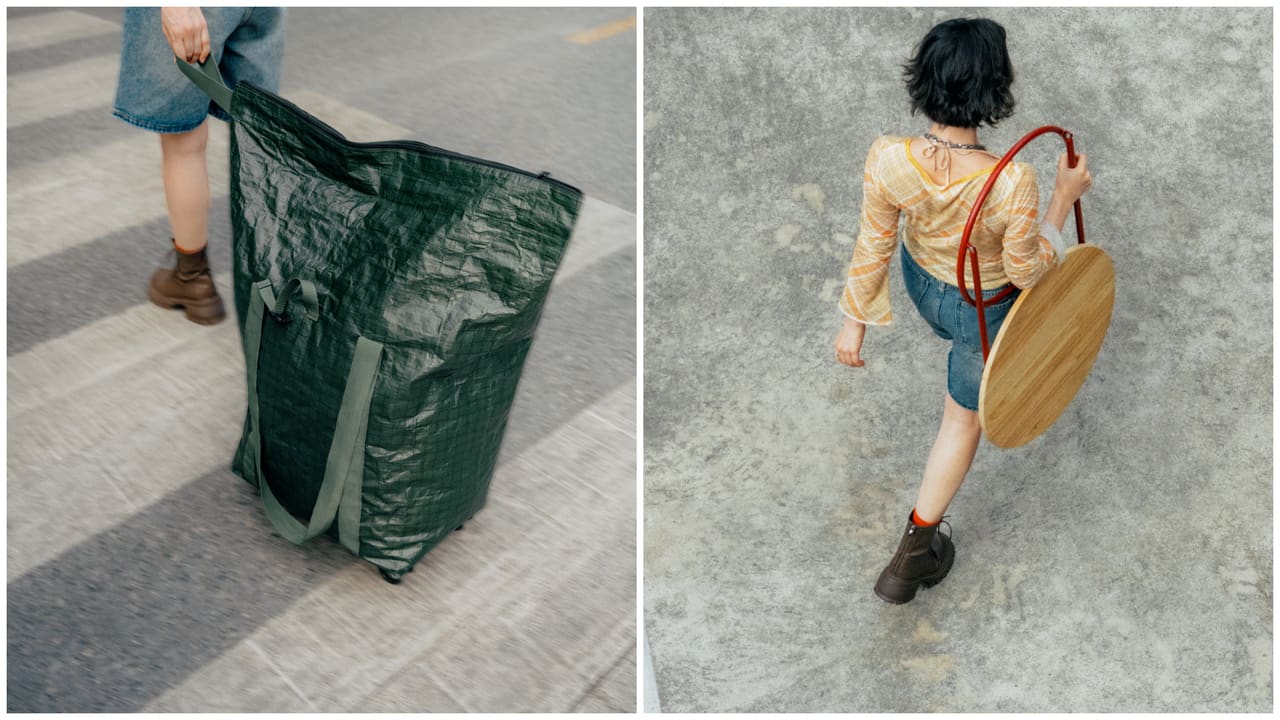
The Furniture That Follows You
At World Archi Design, we've been tracking a quiet shift in how younger generations relate to domestic space. For many urban dwellers in their twenties and early thirties, home is less a fixed address than a sequence of provisional arrangements: studio apartments with no closets, shared flats where the bedroom doubles as office and living room, leases that expire after twelve months. The transience isn't aspirational; it's structural. And yet the imperative to make a space feel intentional, even cherished, persists.
Ikea has turned this tension into the organizing principle of a new collection. After observing the daily realities of young adults in central London, the Swedish retailer developed Kompishäng, a twelve-piece line of furniture and accessories engineered to move as often as their owners do. The brief was straightforward: create objects light enough to carry without a vehicle, compact enough to fit in tight quarters, and resilient enough to survive repeated assembly, disassembly, and transit.
Design Born from Observation, Not Assumption
The collection emerged from ethnographic fieldwork rather than trend forecasting. Ikea's design team spent time in the homes of twentysomethings navigating rental markets, noting recurring patterns. Storage was perpetually inadequate. Cardboard boxes, battered from prior moves, often served as makeshift furniture. But certain objects, usually small and easily transported, appeared again and again across different dwellings: a particular mirror, a folding chair, a single shelf unit. These were the belongings that survived the churn.
What the team identified was not a lack of attachment to home, but a pragmatic calculus about which possessions could justify their place in a life defined by mobility. The resulting designs reflect that calculus. A pair of cylindrical stools, for instance, stack vertically to form a modular shelving system. A folding table, constructed from solid pine, collapses flat and weighs little enough to carry solo up several flights of stairs. A bookshelf doubles as a bookend, occupying minimal floor area while remaining stable enough to hold a modest library.
Modularity Without Compromise
The collection's material palette skews utilitarian: powder-coated steel, canvas, solid pine, jute. These are not materials chosen for novelty. They're selected for durability and ease of repair, qualities that matter when an object must endure multiple relocations and the rough handling that comes with them. The steel frame of the hanging wardrobe organizer, for example, is robust enough to support winter coats yet folds into a profile slim enough to slide behind a door or into a car trunk.
Designer David Wahl, who contributed a round side table to the line, describes the design philosophy as one of "accompaniment rather than anchoring." The table is lightweight, folds entirely flat, and can be reassembled without tools. It's designed to adapt to shifting contexts: a bedside surface in one apartment, a plant stand in the next, a laptop desk in a third. The form is simple, almost austere, but the function is elastic.
Wiebke Braasch, another designer on the project, emphasizes the collection's human-scale portability. "We wanted to create furniture that could be moved with your body alone, without needing a car," she notes. This constraint shaped every dimension and joint. The wheeled shopping bag, which can double as a picnic carrier or laundry hauler, exemplifies this thinking. It's a hybrid object, refusing to be categorized as purely furniture or purely accessory, existing instead in the liminal space that defines much of contemporary rental living.
The Aesthetics of Impermanence
One of the more nuanced challenges the team faced was aesthetic. How do you design for transience without signaling disposability? According to Dora Ding, a product developer on the project, the answer lies in intentionality. "Even if you move often, you don't want your home to feel temporary," she observes. The collection was conceived to look considered, not makeshift. The mirror, for instance, features grooves along its frame that allow it to double as a display for postcards or photographs, small gestures that invite personalization.
This is a departure from the flat-pack ethos that has long defined accessible furniture. Kompishäng pieces are designed to be reconfigured rather than replaced. The stacking stools can shift from seating to storage to display, depending on need. The collapsible jute plant pot compresses when not in use, then expands to accommodate greenery, a small concession to biophilic impulses even in the tightest quarters.
The collection also includes back-of-door storage, a typology often overlooked in furniture design but critical in spaces where vertical real estate is the only real estate available. These are details born from observation rather than convention, and they signal a broader shift in how design responds to economic and demographic realities.
Precedent and Context
Portable, modular furniture is hardly a new concept. Charlotte Perriand's folding furniture for mountain chalets in the 1930s, Enzo Mari's Autoprogettazione DIY designs, and more recently, the work of studios like Opendesk, have all explored the intersection of mobility, affordability, and user agency. What distinguishes Kompishäng is its explicit engagement with the rental economy as a design context, not an afterthought.
Where earlier experiments in modular furniture often imagined the user as an itinerant creative or a back-to-the-land idealist, this collection is rooted in the mundane constraints of contemporary urban life: lease terms, security deposits, the absence of storage, the logistical hassle of moving without a vehicle. It's furniture for a generation that doesn't expect to own property but still expects to inhabit space with intention.
What Remains
The Kompishäng collection will be available through Ikea's retail channels, with pieces priced accessibly: stools at forty pounds per pair, the folding desk at seventy, the mirror at twelve. These are not luxury objects, but they're designed with a seriousness that resists the throwaway culture often associated with budget furniture.
Whether this approach will resonate beyond its intended demographic remains to be seen. But the collection does pose a useful question for the discipline at large: what does it mean to design for permanence when permanence itself is increasingly rare? In a landscape where fewer young people will own homes, where urban density continues to climb, and where the average tenancy shortens, furniture that moves with you, rather than anchoring you, might be less a niche offering than a preview of the norm.
Save this story. A free account keeps your reading list and the 07:00 email in one place.
CREATE FREE ACCOUNT →SIGN IN