
The Architectural Thread
Furniture becomes architecture when it stops being placed in a room and starts shaping the room itself. That principle, articulated most clearly by the Bauhaus and later refined by the generation who passed through Cranbrook Academy, remains the organising logic of Knoll's collection. Florence Knoll, who studied under Mies van der Rohe and worked alongside Gropius and Breuer before establishing the Knoll Planning Unit in 1946, understood interiors as spatial problems rather than styling exercises. The Planning Unit designed entire environments, positioning furniture as load-bearing components of the spatial programme. Eighty years on, that ethos persists: new commissions sit comfortably beside pieces from the 1920s because both are addressing the same question of how objects structure space.
The result is a catalogue that spans Marcel Breuer's 1925 Wassily Chair to Willo Perron's 2023 Perron Pillo Sofa without requiring a historical footnote to justify the gap. In Australia, Living Edge maintains the full range, offering both the canonical works and recent releases as a continuous design lineage rather than a heritage archive.
Breuer's Bicycle Frame
The Wassily Chair remains the clearest expression of structural transparency in furniture. Breuer, then teaching at the Bauhaus in Dessau, observed the bent tubular steel of his bicycle and recognised that the same material could replace the hidden timber frame of the traditional upholstered armchair. The chair reduces seating to chrome-plated steel tubing and a handful of leather slings, leaving the structural logic completely visible. Nothing is concealed; the frame is the chair.
A century later, the design reads as effortlessly modern precisely because it refuses ornament. The proportions are balanced, the material honest, and the form follows directly from the manufacturing process. It does not date because it never relied on stylistic convention in the first place. That purity of tectonic expression is why the Wassily remains in production and why it continues to anchor contemporary interiors without apology.
Schultz and the Problem of Outdoor Furniture
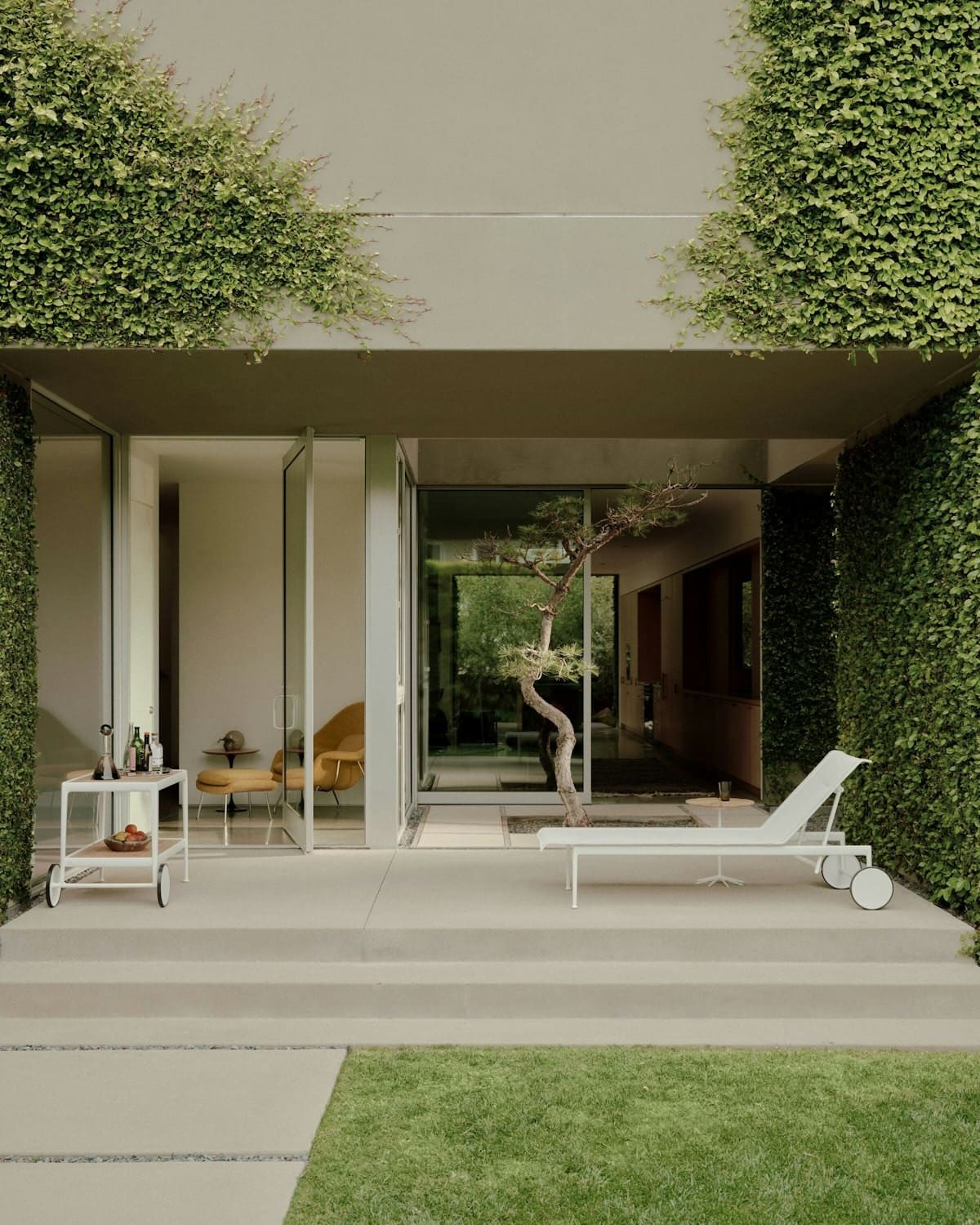
Richard Schultz's 1966 Collection for Knoll originated in a domestic brief: Florence Knoll needed outdoor furniture for her Florida residence that could withstand salt air and intense sunlight without degrading or resembling poolside resort furniture. Schultz responded with a series in cast aluminium and woven vinyl-coated polyester mesh, translating the proportions and restraint of Knoll's indoor catalogue to the exterior.
The lounge chairs, dining tables and chaise lounges in the 1966 Collection carry the same tectonic clarity as Breuer's tubular steel, but adapted to the demands of weather and material durability. The aluminium frames are powder-coated, the mesh is stretched taut across the structure, and the profiles remain deliberately slender. Sixty years later, the series continues to define the vocabulary of modern outdoor furniture, demonstrating that architectural rigour need not compromise comfort or longevity. The pieces work equally well on a terrace or in a garden today as they did when Schultz first delivered them to Florida.
Perron's Pillow Stack
Willo Perron's 2023 Perron Pillo Sofa represents the other end of the timeline, and it makes the case for why the collection remains relevant. The sofa is low, deep and modular, constructed from oversized cushions that resemble a deliberate pile of pillows rather than a conventional upholstered frame. It has none of the structural tension of the Wassily and none of the taut precision of Schultz's outdoor chairs, and that divergence is intentional.
The Perron Pillo acknowledges that contemporary living rooms are used for reclining, working, eating and informal lounging rather than formal sitting. The sofa adapts to those behaviours by offering a soft, reconfigurable surface that prioritises comfort over geometry. Yet it remains consistent with Knoll's broader logic: the form responds directly to how the piece will be used, and the proportions are carefully calibrated. The cushions are not arbitrarily sized; they are designed to support a range of postures without collapsing or requiring constant adjustment.
The precedent exists within Knoll's own archive. In 1948, Florence Knoll asked Eero Saarinen for a chair she could curl up in, describing it as a basket full of pillows. Saarinen delivered the Womb Chair, a moulded fibreglass shell with generous upholstery. Perron's sofa, seventy-five years later, is a more literal interpretation of the same brief: more pillows, less structure. Both pieces share an attention to proportion and an understanding of comfort as a design parameter rather than a styling afterthought. Placed together, they read as variations on a consistent theme rather than artefacts from different eras.
A Continuous Lineage
Knoll's catalogue includes work by Harry Bertoia, whose Diamond Chair from 1952 applies Breuer's logic to welded steel wire, and Mies van der Rohe, whose Barcelona Chair from 1929 refines the cantilevered profile into a single fluid gesture. The collection also includes more recent commissions that extend the same principles: furniture as spatial infrastructure, material honesty, and form derived from use.
What distinguishes this approach is that the classics are not treated as historical artefacts. They share showroom space with new releases, and the juxtaposition is deliberate. The Wassily Chair does not require a museum label to justify its presence; it functions as effectively in a 2026 interior as it did in 1925. Similarly, the Perron Pillo Sofa does not need to reference Breuer to validate its inclusion. Both are responses to the question of how people occupy space, separated by a century but united by method.
Living Edge, which represents Knoll in Australia, maintains this full range, from the 1920s Bauhaus pieces to the most recent commissions. The showroom is not organised chronologically; instead, it presents the collection as a coherent vocabulary of forms that can be combined across decades. A dining table by Saarinen can sit alongside lounge chairs by Schultz and a sofa by Perron without requiring explanation, because all three were designed with the same understanding of furniture as architecture.
Why the Collection Still Matters
Design history becomes useful when it remains in active use. Knoll's collection is not a retrospective; it is a working archive, continuously updated and continuously relevant. The 1966 Collection is still manufactured to Schultz's original specifications, the Wassily Chair is still bent from the same tubular steel, and new commissions are still evaluated against the same criteria Florence Knoll established in the 1940s: does the piece solve a spatial problem, is the material appropriate, and will it remain coherent in ten years?
That rigour is why the collection avoids the trap of nostalgic reproduction. The pieces are not mid-century styling exercises; they are solutions to enduring problems of proportion, structure and use. The Perron Pillo Sofa, for instance, acknowledges that domestic life has changed since 1948, but it does so without abandoning the architectural logic that made the Womb Chair successful. The result is a collection that spans a century without feeling eclectic, because the underlying principle has never shifted: furniture is architecture at the scale of the body.
Save this story. A free account keeps your reading list and the 07:00 email in one place.
CREATE FREE ACCOUNT →SIGN IN