
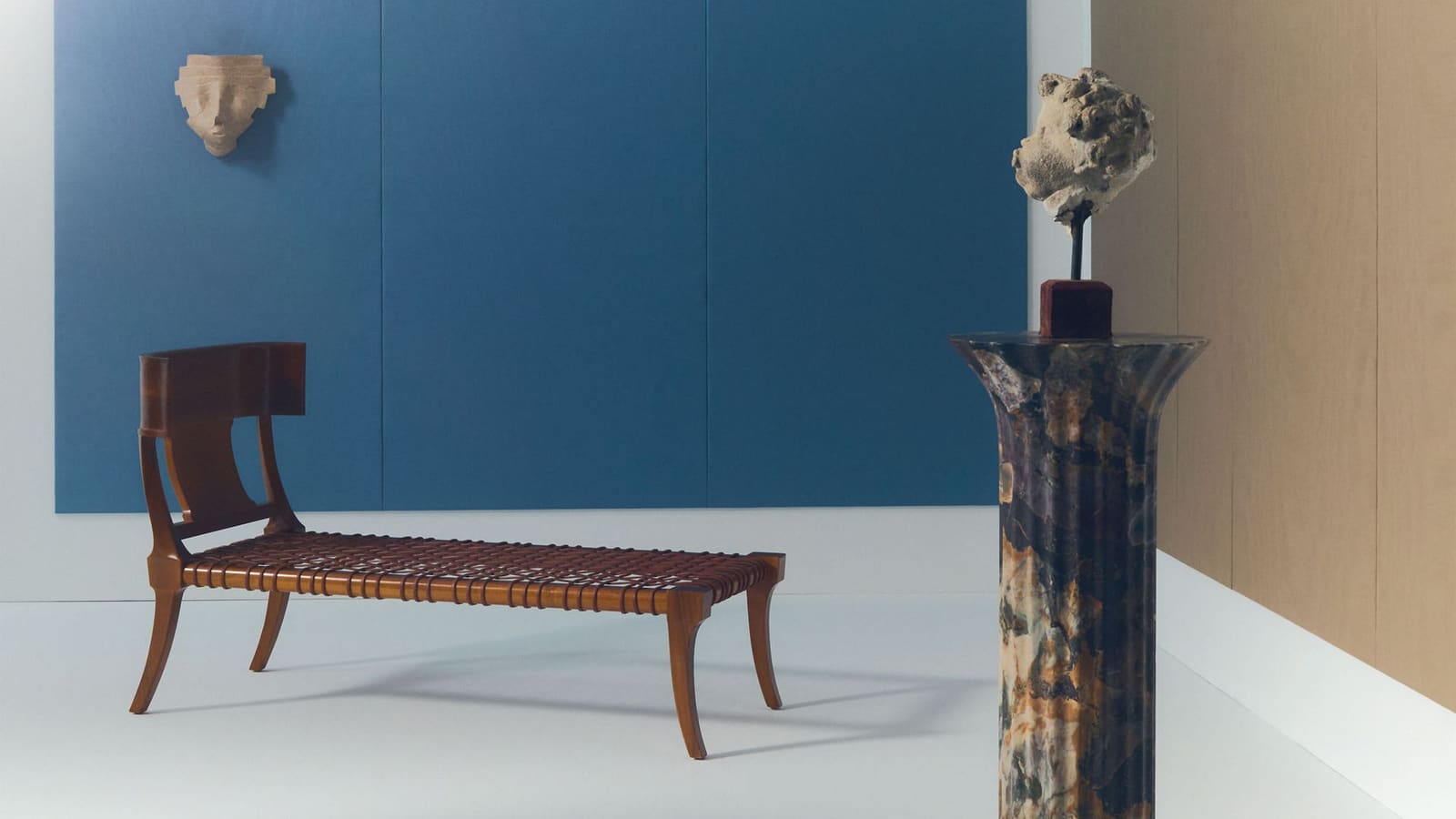
A Form Born Twice
The story begins not with a chair but with a drawing on ceramic. In the middle of the fifth century BC, an Athenian craftsman painted a stool onto a lekythos vessel; another, working between 465 and 460 BC, rendered a similar form on a red-figured Kylix discovered centuries later in Spina. These images - lines on clay - would lie dormant until 1961, when TH Robsjohn-Gibbings, a British-born designer who had settled in Athens late in life, translated them into Greek walnut and bull-leather thong.
Robsjohn-Gibbings called the result the Klismos collection. Saridis of Athens still produces the original designs today, more than six decades later. The chair is not a replica; it is a distillation. Where ancient Greece offered proportion and poise, Robsjohn-Gibbings offered material honesty and structural clarity. The vocabulary changed - no painted terracotta, no ritual context - but the grammar held.
Classicism as a Bridge, Not a Costume
In the 1990s, Michael Gabellini designed the Jil Sander stores and showrooms on Avenue Montaigne in Paris and the designer's headquarters in Hamburg. The Paris project occupied an 1890 French Beaux-Arts building; the Hamburg space, a mid-19th-century villa on the shores of Lake Alster. Gabellini reduced both interiors to their essence, stripping away ornament until only proportion and light remained. In both, he placed Klismos stools and benches in walnut.
The choice was precise. Gabellini was not styling a room; he was building a lineage. The Klismos form, with its splayed legs and curved backrest, carries no stylistic excess. It does not announce itself. It simply occupies space with the same confidence as a Doric column or a Palladian window. In Gabellini's hands, it became the most considered bridge between classicism and modernity - a piece of furniture that could sit in a fifth-century BC symposium or a 1990s showroom without friction.
Echoes in Oak, Mahogany, and Leather
Other designers have pursued the same idea, though not always under the same name. Antonio Citterio's 1993 Modus collection for Maxalto, later updated in 2023 as Cleide, employs brushed light oak and bull leather in forms that recall the same restraint. Tobia Scarpa's recent Ule chair for Bottega Ghianda, rendered in mahogany, shares the splayed-leg stance and the refusal to ornament. Romeo Sozzi's Irene chair for Promemoria follows a similar logic.
None of these pieces are literal revivals. They do not mimic ancient prototypes. Instead, they extract principles: the relationship between seat and leg, the angle at which a backrest meets a frame, the way a curve can distribute weight without announcing its engineering. The result is a family of objects that feel both archaic and contemporary, as though they were designed yesterday and excavated from a hillside in Attica.
Functionality as Essence
Rena Dumas, the Greek-born architect who founded RDAI, named her 1985 travelling furniture collection for Hermès after Peter Coles, her friend and co-creator. The Pippa collection included a desk, a high console, and a folding armchair. The Cooper Hewitt Museum notes that Dumas believed the essence of Greek architecture was functionality - a conviction reflected in the simple nature of her interiors and furniture.
The Pippa desk, with its folding mechanism and unadorned surfaces, shares the Klismos chair's refusal to separate form from purpose. Both pieces treat ornament as extraneous. Both assume that a well-proportioned object, built from honest materials, requires no further justification. This is not minimalism as style; it is minimalism as inheritance, a way of thinking about objects that predates the term by two and a half millennia.
A Museum Without Walls
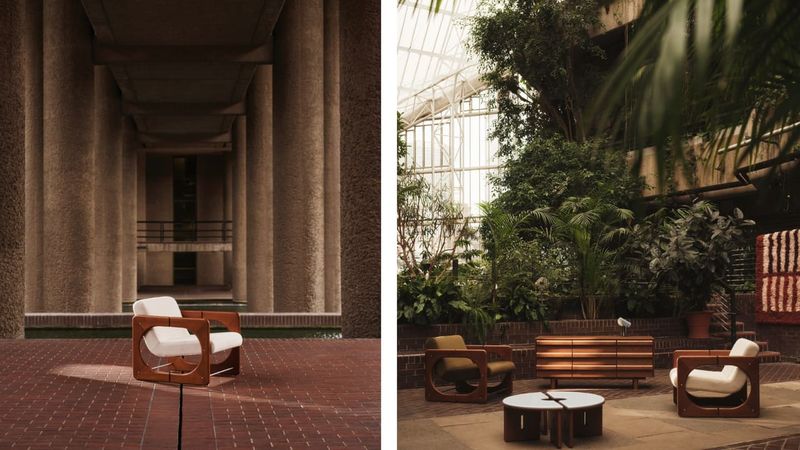
A recent photoshoot staged this lineage as a kind of portable museum. The set employed panels upholstered in Charles, a cotton and linen moiré by Rubelli, in colours - tobacco, green, blue - that reference Carlo Scarpa's 1953 intervention in Palazzo Abatellis in Palermo. There, Scarpa had created a series of polished Venetian plaster panels to frame artworks inside a late 15th-century building. The textile panels in the photoshoot performed a similar function, creating a scenography that allowed furniture and sculpture to speak without competing.
The objects assembled for the shoot were chosen for their evocative relationship to classical sources. Sergio Roger's plant-dyed antique linen head, titled Dionysus, sat on a white suede Athene plinth by Giobagnara. Francis Upritchard's balata rubber work, Sensitive Centaur, occupied another corner. Jaime Hayon's Etruscado vessel for Marsotto Edizioni, which the designer describes as evoking ancient histories and civilisations, carried a sense of time and permanence. Emily Young's Shelley Head in Jaisalmer sandstone stood on a plinth, its strong profile echoing the nose shown in the Profilo rug by Fornasetti for CC Tapis. An 18th-century Testa di Putto from Brun Fine Art rested atop the Aphaia marble column by Claesson Koivisto Rune for Kreoo, named after the Greek Doric temple of Aphaia in Aegina.
Two pieces by Michele De Lucchi - reduced in form, based on classical silhouettes - completed the assembly. The photoshoot did not argue for a revival of ancient forms. It demonstrated that certain proportions, certain relationships between mass and void, remain legible across centuries.
Why the Form Persists
The Klismos chair endures not because it is beautiful - though it is - but because it solves a problem that has not changed. A seated human body requires support at specific angles. A chair must distribute weight without collapsing. It must be light enough to move and stable enough to trust. These constraints have not evolved since the fifth century BC.
What has changed is the material palette and the cultural context. Robsjohn-Gibbings worked in walnut and leather, not painted wood and woven cord. Citterio and Scarpa employed industrial joinery, not hand-carved mortise and tenon. But the underlying logic - the recognition that a chair is a tool, not a symbol - remains constant.
The Klismos chair, and the lineage it represents, suggests that classicism is not a style to be revived but a method to be understood. It is a way of thinking about proportion, material, and use that predates the categories we now use to organise design history. In that sense, the chair is not ancient. It is simply correct.
Save this story. A free account keeps your reading list and the 07:00 email in one place.
CREATE FREE ACCOUNT →SIGN IN