
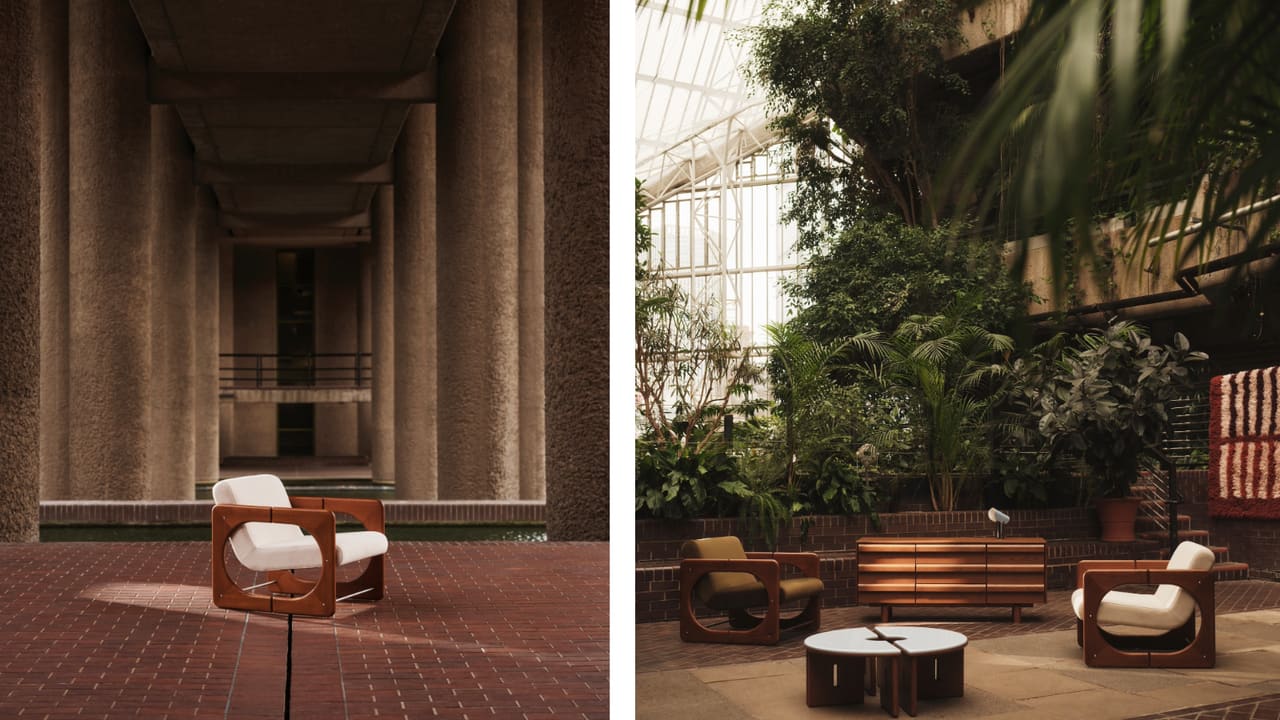
When Architecture Becomes Tactile
There's a peculiar intimacy to sitting inside a building's DNA. Not metaphorically, but literally, when the forms that shelter you at monumental scale are condensed into the chair beneath you, the lamp at your elbow, the rug under your feet. Made's recent collaboration with the Barbican Centre asks what happens when one of Britain's most celebrated Brutalist complexes is reinterpreted not as homage, but as habitat.
The 23-piece range translates architectural elements from the Chamberlin, Powell and Bon landmark into furniture, lighting, textiles, and accessories. It's a direct lineage: the curves of acoustic panels become lamps, concrete pillars inform chair silhouettes, and waffle-grid ceilings reappear as ceiling fixtures. The collection, launching this month, doesn't simply reference the Barbican. It reconstructs its spatial logic at domestic scale.
Archival Forensics and Show-Home Precedent
Made's design team undertook what amounts to material archaeology, working through the Barbican's archives to understand how the complex was originally furnished. Central to this research was Miriam Howitt, the designer commissioned to create five show apartments in the late 1960s. Howitt's interiors, shaped by Scandinavian restraint and the colour confidence of Dutch modernism, established a visual vocabulary that the new collection deliberately revives.
Her strategy was grounding: anchor vast, off-white rooms with bold patterned carpets and saturated tones so that openness reads as spaciousness rather than emptiness. The 'Brute' rug in the current line, with its ochre body and white stripes, is a direct descendant of that thinking. So too is the warm palette of moss greens and burgundy that recurs across soft furnishings, echoing Howitt's original schemes.
This isn't nostalgia. It's methodological retrieval, treating the Barbican's early interiors as a body of work worth serious study. At World Archi Design, we've noted a broader shift in adaptive reuse thinking: not just preserving buildings, but preserving the design intelligence embedded in their original inhabitation.
Translating Form: From Concrete to Oak
The collection's formal language is forensic. The 'Dual' accent chair features timber side panels shaped as semi-circles, a motif that appears throughout the Barbican complex: in podium window sills, penthouse rooflines, stair towers, and the plan of Frobisher Crescent itself. The chairs also echo the estate's cylindrical concrete pillars, translating vertical load-bearing elements into lateral support.
The 'Plinth' coffee table draws from the sunken seating pods adjacent to the Barbican lake, those recessed social zones that punctuate the elevated walkways. Meanwhile, the 'Curve' lamp series reinterprets the Concert Hall's tubular acoustic panels, turning a performance-space detail into ambient domestic lighting.
Perhaps most striking is the 'Coffer' series of ceiling and wall lights, which mimics the estate's waffle-grid ceilings. These coffered concrete structures, with their rounded square modules, were both structural necessity (they reduced material use) and aesthetic signature. The lighting fixtures retain the geometric rhythm but soften the material palette, replacing raw concrete with warmer finishes suited to residential interiors.
A wooden sideboard in stained ash, two sofa designs, a dining table, and chairs round out the furniture offerings. There's also a graphic cushion that abstracts the Barbican's distinctive boat-edge balconies, those cantilevered horizontal planes that define the complex's massing when viewed from below.
The Social Geometry of Brutalism
According to Made, the collection was conceived as a complete product range capable of functioning both independently and cohesively within an open living space. This reflects the Barbican's original ambition: a complex designed for both cultural programming and residential life, where public and private realms negotiate shared architectural language.
The estate, built on the largest Second World War bomb site in the City of London and completed in 1982, was conceived as inherently social. Its raised walkways, fountain court, and interlocking residential towers create layered zones of encounter. The furniture collection attempts to capture that ethos at the scale of a single room, using modular layouts and sculptural forms to encourage flexible, communal living arrangements.
This idea, that Brutalism's aesthetic can encode a social programme, has precedents. Alison and Peter Smithson's work on Robin Hood Gardens similarly aimed to script interaction through form. The Barbican's architects, Chamberlin, Powell and Bon, were part of the same postwar generation exploring how concrete megastructures might foster community rather than alienate it. Made's collection, whether intentionally or not, revives that question: can furniture carry social ambition?
Material Continuity and Texture
One of the Barbican's defining characteristics is its pick-hammered concrete, a labour-intensive surface treatment that took nearly 17 years to complete across the entire complex. That textured, almost geological finish is absent from the furniture collection, which relies instead on stained ash, warm metals, and textile surfaces. Yet the collection maintains a material honesty that feels continuous with the original building: exposed joinery, visible grain, straightforward construction.
This restraint aligns with broader trends in contemporary furniture design, where tactility and legibility of making are prized over applied ornament. We've tracked similar approaches in recent work by studios like Frama and Norm Architects, where materiality itself becomes the primary expressive tool.
A Public Installation and a Larger Conversation
To mark the launch, Made will present an immersive installation at the Barbican Centre in partnership with London Design Festival this September. Situated at the Level G Hub Space, the installation will surface archival material and trace the conceptual threads linking building to collection.
The timing is notable. The Barbican is currently seeking a designer to create up to 500 bespoke furniture pieces for its public spaces as part of a 50th-anniversary refurbishment. The original Barbican furniture was designed by Robin Day, a figure whose work helped define British modernism. The competition, open to all designers with submissions due by the end of the month, sets a high bar. It also suggests that the institution is rethinking how its interiors mediate between architectural legacy and contemporary use.
Made's collection, with prices starting at £32, positions itself as accessible design, a homeware line that brings high-concept architectural thinking into everyday domestic contexts. Selected items will be available at the Barbican Shop, alongside the full range at Made.com from August 2026.
What Brutalism Means Now
The question underlying this collaboration is whether Brutalism's formal language can be domesticated without dilution. The architecture was monumental by necessity: poured-in-place concrete, megascale massing, uncompromising geometry. Shrinking that vocabulary to fit a living room risks either kitsch or irrelevance.
Made's collection navigates this by focusing on specific, legible translations: a curve lifted from an acoustic panel, a grid borrowed from a ceiling, a colour scheme retrieved from an archive. It doesn't attempt to miniaturize the Barbican wholesale. Instead, it isolates elements and recontextualizes them, treating the building as a design library rather than a monument to replicate.
Whether this approach succeeds will depend on how the pieces inhabit actual homes. Do the semi-circular chair panels read as architectural quotation, or do they simply function as good chairs? Can a rug encode social ambition, or is it just a rug? These aren't rhetorical questions. They get at the heart of what we ask from design: whether objects can carry meaning beyond their use, and whether that meaning matters when you're simply trying to furnish a room.
At World Archi Design, we remain cautiously optimistic. The collection demonstrates rigorous research and formal discipline. It treats the Barbican not as aesthetic surface to be skimmed, but as a coherent design system to be studied and extended. If nothing else, it's a reminder that architecture's influence doesn't end at the building envelope. Sometimes, it follows you home.
Save this story. A free account keeps your reading list and the 07:00 email in one place.
CREATE FREE ACCOUNT →SIGN IN