
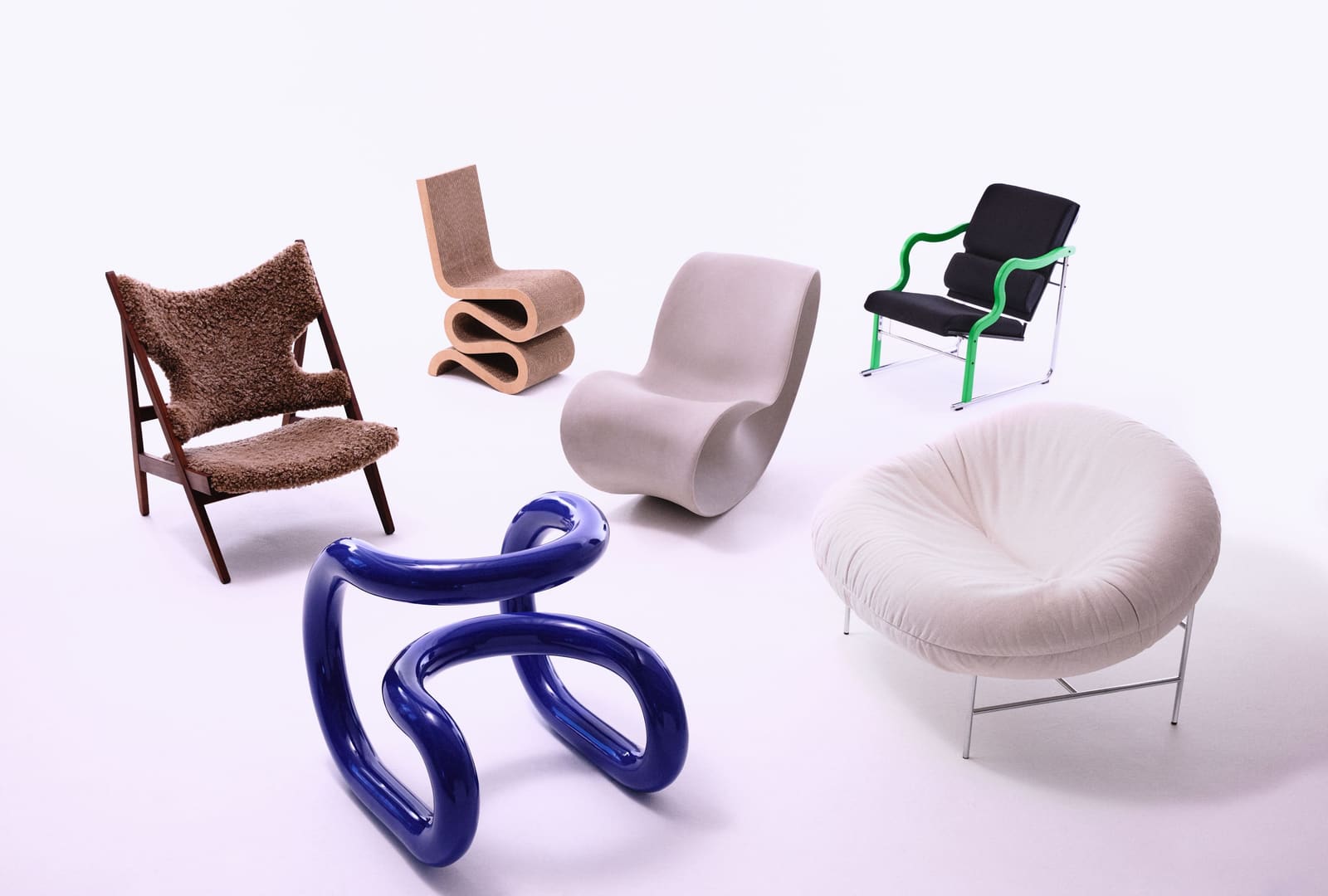
The Seat as Statement
There's a peculiar intimacy to sitting. We choose our perch based on mood, task, and sometimes pure aesthetic whim. Yet across the projects we've covered this year at World Archi Design, one truth persists: the right chair does more than accommodate the body. It establishes a spatial logic, a tonal center, a conversation between material and inhabitant.
What follows is not a catalog of every notable chair ever produced. Instead, we've assembled twelve designs that represent distinct approaches to the seating problem, each one wrestling with questions of comfort, structure, and visual identity. Some lean toward sculpture. Others privilege ergonomics. A few manage both.
Willo Perron's Bun Chair: Comfort as Form
Dimensions matter. The Bun Chair, produced by Knoll, measures 45 inches wide, which means it can accommodate two adults without crowding. Perron, known for his work in music video production and set design, approached this piece as a kind of oversized cushion suspended on chrome legs. The result feels like an evolution of the bean bag, but with a structural clarity that keeps it from collapsing into formlessness.
The upholstery is available in five colorways. We examined the white version, which proved predictably vulnerable to staining. Darker tones would be more practical for spaces with high traffic or pets. What distinguishes this chair is its refusal to choose between lounge and task seating. You can work from it for hours, or sink into it for a film. The pillow-like construction supports both modes without discomfort.
Perron's background in entertainment design shows in the piece's theatrical presence. It demands attention but doesn't alienate. Think of it as a social object, one that invites lingering.
Frank Gehry's Wiggle Chair: Cardboard as Architecture
In 1972, Gehry began experimenting with corrugated cardboard as a furniture material. The Wiggle Side Chair, now manufactured by Vitra, emerged from that investigation. It measures 14 inches wide and 34.25 inches high, a compact footprint that belies its visual impact.
The construction is straightforward: layers of cardboard glued and shaped into a sinuous profile. What surprises is the durability. Cardboard carries associations of disposability, yet this chair holds up over years of use, provided you keep liquids at a safe distance. The material also lends the piece an unexpected warmth. Unlike metal or plastic, cardboard has texture and grain. It reads as both industrial and handmade.
Gehry's architectural work often plays with unconventional materials, and the Wiggle Chair shares that exploratory spirit. It functions as a kind of thesis statement: luxury is not tied to precious materials. Form and execution matter more.
Audo Copenhagen's Knitting Chair: Recline Without Collapse
Designed for the Copenhagen-based brand Audo, the Knitting Chair measures 28.125 inches wide and 35.75 inches high. The frame is waxed solid oak; the seat and back are plywood, upholstered in either sheepskin or leather. The proportions feel low and relaxed, but not so reclined that you lose postural support.
The sheepskin version adds tactile richness, though the leather option suits more minimal interiors. Either way, the chair reads as midcentury in lineage, with a nod to Japandi restraint. It's not small. If your space is tight, this piece will dominate. But in a loft or open-plan living area, it establishes a zone of calm without fussiness.
The name references knitting, though the connection is more conceptual than literal. The chair invites slow, meditative activities: reading, handwork, conversation. It's designed for staying, not passing through.
The Eames Lounge Chair: Ergonomics as Icon
First produced by Herman Miller in 1956, the Eames Lounge Chair and Ottoman measure 31.5 inches high, 33.5 inches wide, and 35 inches deep. Charles and Ray Eames conceived it as a modern interpretation of the 19th-century club chair, with molded plywood shells, die-cast aluminum hardware, and leather cushions.
The swivel base allows for subtle adjustments in orientation. The dramatic tilt of the backrest supports multiple postures: upright for conversation, reclined for reading, fully back for rest. What's remarkable is how the chair accommodates all three without requiring manual adjustment. The angles are simply correct.
The Eameses understood that comfort is not softness alone. It's the relationship between seat depth, back angle, and arm height. This chair gets that geometry right. Decades later, it remains a benchmark for lounge seating, copied endlessly but rarely improved upon.
Marcel Breuer's Wassily Chair: Negative Space as Design
Breuer designed the Wassily Chair in 1925, inspired by the tubular steel frame of a bicycle. Now produced by Knoll, it measures 29 inches high, 31 inches wide, and 27 inches deep. The frame is minimal: a continuous loop of steel tubing that supports leather slings for seat, back, and arms.
The negative space is as important as the structure itself. The chair occupies less visual volume than a traditional upholstered seat, which makes it useful in smaller interiors or spaces where you want to maintain sightlines. The leather develops patina over time, which adds character but also demands maintenance.
This is a conversation piece. It announces its modernist credentials clearly, which means it works best in interiors that share that vocabulary. Drop it into a rustic or eclectic space and it will feel misplaced. But in a Scandinavian or Bauhaus-inflected room, it becomes a anchor.
IKEA's POÄNG Armchair: Democracy in Design
Launched in the late 1970s, the POÄNG armchair was designed by Noboru Nakamura in collaboration with Lars Engman. It measures 39.375 inches high, 26.75 inches wide, and 32.25 inches deep. The frame is bent birch veneer; the cushion is polyester. The price is $189.
Nakamura wanted the chair to swing, to offer what he called "emotional richness." The bent-wood construction flexes slightly when you lean back, creating a gentle rocking motion. It's subtle, not aggressive. The low arms don't restrict movement, which makes the chair versatile: reading, working, nursing a child.
The POÄNG has been dismissed as too simple, too ubiquitous. But ubiquity is not the same as mediocrity. This chair endures because it solves the seating problem efficiently and affordably, without sacrificing form. It's a reminder that good design need not be expensive.
Mies van der Rohe's MR Chaise: The Cantilever Principle
The MR Chaise, produced by Knoll, measures 37 inches high, 23 inches wide, and 47 inches deep. The frame is tubular steel in a cantilever configuration; the upholstery is leather. The cantilever design means the seat rocks slightly when you recline, a sensation that can be disorienting if you're not expecting it.
The leather is premium, hand-stitched, and curves to follow the body's contours. The piece reads as both lounge and sculpture. It demands space. In a small room, it will overwhelm. But in a loft or open-plan interior, it becomes a focal point, a piece that rewards contemplation even when unoccupied.
Mies understood that furniture could be architectural, that a chair could articulate space in the same way a column or beam does. The MR Chaise demonstrates that principle. It's not just an object to sit in. It's a spatial intervention.
Eero Saarinen's Womb Chair: Enveloping Without Smothering
In 1946, Florence Knoll asked Saarinen to design a chair that felt like "a basket full of pillows." The result was the Womb Chair, now produced by Knoll. It measures 40 inches wide, 35.5 inches high, and 34 inches deep. The seat shell is foam-covered molded fiberglass; the base is steel rod with a polished chrome or black finish.
The high sides wrap around the sitter, creating a sense of enclosure without claustrophobia. The comfort comes from the shell's curvature, not from added cushions. You can sit cross-legged, sprawl sideways, or curl up. The chair accommodates all of it.
Saarinen's approach was sculptural but not at the expense of function. The Womb Chair looks like a single gesture, a continuous surface that happens to cradle a human body. It's a lesson in how form can follow feeling.
Arne Jacobsen's Egg Chair: The Wingback Reimagined
Jacobsen designed the Egg Chair in 1958 for the SAS Royal Copenhagen Hotel. Manufactured by Fritz Hansen, it measures 43 inches high, 34 inches wide, and 31 inches deep. The frame is molded fiberglass; the upholstery is leather or fabric. The shape is a modern wingback, with high sides that curve around the sitter.
The Egg is sculptural, but it's also practical. The wings block peripheral distractions, which makes it useful in open-plan spaces where you want a degree of privacy. The swivel base allows you to orient yourself toward or away from activity. The cushioning is firm enough for extended sitting without sagging.
Jacobsen was an architect first, and the Egg reflects that training. It's not just a chair. It's a piece of spatial furniture, one that creates a micro-environment within a larger room.
Ludwig Mies van der Rohe's Barcelona Chair: The Pavilion Seat
The Barcelona Chair was designed by Mies van der Rohe and Lilly Reich in 1929 for the German Pavilion at the Barcelona International Exposition. Now produced by Knoll, it measures 30.25 inches high, 29.5 inches wide, and 30 inches deep. The frame is bar-stock steel, hand-ground and hand-buffed to a chrome finish. The cushions are tufted leather.
The tufting is not decorative. It's a structural solution, a way to attach the leather to the cushion without visible seams. The frame is an X-shape in profile, a geometry that references ancient folding chairs but rendered in modern materials. The result is a piece that feels both classical and forward-looking.
The Barcelona Chair is formal. It's not for slouching. But in the right context, a library or study or reception area, it offers a kind of ceremonial presence. It's furniture as architecture, a seat that commands respect.
Why Provenance Matters
Each of these chairs carries a design lineage. They were made by architects and designers who understood materials, ergonomics, and spatial relationships. They've been in production for decades, which means they've survived shifts in taste and market forces. That longevity is its own form of validation.
But provenance alone doesn't guarantee a chair will work in your space. Context matters. A Wiggle Chair in a minimalist loft reads differently than the same chair in a maximalist brownstone. The Egg thrives in open plans; the Wassily needs breathing room. Think about scale, adjacency, and use before committing.
The Endurance of Good Design
Trends cycle. Materials fall in and out of favor. But the principles underlying these twelve chairs remain constant: honest structure, thoughtful ergonomics, respect for the body and the space it inhabits. They prove that furniture can be both functional and sculptural, that comfort and aesthetics need not compete.
At World Archi Design, we return to these pieces again and again, not out of nostalgia but because they continue to offer lessons. They remind us that the best interiors are built one deliberate choice at a time, and that a single chair, well chosen, can anchor an entire room.
Save this story. A free account keeps your reading list and the 07:00 email in one place.
CREATE FREE ACCOUNT →SIGN IN