
The Vertical Turn in Residential Design
The proliferation of open-plan kitchens over recent decades has fundamentally altered how we think about residential seating. Where once a dining chair sufficed, we now encounter a typology that operates at multiple heights, each corresponding to a different mode of gathering. Bar stools and counter stools exist in this liminal zone between standing and sitting, between kitchen work surface and social space. They are, in essence, furniture that negotiates threshold.
At World Archi Design, we've observed that the most successful residential projects treat counter-height seating not as an afterthought but as an integral component of spatial planning. The choice between a backless stool that tucks invisibly beneath an island and a high-backed specimen that commands attention from across the room is fundamentally an architectural decision about volume, circulation, and visual weight.
Material Intelligence: Natural Fibers and Structural Honesty
Rattan and woven materials bring biophilic qualities to what can otherwise feel like overly clinical kitchen environments. The Avalon swivel stool demonstrates how natural fiber construction can soften the hard surfaces typical of contemporary kitchens, while its 360-degree rotation acknowledges the multidirectional nature of open-plan socializing. The material choice here is deliberate: rattan reads as casual but carries enough craft credibility to hold its own in a considered interior.
Similarly, the Dakota counter stool employs cotton webbing across a shaker-inspired frame, a gesture that recalls mid-20th-century Scandinavian experiments with textile and wood. The double backrest provides lumbar support without resorting to full upholstery, maintaining the lightness essential to pieces meant to recede when not in use. This is furniture that understands restraint.
Burl wood represents the opposite approach: maximum visual impact through material drama. The Carolina burl wood swivel stool from Crate & Barrel uses the irregular grain patterns of burl veneer to create a sculptural base that contrasts sharply with its smooth upholstered seat. The brass detailing functions as a transitional element, mediating between organic chaos and geometric order. In a monochromatic kitchen, a single burl stool can anchor an entire palette.
Structural Precedents: Bertoia and the Wire Frame Legacy
Harry Bertoia's wire stools, originally designed in the 1950s for Knoll, remain relevant precisely because they solve a perennial problem: how to provide seating that doesn't visually obstruct space. The steel net construction allows light and sightlines to pass through, making these stools ideal for environments where maintaining visual continuity matters. Bertoia understood that in residential design, negative space is as valuable as positive mass.
Contemporary iterations of the wire frame concept continue to populate design-forward interiors. The typology has proven adaptable across aesthetic registers, from industrial lofts to color-saturated maximalist kitchens. The frame's neutrality allows it to coordinate with diverse palettes while maintaining its own formal integrity.
Upholstery as Architectural Softness
The Eloise stool illustrates how upholstery choices can dramatically shift a piece's register. Offering linen with piped edges, textured boucle, and jewel-toned velvet over hammered bronze legs, the design acknowledges that counter-height seating increasingly serves multiple functions: breakfast perch, work-from-home station, and evening cocktail seat. The deep cushioning responds to this programmatic complexity, providing comfort sufficient for extended occupation.
Piped edges and contrasting welts are not merely decorative. They define the geometry of a cushion, making legible the relationship between support structure and upholstered volume. In the Rodin stool, upholstered in a cotton-wool blend engineered to mimic cashmere, the material choice elevates what might otherwise read as purely functional seating into the realm of considered luxury.
Form Follows Posture: Ergonomic Considerations
The Comma stool from Herman Miller applies the company's decades of ergonomic research to counter-height seating. The steam-bent backrest curves to support the lumbar region without creating visual bulk, while the circular seat base distributes weight evenly. This is industrial design operating at high resolution: every curve justified by biomechanics, every angle calculated for comfort over extended sitting.
Footrests, often overlooked, prove critical in counter-height seating where feet don't naturally reach the floor. The absence of a footrest forces the sitter into an unstable posture, legs dangling, core constantly engaged to maintain balance. Well-designed stools incorporate footrests as structural elements, not afterthoughts. The shaker-inspired Dakota stool, for instance, integrates its footrest into the overall geometry, maintaining visual coherence while solving a functional problem.
Color and Pattern as Spatial Punctuation
The Pierce & Ward collaboration with West Elm demonstrates how pattern can transform a utilitarian object into a spatial accent. Striped upholstery and knobby turned legs create a whimsical profile that reads as personality rather than mere function. In neutral interiors, such pieces provide necessary visual relief, breaking up expanses of white and wood with deliberate playfulness.
The Carter counter stool in vibrant lime exemplifies color as spatial strategy. In a light-filled kitchen, a row of saturated stools can define the boundary between cooking and socializing zones without physical barriers. Color becomes architecture, delineating space through hue rather than mass.
The Case for Solid Wood Construction
Engineered wood and metal dominate contemporary furniture production, but solid wood construction offers durability and repairability that composite materials cannot match. The Randle tractor stool from Rejuvenation arrives fully assembled, its solid wood frame promising decades of use without the structural degradation typical of particleboard and veneer constructions.
There's an environmental argument here as well: furniture designed to last multiple decades, to survive multiple moves and changes in domestic arrangement, represents a more sustainable approach than disposable pieces engineered for a single lifecycle. Solid wood ages, develops patina, can be refinished. It participates in the long view.
Versatility and the Neutral Palette
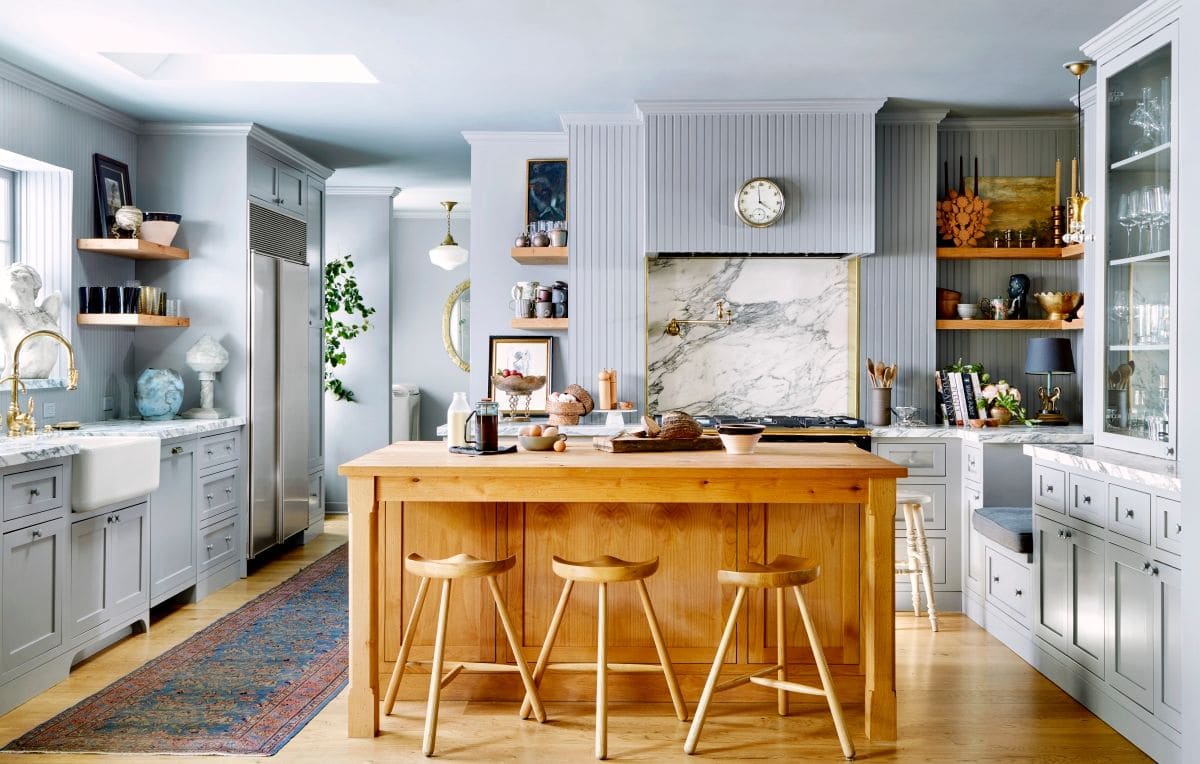
The Esse counter stool in light oak represents the archetype: simple geometry, natural material, minimal ornamentation. This is the Platonic ideal of the bar stool, a form so refined that it disappears into nearly any context. In interiors by designers like Athena Calderone, where restraint and tonal subtlety define the aesthetic, such pieces provide necessary function without competing for attention.
Versatility, however, should not be confused with blandness. The Esse's slight frame and tapered legs demonstrate that simplicity requires precision. Every proportion matters when there's nothing to hide behind. The piece succeeds because its geometry has been carefully calibrated, each element in correct relationship to the others.
Sculptural Ambition: Seating as Object
The Rodin stool explicitly positions itself as sculpture, a three-dimensional composition that happens to be sittable. This approach treats the bar stool not as background furniture but as a focal point, an object worthy of attention even when unoccupied. In sophisticated bar setups or breakfast bars seeking elevation, such pieces shift the register from casual to curated.
Sculptural seating requires careful context. Too many statement pieces create visual cacophony; the right number, strategically placed, can define an interior's character. The key lies in balancing sculptural ambition with spatial restraint, knowing when to let a piece command attention and when to let it recede.
The Coastal Vernacular Reinterpreted
The Declan counter stool synthesizes midcentury and coastal vocabularies through turned wooden legs and scalloped detailing. The striped linen seat cushion reinforces the coastal reference while providing necessary comfort. This is regional vernacular translated into contemporary production, acknowledging tradition without pastiche.
Coastal design has often suffered from cliché, an overreliance on nautical motifs and blue-and-white palettes. The Declan stool demonstrates how designers can evoke place through subtler means: material choice, detailing, proportion. The result feels appropriate to a seaside setting without resorting to literal references.
Assembly and the User Experience
Furniture that arrives fully assembled respects the user's time and acknowledges that not everyone possesses the tools or inclination for complex assembly. The Randle tractor stool's ready-to-use delivery removes a significant friction point in the purchasing process. In an era of flat-pack ubiquity, this represents a return to an earlier model of furniture retail, one that prioritized immediate usability over shipping efficiency.
The trade-off, of course, is cost. Assembled furniture requires more careful packaging and higher shipping fees. But for pieces intended to last decades, the initial premium proves negligible when amortized over the product's lifespan.
Defining Space Through Repetition
Bar stools rarely appear singly. Arranged in multiples along an island or counter, they create rhythm through repetition, a visual cadence that helps define spatial boundaries in open plans. Three stools signal a casual breakfast bar; five or six indicate serious entertaining capacity. The number matters as much as the design.
The Dunham stool's high-contrast composition, woven back paired with leather seat and black frame, gains power through multiplication. A single specimen reads as accent; a row becomes architectural element, a linear composition that organizes space through consistent vertical punctuation.
Looking Forward
Counter-height seating will continue to evolve as residential layouts shift and domestic routines change. We may see increased emphasis on adjustability, allowing a single stool to serve multiple users and contexts. Material innovation, particularly in sustainable and recycled composites, will likely expand the palette beyond traditional wood, metal, and upholstery.
What remains constant is the typology's essential function: mediating between different spatial zones and social modes, providing flexible seating that adapts to casual meals, extended work sessions, and evening gatherings. The bar stool, in all its variations, has become indispensable to contemporary domestic life. Its design, far from trivial, shapes how we inhabit our homes.
Save this story. A free account keeps your reading list and the 07:00 email in one place.
CREATE FREE ACCOUNT →SIGN IN