
The Litmus Test
When two artists began searching for an architect to renovate their Brooklyn townhouse, they arrived at every interview with a portfolio of vintage room schemes: vivid linoleum floors, layered patterns, unabashed colour. The images were not from a celebrated mid-century master but from the catalogues and advertisements of Armstrong Cork Company, a Pittsburgh manufacturer that, in the early 1920s, hired a young arts educator named Hazel Dell Brown as its in-house decorator. For more than thirty years, Brown designed interiors that appeared in the company's promotional materials, shaping how a generation of American households understood domestic space. Her work was surface-driven, unafraid of pastiche, and rooted in an embrace of intimacy over grandeur.
Most architects the couple interviewed politely acknowledged the references, then steered the conversation elsewhere. Tal Schori and Rustam Mehta of GRT Architects did not. The duo, recognised in the AD100, immediately grasped what the clients valued: Brown's approach to spatial nesting and her willingness to let materials and pattern carry the architecture. Interior designer Penelope August, a friend of the wife's since preschool, required no convincing at all.
A Career in the Margins
Brown's influence extended across the Rust Belt and beyond, yet her name remains largely absent from design histories. Her role at Armstrong Cork Company placed her at the intersection of commerce and domesticity, a position that afforded her unusual reach but little institutional recognition. The rooms she conceived were not built for clients but for reproduction: printed in booklets, staged in showrooms, disseminated through mail-order catalogues. They were didactic, aspirational, and above all, replicable.
What distinguished her interiors was their confidence in decoration as a structuring device. Where many designers of the period treated pattern as accent, Brown deployed it as architecture. Linoleum, the company's flagship product, became a field for chromatic and geometric experimentation. Her schemes layered wallpaper, textiles, and flooring into compositions that read as coherent wholes, not assemblages of discrete products. The effect was immersive, a quality the Brooklyn clients sought to recover.
Rooms Within Rooms
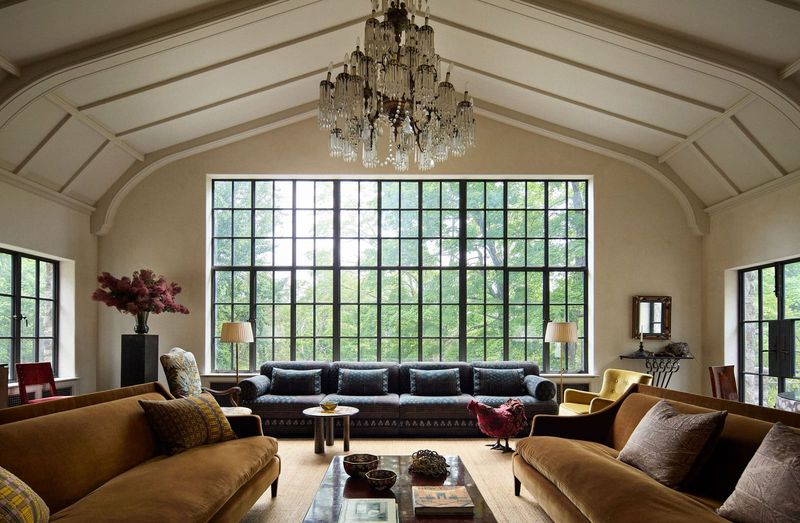
The townhouse, built around 1980, required both spatial reorganisation and a recalibration of scale. Schori describes the guiding principle as "rooms within rooms", a concept that borrows from Brown's tendency to define zones through material change rather than partition. In the living room, a circa 1980 Gio Ponti chandelier hangs above a vintage Vladimir Kagan sectional sofa and a Jens Risom chair upholstered in a custom fabric based on a painting by Macgregor Harp. Wallpaper by Antoinette Poisson and artwork by Rose Marcus complete the layering.
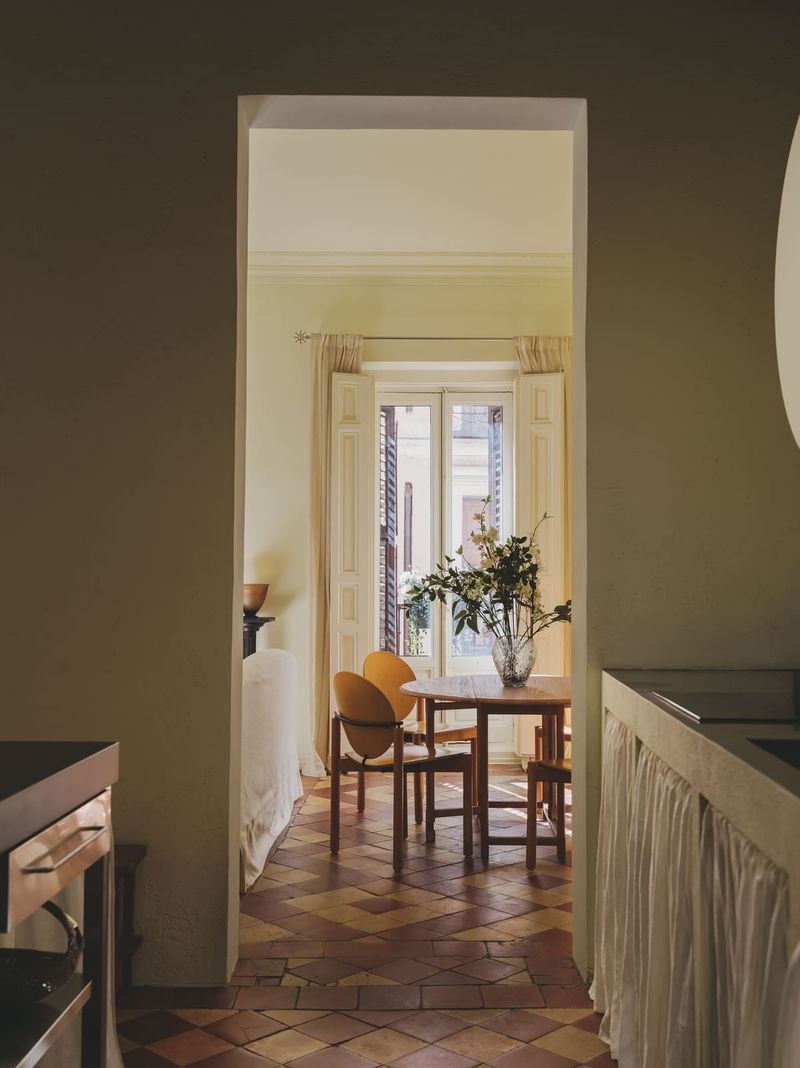
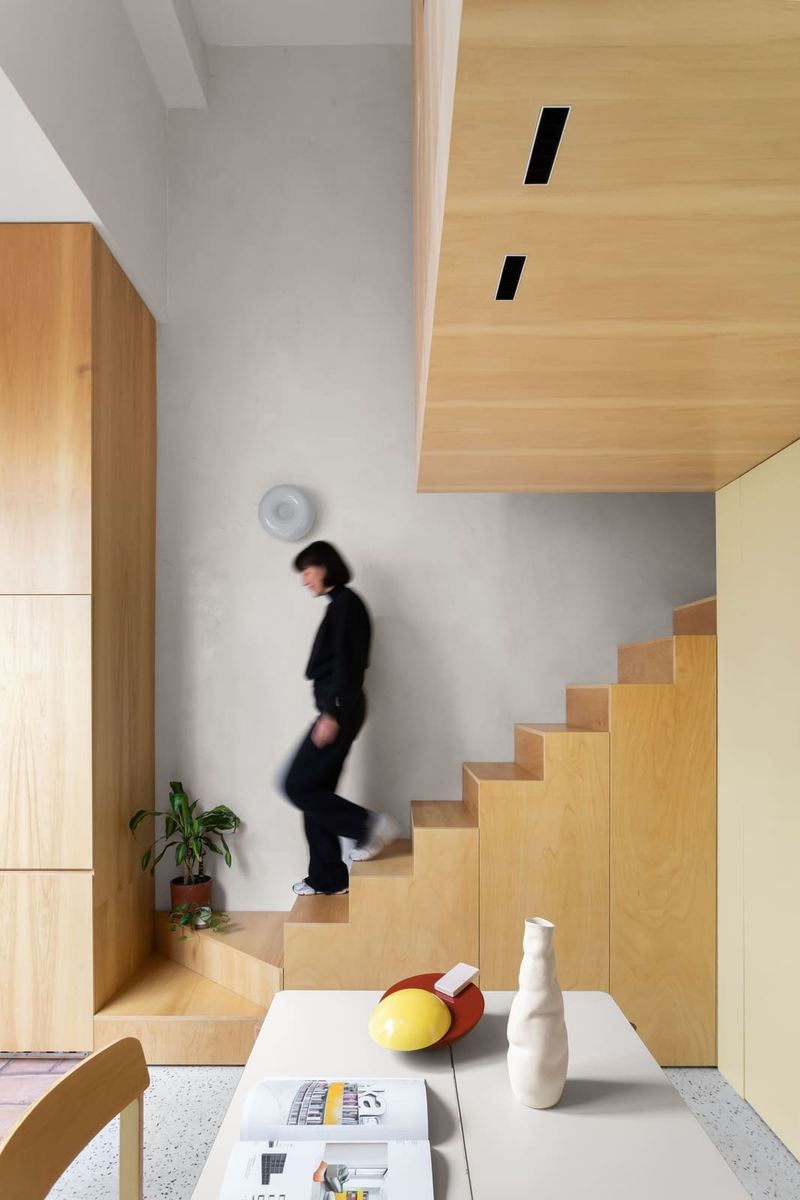
The approach is less about historical pastiche than about recovering a spatial logic that contemporary open-plan conventions have largely abandoned. Brown's interiors were inward-facing, designed to make small rooms feel abundant rather than cramped. GRT Architects translated this into a series of interconnected spaces that retain distinct identities without relying on doors or corridors. Surface becomes boundary; colour and pattern become wayfinding.
Material as Memory
The wife first encountered Brown's work while on a project in Pittsburgh, where the designer's legacy remains more visible than elsewhere. Armstrong Cork Company, now Armstrong World Industries, no longer produces linoleum in the volumes it once did, but the visual language Brown established persists in the vernacular of American domestic interiors. Her schemes circulated widely enough to become templates, absorbed into the collective memory of what a "proper" room should look like.
For the Brooklyn renovation, that memory was not nostalgic but operational. The clients and their collaborators used Brown's work as a framework for decision-making: a way to test whether a proposed material or colour arrangement could hold its own in a densely patterned field. The result is a home that feels both historically informed and resolutely contemporary, a space where decoration is not applied but integral.
The Architect as Curator
Schori and Mehta's willingness to engage with Brown's work reflects a broader shift in how architects approach renovation. Rather than imposing a singular aesthetic, the project became an exercise in curation, assembling elements that speak to one another across decades. The Ponti chandelier, the Kagan sofa, the Harp-inspired upholstery, these are not period pieces but participants in a conversation about how pattern and colour organise experience.
August's role as interior designer extended this curatorial logic into the selection of textiles, wallpapers, and finishes. Her long friendship with the wife allowed for a shorthand that bypassed the usual client-designer negotiations. The result is a coherence that feels intuitive rather than laboured, a quality that Brown herself might have recognised. Her interiors, after all, were designed to be lived in, not simply admired.
A Precedent Recovered
The Brooklyn townhouse stands as evidence that forgotten figures can exert influence long after their names have faded from discourse. Brown's work was never monumental, never intended for museums or monographs. It was commercial, pragmatic, and deeply embedded in the material culture of its time. Yet its principles, spatial intimacy, decorative confidence, and the integration of surface and structure, remain legible and applicable.
The renovation does not attempt to recreate a 1920s Armstrong showroom. It does, however, recover a way of thinking about domestic space that prioritises richness over minimalism, layering over clarity. In doing so, it offers a model for how contemporary practice can engage with historical precedent without resorting to pastiche or nostalgia. Brown's interiors were never about the past. They were about making rooms that felt complete. A century later, that ambition still holds.
Save this story. A free account keeps your reading list and the 07:00 email in one place.
CREATE FREE ACCOUNT →SIGN IN