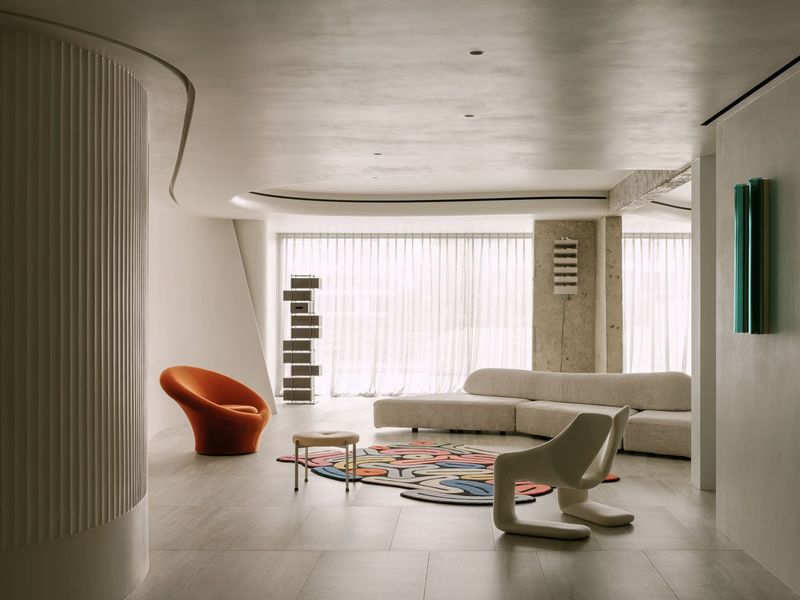

Technology once lived inside our devices; now, it’s embedded in our surroundings. The evolution of smart furniture marks one of the most significant transformations in how we inhabit space - not just as users, but as participants in a living system. The new generation of multi-functional furniture integrates power, lighting, sensors, and connectivity to anticipate needs, adapt in real time, and dissolve the boundaries between comfort and technology.
From Object to Ecosystem
For decades, furniture design has focused mostly on form, ergonomics, and materiality. But as our homes and workplaces become more connected, furniture itself is evolving into an ecosystem. Tables with wireless charging surfaces, desks that monitor posture, mirrors that analyze air quality, lighting-integrated headboards - all redefine what “living smart” means.
These objects no longer merely accommodate technology, they incorporate it. A nightstand becomes a wellness node that dims light and tracks sleep; a work desk adjusts height, charging ports, and lighting based on use and time of day. The key: technology supports intuition, not distraction.
Autonomous’s Lumicharge LED Lamp with Wireless Charger combines ambient lighting, a folding reading lamp, and wireless charging pad
Photo Credit: Autonomous
The collection by Sedus (2025) features systems like the se:vision desk and se:living modular sofa system which integrate ergonomic, modular, and power-enabled design
Photo Credit: Sedus
Designing for Interaction
What sets this new era apart is not just the inclusion of smart features, but how furniture communicates with users through subtle cues. Embedded sensors allow surfaces to respond to proximity or touch, surfaces that warm as hands approach, lights that fade as you leave.
Designers have embraced the concept of “calm technology” - systems that serve quietly in the background. Smart furniture embodies that ethos. It should not dominate, but slip into the background: smooth, responsive, and unobtrusive.
The concept side-table Epione SmartDesk Pro 2.0 offers gesture control, hidden USB-C ports, built-in wireless charger, and posture-monitoring sensors in its surface
Photo Credit: Epione
The IKEA SYMFONISK bedside table speaker (2025 edition) merges lighting, sound, and smart control in a single home furniture piece
Photo Credit: IKEA
In practice, this means that interfacing happens without explicit buttons. Lighting changes are automated, charging surfaces merge with tabletops, and furniture begins to understand behaviour rather than just accommodate it.
Multi-functionality: The New Aesthetic
Minimalism once meant fewer things. Today, it means fewer visible things. Multi-functional smart furniture condenses multiple uses into one elegant object, a form of design sustainability through efficiency.
Smart storage units hide retractable lighting and power modules. Convertible benches become workstation hubs with integrated displays. Even acoustic partitions may now purify air or provide wireless charging.
Sobro Smart Coffee Table combines refrigeration drawers, Bluetooth speakers, LED lighting, and charging ports into one living room hub
Photo Credit: Sobro
Hi-Interiors HiBed features integrated ambient lighting, sleep-tracking sensors, a retractable screen, and voice control
Photo Credit: Hi-Interiors
The resulting aesthetic is subtle: clean, tactile, and calm. The visual quietness of these pieces conceals complex systems within, signaling a shift from technology as spectacle to technology as ambient design.
Sensory Design: Comfort Beyond Touch
Smart furniture doesn’t just respond to actions: it perceives conditions. Embedded sensors detect temperature, humidity, light levels, even biometric data. The goal becomes environments that self-regulate, adjusting lighting to reduce strain, heating to promote comfort, or sound levels to improve focus.
For instance, ambient lights integrated into furniture can transition from cool white in the morning to warm amber at night, synchronizing with the body’s circadian rhythm. Or tabletops with wireless charging might also monitor air quality and alert users via subtle light cues. A piece of furniture becomes a conscious node within the space.
“BARS” electric sofa bench, designed by Dream Inc., transforms configuration and contains integrated posture and relaxation modes
Photo Credit: Dream Inc.
Lumera’s side table with wireless charger emphasises ambient lighting and minimal controls to support a restful atmosphere
Photo Credit: Gaurav Sood
Living as a System
The deeper implication of smart furniture is that it redefines the relationship between humans and space. As each object becomes responsive, the boundary between design and behaviour softens. Rooms no longer just host activities, they anticipate them.
In this new ecosystem, furniture becomes the interface. It learns from routine, collaborates with architecture, and responds to light, time, and energy. Future homes and offices will not just contain smart devices, they will be the device: a living network of surfaces, materials, and interactions designed to enhance life unobtrusively.
Ultimately, “living smart” is less about connectivity and more about empathy. The goal isn’t dozens of gadgets talking at us, but environments that understand rhythm, care, and rest. When furniture becomes a system, design ceases to be static - it becomes alive.
Save this story. A free account keeps your reading list and the 07:00 email in one place.
CREATE FREE ACCOUNT →SIGN IN