
Mapping Violence Through Celestial Form
The night sky above zones of prolonged conflict no longer belongs solely to stars. Drones, satellites, rockets and missiles now traverse the darkness, altering both the visual field and the cultural imagination of those beneath. At the 2026 Sharjah Architecture Triennial, architect Mohamad Nahleh and architecture professor Ozayr Saloojee address this transformation through After Night There is Nothing, three domed installations that recast military objects as constellations, fusing mythology with the lived reality of contemporary warfare.
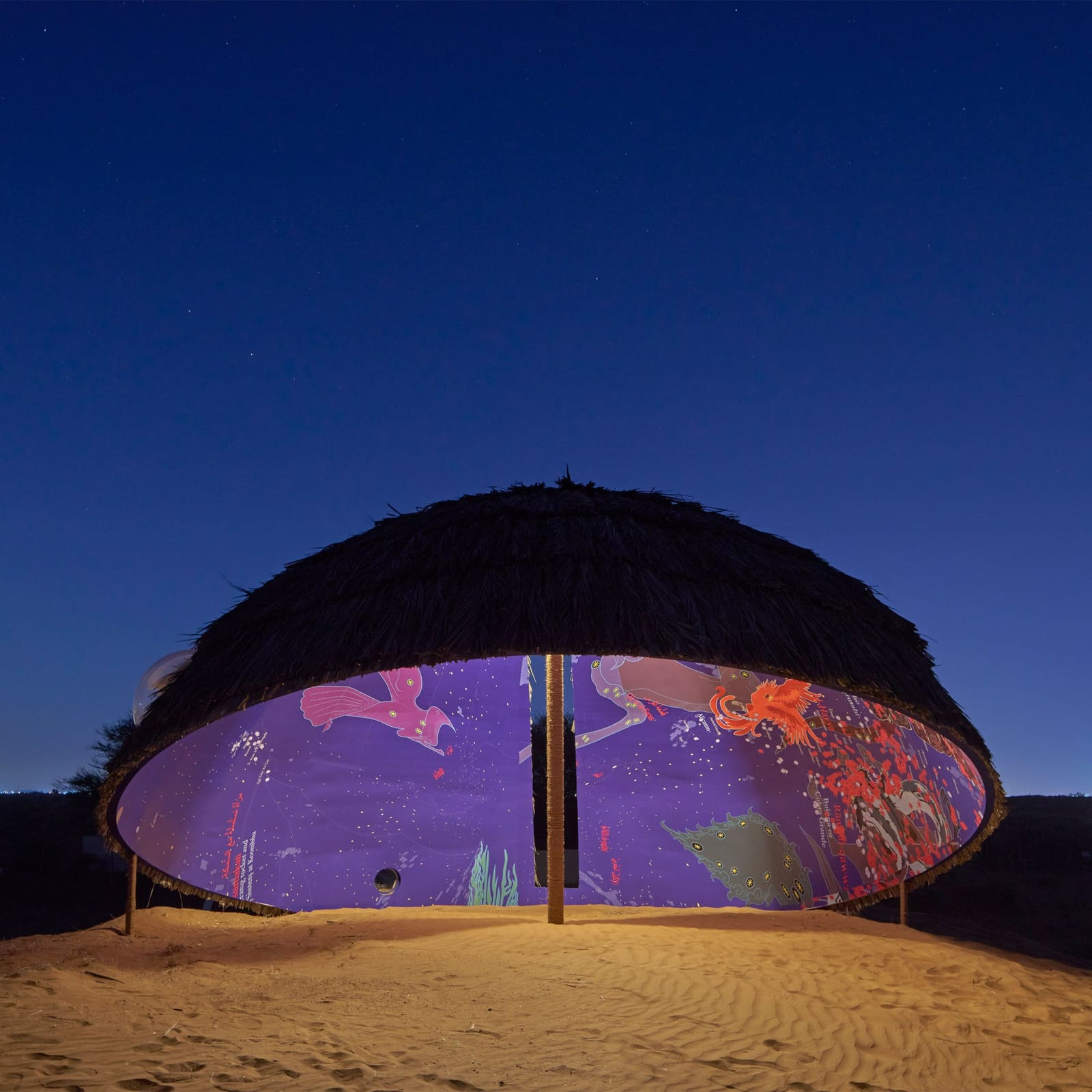
Each structure is a segment of an imagined globe, its curved timber-and-steel frame clad in thatch and lined internally with vinyl surfaces. Upon these interior skins, Nahleh and Saloojee have drawn creature-like figures, constellations derived not from ancient myth but from the trajectories and forms of weaponry. The installations occupy three distinct sites across Sharjah: the Al Qasimiyah School, a disused slaughterhouse, and the sandy expanse of Al Madam. The dispersal of the pavilions across disparate contexts mirrors the ubiquity of aerial surveillance and attack, a presence that refuses singular location.
The Solifugi: A Nocturnal Armature
The pavilions themselves are modelled on the Solifugi, a nocturnal arachnid native to arid regions that flees sunlight, seeking shade beneath stones and vegetation. This creature, with its thick exoskeleton adapted to harsh brightness, becomes both formal precedent and conceptual anchor. Nahleh describes the Solifugi as an emblem of resistance to what he terms "imperial savagery", its belly inscribed with a map of the contemporary sky. The choice of a desert-dwelling spider as structural metaphor is neither arbitrary nor decorative; it reflects an architecture that shelters against omnipresent luminosity, whether solar or militarised.
The thatch cladding reinforces this protective function while invoking vernacular building traditions. Yet the materiality is not nostalgic. Thatch here operates as insulation against a sky that has become weaponised, a sky where phosphorus flares and drone optics generate a brightness that erases rather than illuminates. The curved form, fragmentary and open, suggests both refuge and vulnerability. Each pavilion is punctured by three apertures, calibrated to specific sightlines and scales. At Al Madam, a vertical opening frames the minaret of a distant mosque, aligning religious architecture with the newly militarised horizon. At the slaughterhouse site, a horizontal slot is positioned at the height of livestock, a gesture that implicates both animal and human erasure within the same visual field.
Constellations Born from Conflict
The vinyl interiors carry the project's central argument: that communities under sustained aerial threat are generating new mythologies, reinterpreting military objects through cultural practices of storytelling and sense-making. Nahleh and Saloojee's research into regions experiencing prolonged violence revealed recurring patterns of myth-making, where drones and missiles are absorbed into local cosmologies, transformed into creatures that populate a reimagined sky.
These "modern constellations" do not replace traditional star patterns but overlay them, creating a palimpsest of celestial narratives. The drawings fuse technological forms with epistemic traditions, producing hybrid figures that attempt, in Nahleh's words, to "tame the military brightness" overhead. The constellations are not celebratory; they register the paradox of communities inscribing meaning onto the instruments of their annihilation. Children now make wishes upon shooting stars that are, in fact, missiles. The practice retains the structure of hope while acknowledging its corruption.
This phenomenon recalls the adaptive iconography seen in post-conflict urban environments, where shrapnel is repurposed into domestic objects and bomb craters become informal gathering spaces. Yet the sky, unlike the ground, resists material appropriation. It can only be reinterpreted, its violence metabolised through narrative. Nahleh and Saloojee's intervention is to spatialise this reinterpretation, to give it architectural form. The pavilions become observatories not of distant galaxies but of proximate threat, instruments for reading a sky that has been militarised.
Storytelling as Spatial Practice
The triennial programme includes performances by Hakawati, traditional Arab storytellers, who will narrate within the pavilions throughout the event, which runs until April 2027. The inclusion of oral tradition is structural rather than supplementary. Hakawati storytelling historically functioned as a communal practice of knowledge transmission, often in public spaces such as markets and courtyards. Here, the domed interiors become stages for stories that confront the erasure of libraries, the scarcity of paper, and the impulse to inscribe histories onto the surfaces of incoming ordnance.
This gesture towards orality addresses a material condition: when archives are destroyed, memory migrates to the body and the voice. The pavilions, with their sheltering geometry and internally mapped skies, provide a space where this migration can occur collectively. The architecture does not resolve the violence it depicts, nor does it offer redemption. Instead, it constructs a threshold where catastrophe can be witnessed and narrated, where the sky's transformation from celestial to militarised can be acknowledged without capitulation.
Precedent and Divergence
The project shares lineage with architectures of observation and cosmology, from Renaissance star theatres to Cold War-era bunkers equipped with periscopes. Yet it diverges from both typologies. Unlike the Renaissance models, which sought to map a stable cosmos, After Night There is Nothing maps instability, a sky in flux. Unlike bunkers, which prioritise concealment, the pavilions are porous, their openings deliberate exposures. The thatch cladding, more commonly associated with rural shelter or temporary construction, refuses the permanence of monumental observatories. It signals ephemerality, acknowledging that the sky it maps will continue to change.
The triennial context amplifies this temporality. Installations at biennials and triennials exist within compressed timeframes, their arguments distilled into moments of encounter rather than extended habitation. Nahleh and Saloojee exploit this condition, proposing a form of architecture that does not aspire to endure but to register, to mark a moment when the night sky shifted from inherited to occupied.
The Paradox of Night Sky Optimism
Nahleh describes the project as embodying "night sky optimism", a phrase that carries deliberate contradiction. Optimism here is not the absence of catastrophe but its acknowledgment, a refusal to retreat into nostalgia for a sky that no longer exists. The creatures mapped onto the pavilions' interiors are neither victorious nor defeated; they are adaptive, emerging from the collision of violence and imagination.
This optimism is precarious, sustained by communities that continue to dream despite, or through, the presence of missiles overhead. It is an optimism that does not deny loss but insists on the persistence of meaning-making. The pavilions, scattered across Sharjah's varied landscapes, become sites where this insistence is spatialised, where the militarised sky is confronted through the twin acts of mapping and storytelling.
The architecture itself performs a kind of optical reversal. Rather than shielding occupants from the sky, the domes invert it, bringing its violence indoors, rendering it legible. The viewer stands within the belly of the Solifugi, surrounded by constellations of threat, framed by apertures that align distant minarets with proximate drones. The experience is neither immersive nor distancing; it occupies a threshold, a space where catastrophe and myth coexist, where the sky is both lost and continually remade.
Save this story. A free account keeps your reading list and the 07:00 email in one place.
CREATE FREE ACCOUNT →SIGN IN