
The Vernacular as Vertical
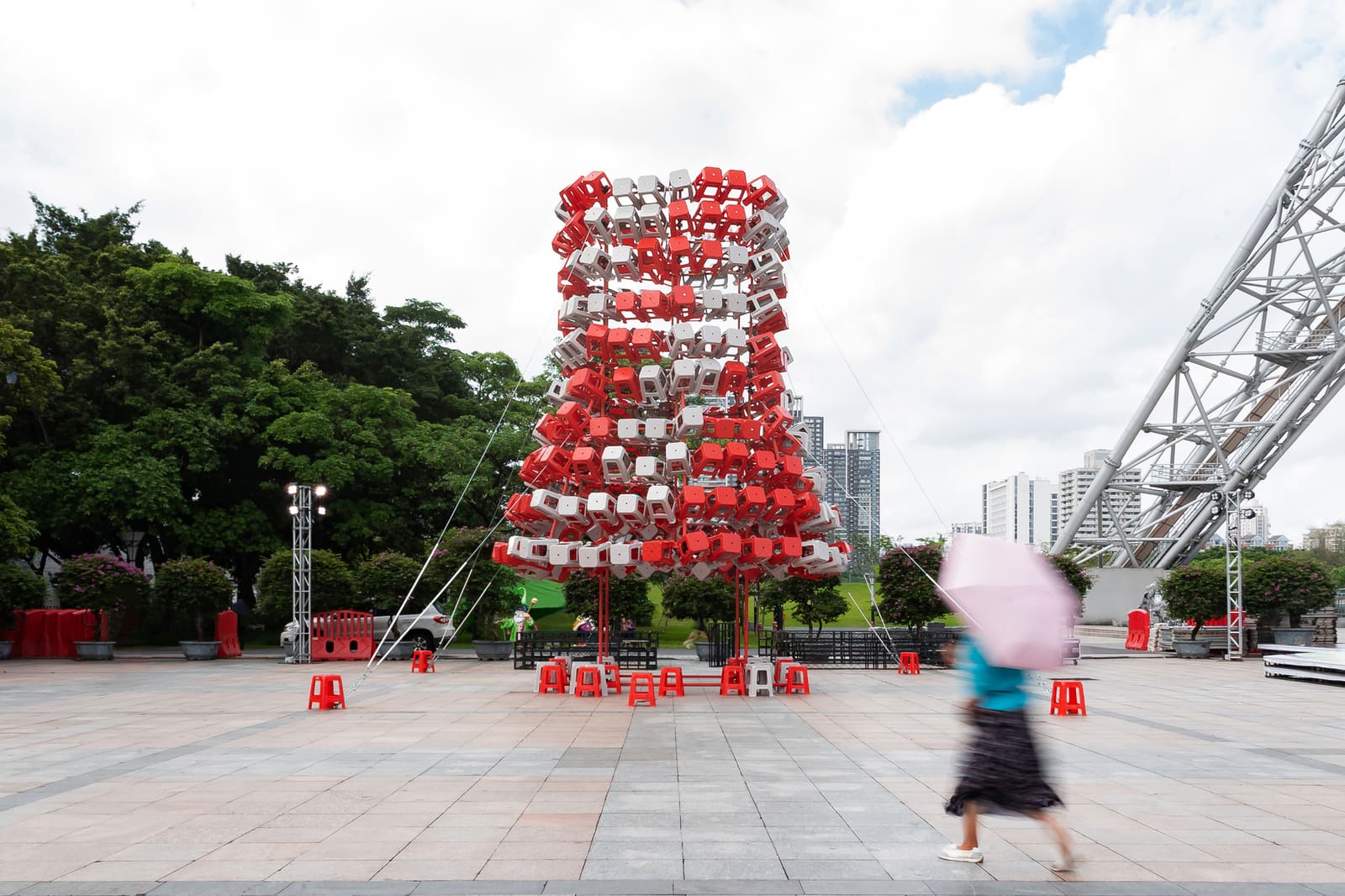
At World Archi Design, we've long argued that the most potent architectural gestures often come not from grand material invention but from the elevation of the everyday. A tower of red plastic stools in Foshan proves the point. When 1Y Architects, led by Fan Chang, accepted a commission to design an installation for the 2026 Foshan International Cultural & Creative Week, the studio did not reach for parametric software or exotic composites. Instead, the team walked the streets, sat in tea houses, and watched people perch on the single object that defines Cantonese street life: the red plastic stool.
The resulting structure, completed in 2027, occupies just thirty-six square meters. Yet within that modest footprint, the installation manages to compress layers of cultural observation, material wit, and spatial ambition. It is part totem, part commentary, part public furniture scaled to the point of absurdity. The project asks a question we find ourselves returning to: when does an everyday object become architecture, and what does that transformation reveal about the culture that produced it?
Observation as Method
The design process began not in the studio but in the field. 1Y Architects spent the early summer of 2026 embedded in the daily rhythms of Foshan, a city in Guangdong Province known for its ceramics, martial arts heritage, and dense urban fabric. The red plastic stool appeared everywhere: outside noodle shops, beneath banyan trees, clustered around mahjong tables, stacked in alleyways. It is inexpensive, lightweight, stackable, and nearly indestructible. It belongs to no one and everyone. In Cantonese vernacular culture, it occupies the same category as the folding bamboo chair or the wok: a tool so embedded in daily life that it becomes invisible until someone points a lens at it.
This kind of ethnographic groundwork is rare in contemporary installation practice, where time pressure and budget constraints often push designers toward prefabricated concepts. The choice to begin with observation rather than formal invention signals a different set of priorities. It aligns 1Y Architects with a lineage of designers who treat the built environment as a text to be read before it is rewritten: think of Lacaton & Vassal's cataloging of existing structures before renovation, or Rural Urban Framework's material surveys in rural China.
Aggregation and Monumentality
The installation employs a single formal strategy: vertical aggregation. Hundreds of red plastic stools are stacked, nested, and interlocked to form a slender tower. The geometry is simple, almost naive, but the effect is anything but. As the stools rise, they create a lattice of voids and solids, a play of shadow and light that shifts throughout the day. The structure reads simultaneously as sculpture, as furniture, and as a kind of folk monument.
This approach recalls the aggregative logic of other material-specific installations we've covered: Ai Weiwei's stacked wooden stools, Tomas Saraceno's knotted rope sculptures, even the bundled-rebar towers of Wang Shu's early work. But where those projects often lean toward the poetic or the conceptual, the Stool Tower retains a stubborn literalness. It does not transform the stool into something else; it multiplies the stool until the multiplication itself becomes the subject.
The thirty-six-square-meter footprint is revealing. It suggests a compact urban lot, the kind of sliver site common in dense Cantonese cities. The tower does not sprawl; it rises. In doing so, it mirrors the verticality of Foshan itself, a city where space is scarce and buildings grow upward out of necessity. The installation becomes a miniature study in density, a formal echo of the forces that shape the city around it.
Material Honesty and Cultural Legibility
One of the installation's strengths is its refusal to disguise its material. The stools are not painted, reconfigured, or abstracted. They remain red, plastic, and recognizable. This decision carries both practical and symbolic weight. Practically, it keeps costs low and construction straightforward; N-Design, the construction team, worked with a material that required no specialized fabrication. Symbolically, it ensures that the installation remains legible to its intended audience. A Foshan resident does not need an architecture degree to understand what they are looking at. The tower speaks in the local dialect.
This kind of material honesty has precedents in the work of studios that prioritize cultural specificity over formal novelty. We think of Anna Heringer's earth-and-bamboo schools in Bangladesh, or the rammed-earth interventions of Martin Rauch in the Alps. In each case, the material itself carries meaning, and the designer's role is to arrange rather than invent. The red plastic stool, in this context, becomes both medium and message.
The Festival as Context
The installation was commissioned for a cultural festival, a format that often encourages spectacle over substance. Festivals reward the photogenic, the brightly colored, the immediately legible. The Stool Tower meets these criteria, but it does so without sacrificing conceptual rigor. It is visually striking, yes, but it also invites a slower reading. Visitors can walk around it, peer through its lattice, consider the relationship between the individual stool and the collective form.
The client, SMART Cultural and Creative Co., Ltd., deserves credit for selecting a proposal that privileges local resonance over imported aesthetics. Too often, international festivals in China default to generic global forms: parametric pavilions, LED-wrapped structures, imported design languages that could exist anywhere. The Stool Tower, by contrast, could only exist in Foshan. It is a piece of site-specific design in the truest sense.
Precedents and Divergences
To place the Stool Tower within a broader lineage, it is worth comparing it to other furniture-based installations. Ai Weiwei's "Bang" (1996) stacked Qing Dynasty wooden stools into a jagged wall, using the collision of objects to evoke historical rupture. Tejo Remy's "Rag Chair" (1991) bundled discarded clothing into seating, turning waste into function. Martino Gamper's "100 Chairs in 100 Days" (2007) recombined salvaged furniture into a series of hybrid forms.
The Stool Tower shares with these works a fascination with the readymade and the everyday. But where Ai's work is elegiac and Remy's is ecological, 1Y Architects' installation is celebratory. It does not mourn the stool or critique its mass production. It simply amplifies it, turning quantity into quality, the mundane into the monumental.
Implications for Public Space
The installation raises questions about the role of temporary structures in shaping public life. At thirty-six square meters, it is small enough to be intimate, large enough to be a gathering point. It does not block circulation or dominate its surroundings; it punctuates them. This modesty is strategic. In a festival context, where multiple installations compete for attention, the tower achieves presence without aggression.
We have been tracking a broader trend toward ephemeral architecture that prioritizes engagement over permanence: the Serpentine Pavilions in London, the MPavilion series in Melbourne, the annual installations at MoMA PS1 in New York. These projects test ideas at full scale, offer public amenities, and then disappear. The Stool Tower belongs to this lineage, but it does so with a distinctly local vocabulary. It does not import a global template; it exports a local one.
Craft and Assembly
The construction process, led by N-Design, involved stacking and securing hundreds of individual stools. The technical challenge was not complexity but repetition: how to ensure stability across a large number of identical units. The solution likely involved internal bracing or tensioned cables, though the final structure reads as a pure stack. This kind of hidden engineering is common in installations that aim for visual simplicity. The craft lies not in ornament but in the precision of assembly.
We are reminded of the Japanese concept of "kasane," the layering of identical elements to create depth and texture. In traditional architecture, this principle appears in stacked roof tiles, layered wooden screens, and bundled bamboo. The Stool Tower translates this logic into a contemporary, industrial material. The result is a hybrid: a vernacular form built from a mass-produced object.
A Monument to the Mundane
In the end, the Stool Tower succeeds because it takes its subject seriously. It does not condescend to the red plastic stool or treat it as kitsch. Instead, it recognizes the stool as a genuine artifact of Cantonese urban life and asks what happens when that artifact is multiplied, stacked, and elevated. The answer is a structure that is both familiar and strange, both functional and symbolic.
As cultural festivals proliferate across Asia, the challenge for designers is to create work that resonates locally while engaging broader conversations about material, form, and public space. The Stool Tower offers a model: start with observation, honor the vernacular, and trust that the everyday, when handled with care, can become extraordinary. It is a lesson we hope more studios will take to heart.
Save this story. A free account keeps your reading list and the 07:00 email in one place.
CREATE FREE ACCOUNT →SIGN IN