
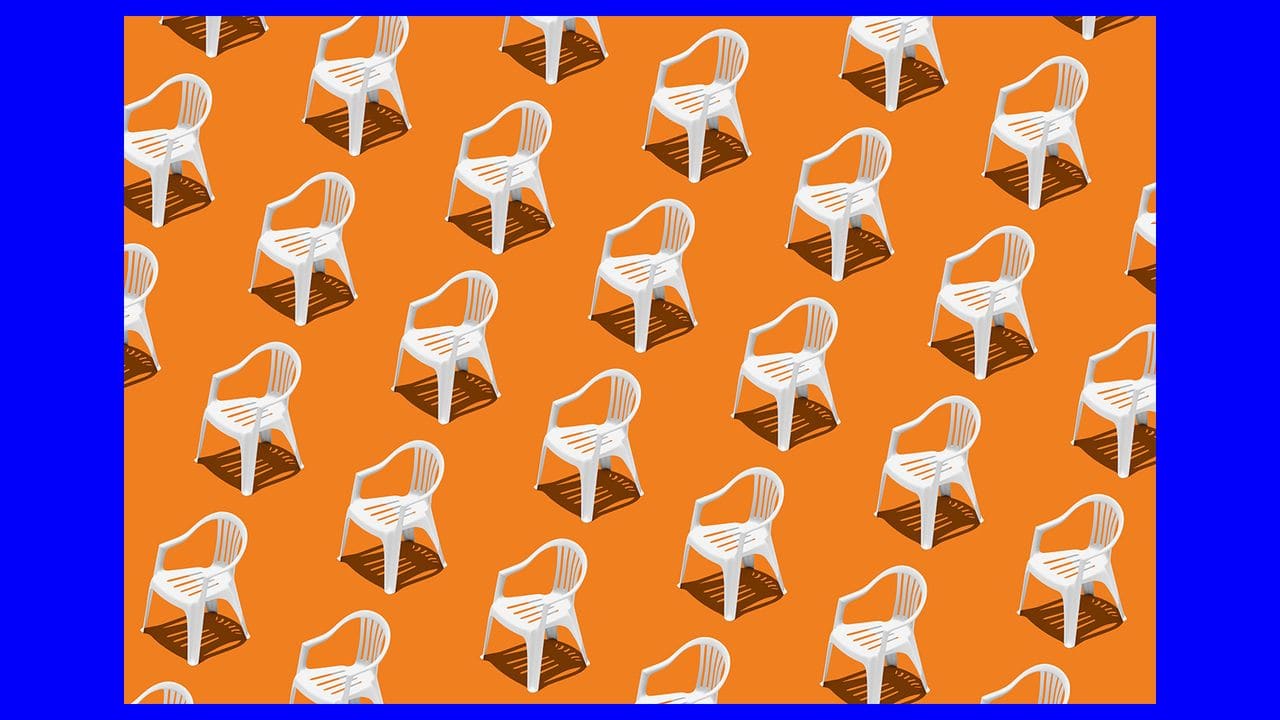
The Object That Vanishes Through Omnipresence
There exists a peculiar threshold in design, a point at which an object becomes so thoroughly woven into the fabric of daily life that it ceases to register as designed at all. The monobloc plastic chair occupies this strange territory. With over one billion units produced, it has achieved something few objects ever do: a state of near-invisibility through sheer ubiquity. You encounter it at beachside cafés in Rio, at wedding receptions in Sicily, stacked against the walls of community centres from Basel to Bangalore. And yet, for many designers and architects, it represents either a triumph of democratic design or an environmental catastrophe, depending on the day and the mood.
This ambivalence is worth examining. At World Archi Design, we have tracked the curious fate of objects that transcend their original context to become something else entirely, something that resists easy categorisation. The monobloc is one such artefact. It prompts a fundamental question: when does replication become saturation? And what happens to an object's meaning when everyone owns one?
A Noble Lineage, Democratised Beyond Recognition
The monobloc's ancestry traces back to more refined origins. Joe Colombo's Universale 4867, produced by Kartell in the 1960s and now held in the permanent collection of the Museum of Modern Art in New York, pioneered the single-mould injection process that made the monobloc possible. Colombo's chair celebrated plastic as a revolutionary material, one that allowed designers to create through addition rather than subtraction. Instead of carving and joining separate components, the entire form could be injected into a mould in one continuous process.
The monobloc inherits this technical innovation but strips away the refinement. It stacks more efficiently than the Universale 4867. It costs a fraction of the price. One Italian manufacturer alone produces approximately ten million units annually, at a unit cost of just a few euros. This economic accessibility has driven its global proliferation, but it has also fundamentally altered the chair's cultural status. What began as an exploration of material possibility has become a symbol of disposability.
The Material That Fell From Grace
Our relationship with plastic has undergone a profound transformation over the past half-century. In the 1960s, synthetic polymers represented modernity, hygiene, and progress. They were lightweight, mouldable, and seemingly indestructible. Today, that indestructibility has revealed itself as a liability. Plastic does not biodegrade; it fractures into smaller and smaller particles, infiltrating ecosystems from polar ice to human tissue. Microplastics have been detected in the food chain, in drinking water, and in the organs of nearly every species studied.
The monobloc, then, carries this burden. It is both an icon of accessible design and a persistent environmental pollutant. When these chairs crack or fade, they rarely enter formal recycling streams. Instead, they accumulate in landfills, wash into waterways, or fragment into the particulate matter that now circulates through the biosphere. This dual identity, this capacity to be simultaneously useful and harmful, makes the monobloc a potent emblem of the contradictions embedded in mass production.
Repetition as Aesthetic Poison
Beyond environmental concerns, there is the problem of aesthetic saturation. The monobloc has become so omnipresent that it has lost the capacity to signify anything beyond its own function. This is not merely a matter of overexposure; it is a deeper question about how objects communicate meaning. Design theorists have long argued that artefacts tell stories, that they encode information about their makers, their users, and the cultural contexts from which they emerge.
But what happens when an object is replicated a billion times? Does the story dilute? Does it disappear altogether? The philosopher and media theorist Ethan Zuckerman at MIT has suggested that the monobloc may have reached a state of "ubiquity" so complete that it has effectively vanished from conscious perception. We sit on it, we stack it, we move it from patio to garden shed, but we no longer see it. It has become infrastructural, like pavement or electrical outlets, something that facilitates other activities without drawing attention to itself.
This phenomenon is not unique to the monobloc. Across the projects we have covered this year, we have observed a recurring tension between singularity and replication. Limited-edition furniture, bespoke architectural commissions, and site-specific installations all resist the logic of mass production precisely because they seek to preserve narrative specificity. They want to be noticed, to provoke thought, to resist fading into the background. The monobloc, by contrast, has surrendered that ambition. It is the design equivalent of white noise.
The Precedent of Democratic Objects
The monobloc belongs to a lineage of objects that aspired to democratic ideals. In the early twentieth century, designers associated with movements such as the Bauhaus and De Stijl pursued the idea that good design should be accessible to all, not merely to the wealthy. Marcel Breuer's tubular steel chairs, Gerrit Rietveld's Red and Blue Chair, and later, Charles and Ray Eames' moulded plywood and fibreglass seating, all explored how industrial processes could produce affordable, high-quality furniture.
The monobloc extends this project to its logical extreme. It is radically affordable, universally available, and requires no maintenance. It is also, by most aesthetic standards, unremarkable. This raises an uncomfortable question: is there an inherent tension between democratic accessibility and design excellence? Or have we simply failed to develop the cultural frameworks necessary to appreciate objects that operate at this scale?
Some designers have attempted to reclaim the monobloc, treating it as a readymade in the Duchampian sense. It has appeared in art installations, been recontextualised in gallery settings, and even graced the cover of albums by contemporary musicians. These gestures acknowledge the chair's cultural omnipresence while attempting to reframe it, to force us to see it again. Whether these efforts succeed is debatable. Once an object has achieved the monobloc's level of saturation, it may be impossible to restore its capacity for surprise.
Material Futures and the Question of Circularity
If the monobloc is to have a future, it will require a fundamental rethinking of its material composition and lifecycle. Current iterations are typically made from polypropylene, a thermoplastic polymer that is technically recyclable but rarely recycled in practice. The economics of plastic recycling remain challenging: virgin plastic is often cheaper than recycled material, and contamination during collection and sorting reduces the quality of reclaimed polymers.
Emerging alternatives include bio-based plastics derived from plant starches or cellulose, as well as advanced recycling technologies that can break polymers down to their molecular components and reassemble them into new products. Some manufacturers are experimenting with modular designs that allow for easier disassembly and repair, extending the usable life of each chair and reducing the volume of waste.
Yet these innovations face significant barriers to adoption. The monobloc's defining characteristic is its low cost, and any material or process change that increases price risks undermining its accessibility. This is the central dilemma of sustainable mass production: how do we create objects that are both environmentally responsible and economically viable at scale? The monobloc, in its ubiquity and simplicity, distils this question into a single, portable form.
What Objects Tell Us About Ourselves
Design has always been a form of storytelling. From the earliest carved implements to contemporary parametric structures, the things we make reflect our values, our technologies, and our aspirations. The monobloc tells a particular kind of story: one about industrialisation, about the promise and peril of synthetic materials, and about the tension between individuality and mass replication.
It also tells a story about who gets to participate in design culture. High-end furniture, limited-edition lighting, and bespoke architectural commissions are accessible only to a small fraction of the global population. The monobloc, by contrast, is genuinely democratic. It appears in contexts where more expensive seating would be impractical or impossible. It enables gatherings, celebrations, and moments of rest in places that lack infrastructure or capital. In this sense, it performs a social function that transcends aesthetics.
But there is a cost to this ubiquity, and it is not only environmental. When an object becomes so common that it disappears from conscious perception, we lose the opportunity to reflect on the choices embedded in its design. We stop asking who made it, under what conditions, from what materials, and for what purpose. We stop seeing it as the product of human decisions and start treating it as a natural feature of the landscape. This erasure, this loss of critical attention, is itself a form of impoverishment.
The Paradox of Disappearance
The monobloc's fate is a paradox. It is everywhere, and therefore nowhere. It is the most successful chair ever produced, and yet it is also the most invisible. This duality makes it a useful lens through which to examine the broader challenges facing contemporary design. How do we create objects that are both sustainable and affordable? How do we balance the need for mass production with the desire for meaningful, contextually specific design? And how do we cultivate a culture that values the stories objects tell, even when those objects are as ordinary as a plastic stacking chair?
These questions do not have simple answers. But they are worth asking, especially as we confront the environmental and social consequences of a century of mass production. The monobloc is not going away. It will continue to appear at barbecues, on beaches, and in backyards around the world. Whether it remains a symbol of democratic design or a cautionary tale about the limits of ubiquity depends, in part, on how we choose to see it.
Save this story. A free account keeps your reading list and the 07:00 email in one place.
CREATE FREE ACCOUNT →SIGN IN