
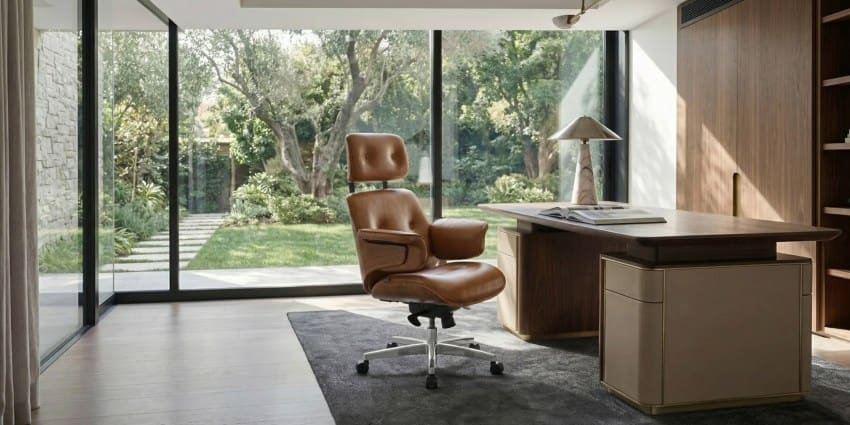
From Placeholder to Permanent Fixture
The desk chair has never been more visible. Where once it occupied a corner of the bedroom or kitchen table, today's home office seating operates in full view during video calls, design walkthroughs, and hybrid work arrangements that demand both performance and presence. We have watched this shift unfold across dozens of residential projects in the past two years: the office is no longer provisional. It is permanent, and its furniture is being chosen accordingly.
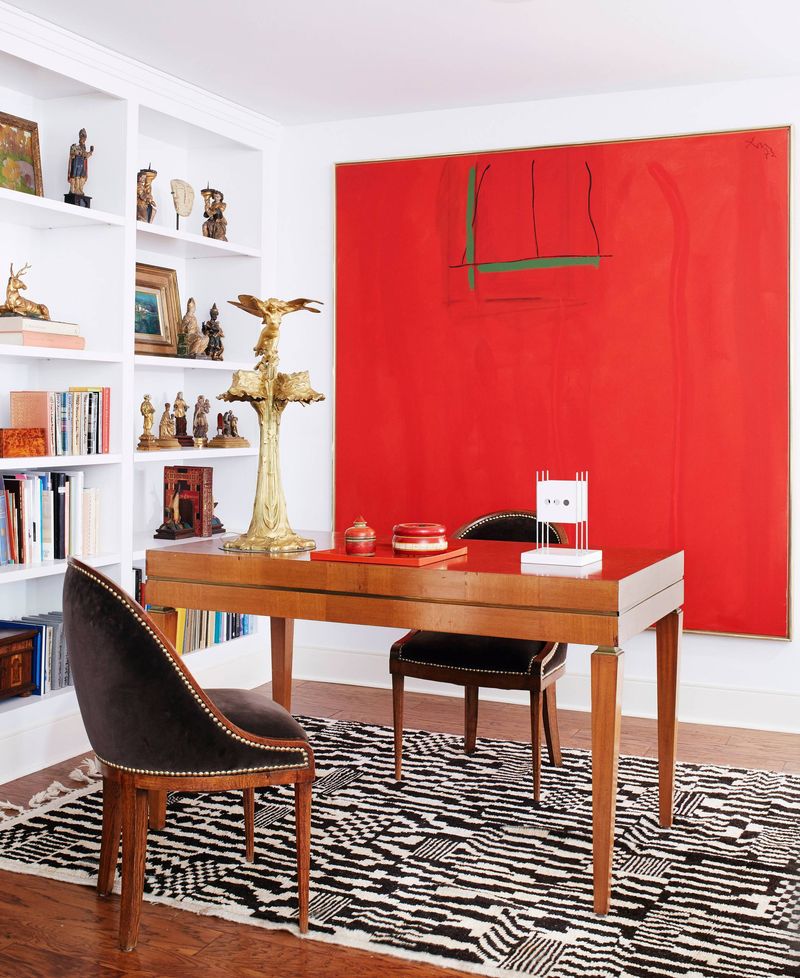
This transition has brought leather and solid walnut back into the conversation. Both materials carry weight, literally and figuratively. They age visibly, develop patina, and resist the flat uniformity of mesh-backed task chairs that dominated corporate procurement for decades. In spatial terms, they anchor a room. A walnut frame paired with vegetable-tanned leather does not recede into the background. It declares intent.
Materiality That Responds to Use
Leather remains one of the few upholstery materials that improves with contact. Full-grain hides soften over time, conforming to the user's posture while retaining structural integrity. This quality makes it particularly suited to seating that will be occupied for extended periods, where synthetic alternatives tend to degrade or lose breathability. The tactile feedback of leather also matters in domestic interiors, where sensory engagement with materials contributes to spatial comfort in ways that purely ergonomic metrics cannot capture.
Walnut, meanwhile, offers tonal warmth and structural clarity. Its grain patterns are legible without being ornamental, and its density allows for slender profiles that can support the cantilevered arms and curved backrests characteristic of mid-century and contemporary office seating. Unlike laminated plywoods or powder-coated metals, walnut telegraphs its own making. You can read the joinery, understand the load paths, and recognize the hand of the maker or the precision of the CNC mill.
Ergonomics Without Erasure
The return of statement seating does not mean abandoning ergonomic principles. Rather, it reflects a growing confidence among furniture makers that comfort and character need not be mutually exclusive. Studios such as Norm Architects, Frama, and even legacy manufacturers like Herman Miller have introduced or revisited designs that integrate lumbar support, adjustable tilt tension, and seat-depth customization within frames that prioritize material honesty and visual restraint.
What distinguishes these pieces from their corporate ancestors is the absence of visual clutter. Mechanisms are concealed or expressed as deliberate details rather than exposed levers and plastic housings. The result is seating that can transition from focused work to informal conversation without requiring a spatial or aesthetic reset. This versatility is critical in homes where the office doubles as a library, guest room, or creative studio.
Precedent and Evolution
The lineage here is clear. Eames lounge seating, Wegner's swivel chairs, and Saarinen's executive series all explored the intersection of comfort, rotation, and refined materiality decades ago. Today's designers are not replicating those forms but revisiting the premise: that a chair used daily deserves the same design rigor as any other piece of residential furniture. The difference now is scale. Where mid-century examples were produced in limited runs or for institutional clients, contemporary statement seating is increasingly accessible through direct-to-consumer channels and modular production methods that maintain craft standards while reducing lead times.
This democratization has implications for how we understand furniture hierarchies. The office chair is no longer a utilitarian afterthought but a category worthy of investment, one that sits alongside dining tables and sofas in terms of both budget allocation and spatial prominence. In projects we have tracked, clients are allocating upward of fifteen percent of their home office budget to seating alone, a figure that would have seemed disproportionate a decade ago.
The Spatial Consequences
Statement seating changes the room around it. A chair with a strong silhouette and rich materiality establishes a focal point, which in turn influences lighting placement, desk selection, and storage solutions. Designers are responding by treating the home office as a composed interior rather than a functional zone. Task lighting is being replaced by adjustable arms with dimming controls; modular shelving is giving way to bespoke cabinetry; and cable management is being integrated into architectural details rather than tacked on as an afterthought.
This shift also affects adjacencies. When the office chair is a piece worth displaying, the threshold between work and living spaces becomes less about concealment and more about continuity. Open-plan homes benefit from this approach, as do compact apartments where every piece of furniture must justify its footprint both functionally and aesthetically.
Durability as Design Philosophy
Leather and walnut are not inexpensive, nor are they low-maintenance. Both require care, periodic conditioning, and acceptance of change over time. This is precisely the point. In an era of disposable goods and planned obsolescence, choosing materials that demand stewardship is itself a design statement. It signals a commitment to longevity, to objects that will be repaired rather than replaced, and to interiors that evolve with their inhabitants rather than conforming to transient trends.
The home office, in this reading, becomes a site of accumulation rather than turnover. The chair you purchase today might still be in use a decade from now, its leather burnished, its walnut deepened, its mechanisms serviced and updated as needed. This temporality aligns with broader movements toward sustainable consumption and circular design, but it also reflects a deeper cultural shift: the recognition that remote work is not a temporary accommodation but a structural change in how many of us organize our professional lives.
Looking Forward
We are likely to see further refinement in this category. Hybrid models that combine traditional joinery with contemporary ergonomics, collaborations between furniture makers and textile studios exploring alternative leathers and bio-based finishes, and modular systems that allow users to upgrade components without discarding the entire chair. The materials palette may expand to include other hardwoods, metal alloys with better environmental profiles, and upholstery options that balance performance with provenance.
What seems certain is that the home office will continue to demand furniture that performs on multiple registers: functional, aesthetic, tactile, and symbolic. The chair is no longer just a place to sit. It is a tool, a marker of identity, and increasingly, an object designed to last.
Save this story. A free account keeps your reading list and the 07:00 email in one place.
CREATE FREE ACCOUNT →SIGN IN