
The Architecture of Becoming
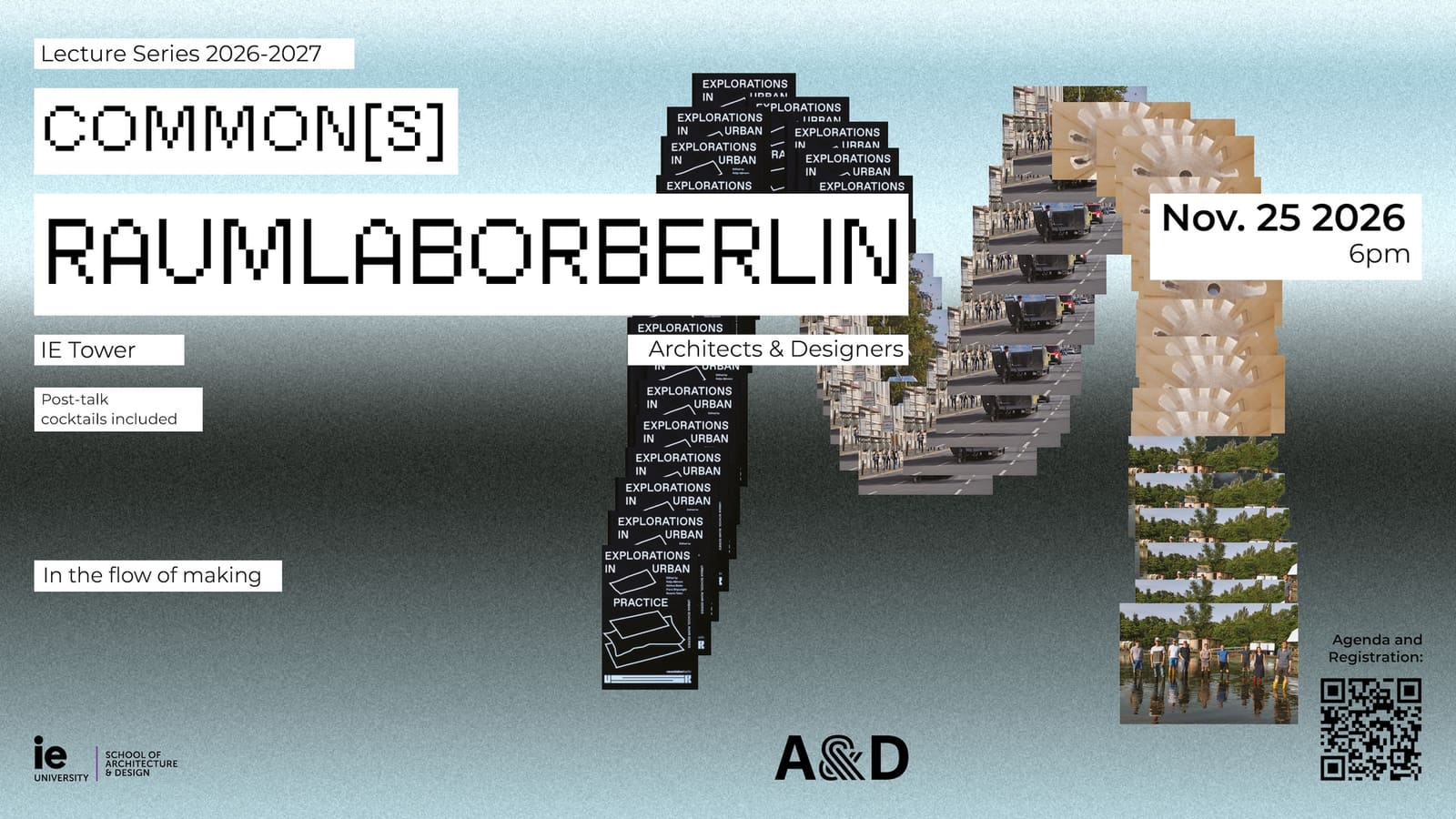
When a discipline defines itself by what it leaves behind - buildings, monuments, permanence - what happens when a practice redefines itself by what it sets in motion? That question sits at the heart of raumlaborberlin's work, and it will frame Benjamin Foerster-Baldenius's lecture "In the Flow of Making" at IE School of Architecture & Design on 25 November 2026. The presentation forms part of the school's COMMON(S) 2026-27 series, which has positioned itself as a platform for practices that resist easy categorisation.
Foerster-Baldenius is a founding member of raumlaborberlin, a nine-person collective established in Berlin in 1999. The group operates across architecture, urban planning, art and performance, but those labels function more as entry points than boundaries. What distinguishes the collective is not medium but method: a conviction that architecture is less about delivering finished objects and more about orchestrating processes that involve people, sites and the relationships between them.
A Practice Rooted in Transition
Berlin at the turn of the millennium offered a particular kind of laboratory. The city was still metabolising reunification, its urban fabric punctuated by voids, leftover spaces and sites awaiting redefinition. Raumlaborberlin emerged in that context, and its early projects engaged directly with the spatial and social uncertainties of post-Wall Berlin. The collective gravitated towards neglected, abandoned or transitional sites - places that conventional development logic had bypassed or not yet reached.
These were not picturesque ruins awaiting adaptive reuse in the traditional sense. They were sites whose future was genuinely open, where the question of what comes next had not been settled by market forces, planning frameworks or institutional agendas. Raumlaborberlin's interventions treated such sites as stages for collective imagination, places where alternative futures could be tested rather than merely proposed.
This approach aligns with a broader shift in European practice during the late 1990s and early 2000s, when a generation of architects began to question the profession's complicity in top-down urban transformation. Projects by collectives such as Atelier d'Architecture Autogérée in Paris or muf architecture/art in London shared a similar interest in participatory processes, temporary interventions and the social life of urban space. Raumlaborberlin's contribution to this lineage has been its sustained commitment to research-based design, a term the collective uses to describe work that begins with observation, involves local communities and other urban actors, and remains open to outcomes that cannot be predetermined.
Research as Design, Design as Research
The phrase "research-based design" risks becoming a catchall, but raumlaborberlin uses it with precision. It signals a practice in which investigation and intervention are not sequential but simultaneous. The collective does not study a site, produce a design and then implement it. Instead, it develops experimental formats - workshops, installations, temporary structures - that function as both research tools and spatial propositions. These formats generate knowledge about a place and its publics while also transforming the conditions they study.
This methodology has implications for how the collective understands authorship. In conventional architectural practice, the architect is the primary author, and the building is the work. Raumlaborberlin distributes authorship across a wider network of actors: residents, municipal officials, artists, activists, passersby. The collective's role becomes one of facilitation and choreography, designing the conditions under which others can participate in shaping space.
That redistribution of agency is not without tension. Participatory design can devolve into consultation theatre, where community input is solicited but ultimately subordinated to predetermined outcomes. Raumlaborberlin's work attempts to avoid that trap by embedding participation into the project's structure from the outset, rather than appending it as a late-stage gesture. The collective's projects often unfold over extended timescales, allowing for iteration, negotiation and the emergence of unanticipated possibilities.
The Pedagogy of Process
Foerster-Baldenius's lecture at IE School of Architecture & Design arrives at a moment when architectural education is grappling with its own relationship to process. Schools have traditionally organised themselves around the studio model, in which students produce individual projects that culminate in final presentations. That model privileges the finished artefact and the singular author. It is less well suited to practices that emphasise collaboration, temporality and open-endedness.
The COMMON(S) series, which hosts the lecture, takes its name from a concept that has gained traction in urban and architectural discourse over the past two decades. The commons refers to resources - spatial, social, ecological - that are collectively managed rather than privately owned or state-controlled. The parenthetical "S" in the series title suggests both plurality and possession, a nod to the contested and evolving nature of what counts as common.
Raumlaborberlin's work offers a practical vocabulary for engaging with the commons. The collective's projects do not produce commons in the abstract; they create specific conditions under which commoning - the active practice of collective resource management - can occur. This distinction matters. The commons is not a static category but an ongoing social practice, one that requires maintenance, negotiation and institutional support.
For students and emerging practitioners, raumlaborberlin's approach raises questions about what architectural training should prepare them to do. If architecture is understood as an ongoing process rather than the production of buildings, then the skills required shift accordingly. Designers need fluency in facilitation, ethnography, coalition-building and adaptive planning, alongside traditional competencies in form-making and technical resolution.
Madrid as Context
The lecture takes place at IE University's Madrid campus, a setting that brings its own resonances. Spain's capital has experienced waves of urban transformation over the past three decades, from the infrastructure investments tied to its 1992 Olympic bid to the speculative development boom of the early 2000s and the subsequent austerity-driven retrenchment. Madrid's recent municipal administrations have experimented with participatory budgeting, neighbourhood-scale planning and the activation of underused public space, creating a policy environment that shares some affinities with the practices raumlaborberlin has developed in Berlin.
Yet the two cities operate under different pressures. Berlin's relative affordability - at least until recently - allowed for a degree of spatial experimentation that is harder to sustain in Madrid, where housing costs and development pressures leave less room for the provisional and the temporary. The question of how raumlaborberlin's methods translate across contexts is not incidental. Participatory design and temporary urbanism can function as tools for genuine democratisation, but they can also serve as placeholders that delay more substantive interventions or as aesthetic cover for gentrification.
Foerster-Baldenius's presentation will likely address these tensions, given the collective's long-standing engagement with the politics of urban space. Raumlaborberlin has been explicit about the limitations of temporary interventions, particularly when they are deployed in lieu of long-term commitments to affordable housing, public infrastructure or social services. The collective's work attempts to navigate a middle path: using temporary projects to open up new possibilities while also advocating for the institutional and policy changes that would allow those possibilities to endure.
The Lecture as Format
"In the Flow of Making" is a title that foregrounds duration and continuity. It suggests that making is not a discrete event but an ongoing condition, one that unfolds over time and involves multiple actors. The lecture format itself becomes a site for exploring that idea. Academic lectures typically position the speaker as expert and the audience as recipient, a structure that mirrors the hierarchies raumlaborberlin's practice seeks to disrupt.
Whether Foerster-Baldenius will use the lecture to enact alternative formats - incorporating dialogue, participatory exercises or open-ended discussion - remains to be seen. The collective has a history of treating presentation contexts as opportunities for experimentation, blurring the line between lecture, workshop and performance. Such moves can feel gestural, but they can also model different ways of producing and sharing knowledge, particularly in institutional settings where those conventions are rarely questioned.
Precedents and Peers
Raumlaborberlin's trajectory can be mapped alongside other practices that emerged in the late 1990s and early 2000s, a period when architecture's disciplinary boundaries were being tested from multiple directions. In the United States, collectives such as Rural Studio and Project Row Houses were exploring community-based design and social engagement, though often within more constrained institutional frameworks. In Latin America, practices such as Elemental in Chile and Urban-Think Tank in Venezuela were developing participatory methodologies tied to housing and infrastructure, often in contexts of acute scarcity.
What distinguishes raumlaborberlin within this broader landscape is its sustained focus on the temporary and the experimental. While many participatory practices aim towards permanent outcomes - a completed building, a new policy framework - raumlaborberlin has often treated temporality as a value in itself, a way of keeping futures open rather than foreclosing them. That stance has drawn both admiration and critique. Advocates see it as a necessary corrective to architecture's obsession with permanence; sceptics worry that it risks aestheticising precarity or avoiding the hard work of institutional change.
The Collective Model
Raumlaborberlin's structure as a nine-member collective also merits attention. Architecture has long been dominated by the star-architect model, in which a single name becomes synonymous with a body of work. The collective model distributes credit and decision-making more evenly, though it also introduces challenges around coordination, consensus and the maintenance of a shared vision over time.
The collective has managed to sustain itself for more than a quarter-century, a notable achievement in a field where partnerships often fracture under the pressures of growth, diverging interests or economic instability. That longevity suggests a degree of institutional resilience, as well as a commitment to the collaborative ethos the collective espouses in its projects.
What Comes Next
The COMMON(S) series will continue through 2027, bringing additional practitioners whose work engages with questions of collective space, participatory design and urban transformation. Foerster-Baldenius's lecture on 25 November offers an early anchor point for the series, one that establishes a set of concerns - process, participation, the politics of the temporary - that subsequent speakers will likely echo, complicate or contest.
For those attending, the lecture provides an opportunity to consider what architecture looks like when it refuses to settle into fixed forms. Raumlaborberlin's work does not offer a replicable formula, but it does provide a set of provocations: about who gets to shape urban space, about the value of the provisional, and about what it means to design not objects but conditions for collective action. Those questions remain urgent, in Madrid and beyond.
Save this story. A free account keeps your reading list and the 07:00 email in one place.
CREATE FREE ACCOUNT →SIGN IN